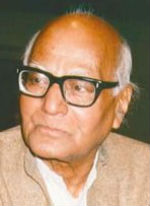












 Not only is the Israel-Palestine problem thousands of years old, but it is unlikely to be resolved easily. – Prof. Makarand R. Paranjape
The title of this column is inspired by a novel by Aldous Huxley, whose 60th death anniversary is coming up on November 22. The first part of this reflection is inspired by its evocative title Eyeless in Gaza, which seems so telling in our times. The second part of this essay, which is to follow, will consider another of Huxley’s works, his later novel, Devils in Loudun (1952).
Eyeless in Gaza is a ponderous tome that few remember, and no one seems to read these days. Published in 1936, it is Huxley’s longest, over 600 pages long, and, some would say, his most ambitious novel. But the title actually refers to a much older work, John Milton’s dramatic poem, Samson Agonistes (Samson the Champion), written over 250 years ago. Says : “Promise was that I/Should Israel from Philistian yoke deliver;/Ask for this great deliverer now, and find him/Eyeless in Gaza at the Mill with slaves….”
The tragic closet drama recounts the fall of the Jewish hero, Samson. He is betrayed by Delilah, his lover. She coaxes him to divulge the source of his strength, his uncut locks. When he is asleep, she cuts off his hair and hands him over to his enemies, the Philistines. Delilah, who hails from the Valley of Soren, is also a Philistine. The valley, called Naḥal Sorek in Hebrew or Wadi al-Sirar in Arabic, still exists, a picturesque place between Jerusalem and Tel Aviv. In the Book of Judges in the Old Testament, where the story occurs, it serves as the border between the Philistines and the Jewish Tribe of Dan.
Betrayed and bound, his eyes gouged out, Samson is put to work at the mill like a slave. But in a last act of desperate heroism, when asked to perform in the temple of the Philistines, he pulls down the pillars. As the structure collapses over those trapped underneath, Samson also perishes, himself dying with his enemies. Milton, lonely and ageing, with failing eyesight and the collapse of the Commonwealth, probably identified with Samson, the Biblical hero and champion. Delilah, as the perfidious femme fatale, embodies his abiding misogyny.
It is, however, the play’s exhibition and extolling of extreme, even suicidal, religious violence and vengeance, all sanctioned by the Hebraic God, which has evoked the most fierce—and divided—contemporary responses. These, quite predictably, are usually along present political lines. With the fighting in Gaza, the play is, once again, relevant in ways that Milton would not have foreseen.
I for one, when I read it for my MA forty years ago, quickly realised that not only was the Israel-Palestine problem thousands of years old, but that it was unlikely to be resolved easily. Worse, as in any war, one had to take sides. One could not remain a fence-sitter forever. Reading Milton’s play those days, my sympathies were on the side of the Philistines. What did they do wrong? What was their sin? Why were they always to be blamed? Just because they did not follow the God of the Jews?
But today the opposite seems to be the case. The Philistines were supposedly “pagan”, worshipping “false” gods. Not that that is sufficient justification for their slaughter. But with the advent of Islam, isn’t that fundamental difference also erased? Isn’t the God of Abraham also the God of Muhammad? Then why the internecine war between the Muslims and the Jews?
Who, then, is eyeless in Gaza? Who is the champion of God, who is the seductress and betrayer of his trust? Is Hamas the false traitor who deceived and attacked Israel? No, it is not easy to superimpose the Biblical story of Samson and Delilah on today’s Israel-Hamas war. Neither theologically, politically, nor strategically, let alone ethically, is it easy to take sides. But one thing is clear. Would those asking Israel to stop today do the same if the equation were reversed? How many Arabs would allow Israel to exist if they had the upper hand militarily?
Without accepting the right of both Israel and Palestine to that small slice of planet Earth, how can we even talk of coexistence, let alone peace? The Abraham Accords were an important beginning in moving towards commonality and concurrence, but now they lie shattered and scattered with the renewed hostilities between Jews and Muslims. Who is to blame? For in any conflict, responsibility must be assigned. It is not for us to judge, but we cannot help asking: if the Hamas manifesto demands the liquidation of Israel, how can there be peace?
Perhaps, we are all trapped and eyeless in Gaza, unable to see clearly any way to peace. I am reminded of the nostrum attributed to Mahatma Gandhi via Louis Fischer, his biographer. Richard Attenborough’s 1982 Oscar-winning biopic also popularised it: “An eye for an eye only ends up making the whole world blind. The reference is to the ancient Hebraic law: “An eye for an eye, tooth for a tooth” (Exodus: 21.24). As Hindu Sanatanis we must ask, “Is there another way?” – News18, 14 Novemeber 2023
› Prof. Makarand R. Paranjape is an author, columnist, and teacher of English at Jawaharlal Nehru University.

Filed under: india, israel, palestine | Tagged: abrahamic religions, hamas, israel-palestine conflict, samson & delilah, yahweh | 1 Comment »