









Swara Bhaskar was right about rape survivors and wrong about Jauhar. Then and now. Here’s a history lesson with a heavy heart. – Kamlesh Singh
Sexual violence against women in an honour-culture society like ours does not end when the violence ends. The keyword in sexual violence is violence. The larger part of society, unfortunately, hears only the first word. Rape is violence. Full stop. There is nothing sexual about it for the one who suffers it. Yet we have spent centuries attaching izzat, sharam and the family’s name and honour to the victim, so that the wound stays open long after the body has healed.
With time, the scar on the body gradually disappears, the scar on the soul coagulates and grows. As if the trauma wasn’t enough, we hand her a lifetime of lowered eyes.
So when Swara says a woman is more than her private parts, and a survivor has every right to live a life of dignity, you have to be thicker than the Swara set to disagree. That is exactly the nuance we want from celebrities when they choose to educate the masses. More of this, please.
Her nuance, however, takes casual leave the moment the film reaches the Jauhar Kund. Swara holds that Padmaavat glorifies Jauhar, and that the glorification will leave today’s survivors blaming themselves for not dying before the assault.
Look at it through a modern lens and she sounds reasonable. That is the problem. She had picked up a 14th century woman, dropped her into a 21st century courtroom and asked why she did not file an FIR.
I argue the opposite. Jauhar has not been glorified enough, because nobody has bothered to explain it. Sati was glorified, and sati pratha (not exactly a pratha because it wasn’t a popular practice) was a social evil that India fought and stamped out, because there was a real risk of a widow being pushed towards the pyre by a mob of relatives with an eye on the property.
Nobody needs to fight Jauhar. The circumstances that produced it no longer exist. No fort is under siege. No sultan’s army is at the gate. There is no danger of a Chittor housewife imitating a Jauhar because Deepika Padukone made it look majestic. Glorifying it harms no one. Misreading it harms history and our own glorious and troubling past.
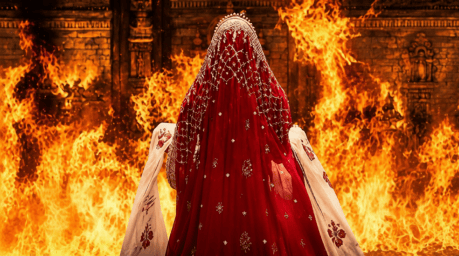
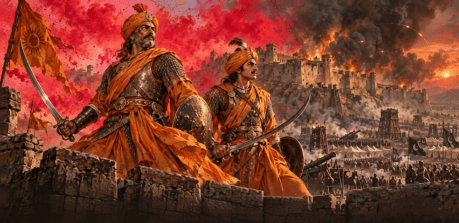
Because Jauhar never came alone. It came paired with Saka. The men wore saffron, opened the gates and rode into a battle they knew they would not survive. Death was certain. The women were warriors too. Some also went into battle, but war offered no certainty of death to them. Only a certainty of capture. What if death eluded them? So they chose the more painful exit. The kund. It gave them an ending decided by their faith rather than one decided by the victor. It left no body to mutilate, nothing to humiliate. It was not an escape from life.
It was an escape from a life in captivity, where death would visit anyway, but late, and after everything else had.
Consider that everything else. A muhasira, the siege, could last months. For example, Chittor saw it in 1303, again in 1535, again in 1568. The men prepared for the last charge and the women prepared for the pyre, because everyone inside the walls knew the alternative.
Female captives were distributed among soldiers as spoils. Soldiers sold them to traders. Traders marched them to the bazaars of the day, and the slave markets were real. They were also far. Mahmud of Ghazni’s own secretary, Utbi, boasted that the 53,000 captives brought back from India in 1019 sold for 2 to 10 dirhams a head, and that merchants came from distant cities to buy, until Khurasan, Iraq and Transoxiana were full of Indian slaves. That is the route.
Ghazni to Nishapur to Baghdad, and on to Damascus and Cairo, the great souk circuit of the Islamic world, where a woman from Kanauj stood on the block next to a Circassian, a Greek and a Nubian. The trade was so mature it had textbooks.
In the 11th century, a Baghdad physician, Ibn Butlan, wrote a buyer’s manual on the purchase and physical examination of slaves, grading women from more than 20 regions on complexion, figure and temperament, with tips on the tricks dealers used to hide a defect. Indian women, he assured the reader, had good figures and ageing skin.
The Persian Qabus Nama of the same century devotes a whole chapter to buying slaves, the way it devotes chapters to buying horses. Three hundred years later, Ibn al-Akfani wrote the same manual all over again for Cairo, because Cairo under the Mamluks was the biggest market of them all. And lest we feel superior about Delhi, Alauddin Khalji, the villain of the very film Swara, denounced fixed slave prices in the capital the way he fixed the price of wheat.
Barani records the schedule: a working girl 5 to 12 tankas, a girl deemed fit for the bed 20 to 40. A third-grade horse cost 60. Al-Umari, writing in Muhammad bin Tughlaq’s time, says thousands were sold daily and a young girl for household service went for 8 tankas, cheaper in the districts.
Ibn Battuta, no enemy of the Sultanate, records slave girls changing hands in Delhi for a handful of tankas. Travellers, Muslim and non-Muslims, describe the haggling, the inspection, the bosoms examined like a tomato at a mandi. Laundi. The word for such a woman has survived 700 years in our streets, and we use it as abuse without remembering what it once meant.
Those women spent whatever remained of their lives cursing themselves for not dying. Every single day. Rape was just one item on the list.
If anyone thinks the life of a slave was anything like living, the 21st century gave us a refresher course. In August 2014, when the Islamic State overran Sinjar, Yazidi women threw themselves off the mountain rather than be marched to the market. Not a medieval market. A market with price lists, videos and dollar figures. Buyers could rape, sell, or simply torture them to death, and they did.
There are survivor testimonies, a Nobel Prize and a UN report to prove it. That was post-Enlightenment humanity, with a smartphone in every hand. Now imagine the 14th century, when the word medieval was not an adjective but the air around you. Nobody blinked an eye upon hearing of a vanquished woman being ravaged and handed to the next man with 10 tankas.
Which is why Jauhar was never about rape or sexual violence in the sense Swara means. We are triggered, and rightly so, by the rape numbers in this country. Sexual violence against women is not unique to India. We hang our heads in shame that women have to suffer this oppressive repressed society in this day and age. Multiply that a thousand times for every captive. Rape is a punishable crime today, however badly punished. Then, it was a state-sanctioned entitlement of the winning side. There was no FIR, no court, no NGO, no open letter. There was a fire, and there was a bazaar. Jauhar saved those women the trauma of a life that was worse than death, because for them, it was, literally, a choice between the two.
The women who walked into that kund believed they were more than their private parts. Because women are not their private parts. Swara Bhasker is absolutely correct. Rani Padmini would agree. She had just agreed seven centuries earlier, and walked into a blaze, with a prayer on her lips: Agniye Swaha! – India Today, 3 September 2026
› Kamlesh Singh, a columnist and satirist at India Today.
Filed under: india | Tagged: honour suicide, jauhar, muslim slave system, rape, saka |