







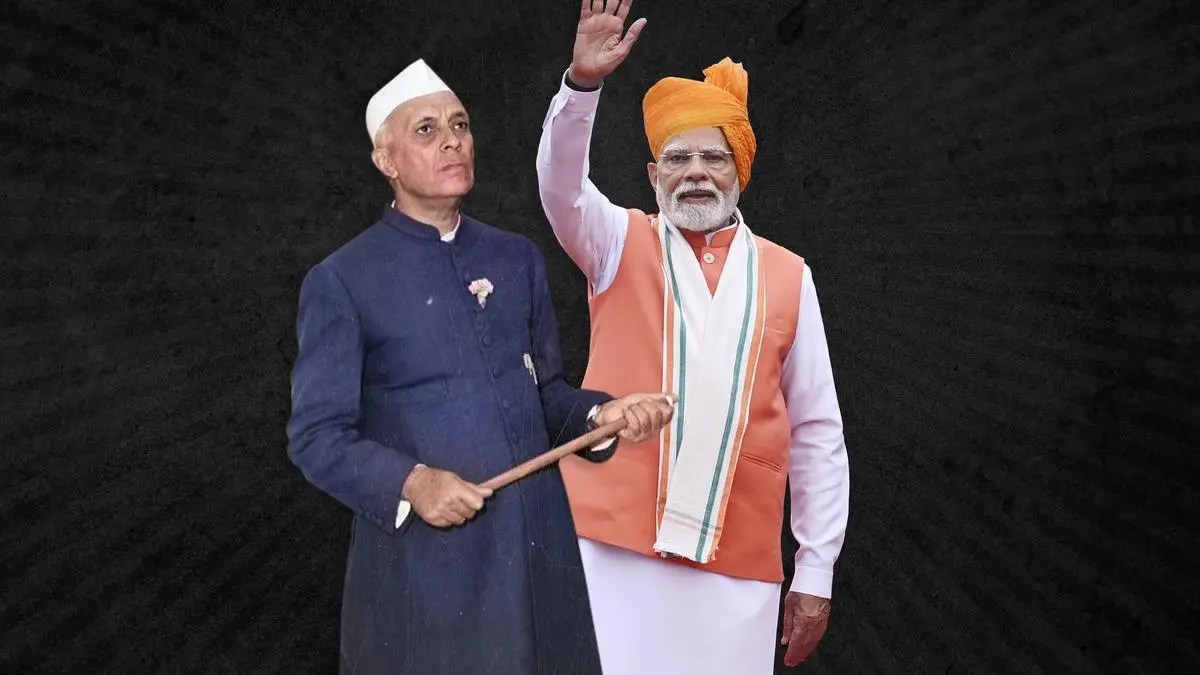
Nehru represented continuity with the colonial past, Modi represents a clean break with that past. Nehru’s vision suffocated India, Modi’s vision has liberated it. For all that, India cannot forget Nehru. It is still paying the price of his follies. – Virendra Parekh
Congress is right in saying that there can be no comparison between Jawaharlal Nehru and Narendra Modi. There certainly can be no comparison between a PM who failed his people comprehensively—economy, military might, foreign affairs and civilizational ethos—in the formative years of a hard-won freedom after several centuries and one who is leading them to new heights with a visionary and decisive leadership. Nehru sought to expel Hinduism from India’s public life and education; Modi has reaffirmed India’s civilizational identity and restored Hindu pride. Nehru protected and institutionalised Muslim separatism; Modi has abolished Article 370, broken the back of the Muslim vote bank and is moving towards a uniform civil code. Nehru stifled India’s historic entrepreneurial genius, Modi has given it a free hand. Nehru created a state which was weak, corrupt and inefficient and yet highly meddlesome. Under Modi, the same state became strong, assertive, respectable and capable of delivering welfare benefits without endless leakages or delays.
Both Nehru and Modi assumed power amid sky-high expectations from the people, who were looking forward to a transformation of their lives. Both wanted to cast the country in their own preferred mould. Both enjoyed tremendous popularity and trust of people. At the time of ascension to power, neither faced any opposition to their writ within their party or outside it. Both were disposed to have a free hand, unfettered by dissidence among colleagues or insubordination among the ranks. Both worked tirelessly to realise their ideals.
This is, however, nearly all that they have in common. If Nehru was the last Englishman to rule India—as he said in a private conversation with John Kenneth Galbraith, a former US ambassador to India—Modi is the first unapologetically Hindu prime minister of the country. Hailing from an elite background, Nehru had a relatively easy ride through life. Even in jail, he was treated as a high-profile political prisoner, receiving facilities denied to ordinary inmates. As is well-known, Nehru had no chance of becoming India’s first prime minister, but for Gandhiji’s intervention in his favour in the critical meeting of the Congress Working Committee in 1946. With his upbringing in a Muslim cultural milieu, education in England and attachment to Fabian socialism, Nehru had little understanding of India, her people and civilisation. He had open disdain, if not contempt for Hinduism whereas his support for any Muslim cause could be taken for granted. Hindu Mahasabha leader N.B. Khare aptly described him as “English by education, Muslim by culture and Hindu only by accident of birth”.
This background shaped Nehru’s self-image, his worldview and guided his policy choices. He had his head in the clouds and clouds in his head. Nehru regarded India and her people as guinea pigs to experiment with his half-baked ideas and irrelevant ideals. He created an interventionist state that did not allow India’s economy, society or foreign policy to evolve in a natural, healthy manner. His socialist policies stifled innate genius of native entrepreneurs, perpetuated poverty, condemned the economy to an abysmally low rate of growth and created a state characterised by corruption, obstruction and inefficiency. His secularism, a united front of anti-Hindu ideologies of Islam, Christianity, Communism and Macaulay-ism, sought to remove all traces of Hinduism from India’s public life and education. It led to a moral disarmament of Hindu society and created a large and powerful class of self-loathing Hindus who thought and behaved as if they were making amends for being Hindus. As India’s foreign minister, Nehru thought of himself as a world class statesman capable of guiding international events and preaching to world leaders on peace, co-existence, etc. Trying to punch well above his height, he made India an irritable laughing stock in influential parts of the world. His blunders on Tibet, China, Pakistan and Jammu and Kashmir are part of recorded history. Whatever his objectives, Nehru’s policies left India economically poor, socially divided and backward and internationally weak.
The late Girilal Jain perceptively observed that Nehru regarded himself as an arbiter between the rival camps in the cold war and between Hindus and Muslims in the country. Obviously, the cost has been pretty heavy on both the counts. China and Pakistan could not pose the kind of threat that they have to our security if we had made a common cause with the West, and the Muslim problem would not have remained wholly unresolved if India had declared itself a Hindu Rashtra at the time of independence.
By a happy and heartening contrast, Narendra Modi is firmly rooted in the soil of the country. He is a realist with his ears close to the ground. His whole life is an inspiring saga of ceaseless effort to overcome seemingly intractable challenges and achieve the impossible. He has not read or heard about poverty; he knows it first hand, having lived in it in the formative years of his life. As a fulltime RSS pracharak who has travelled across the country, he has absorbed and internalised India’s civilisation in all its richness. As a political leader, he has scaled pinnacle of power and glory, but he has earned it, having fought for every inch of his advancement. True, he became chief minister of Gujarat in 2001 without fighting a single election, but he successfully passed through the agnipariksha of a decade-long sustained campaign of disinformation, vilification and demonization before emerging on the national scene. His ascent as the top leader in BJP was not without challenges.
Nehru had inherited a party with the halo of the freedom movement and a strong pan-India organisation. The opposition was weak and fragmented. In all the three Lok Sabha elections he fought (1952, 1957 and 1962), the outcome was a foregone conclusion. On the other hand, every Lok Sabha election that Modi won was fiercely contested. The forces ranged against him were strong, resourceful and had powerful backers abroad. Today, they are struggling hard to remain relevant.
Modi’s greatest contribution is the reassertion of India’s civilizational ethos and restoration of Hindu pride. He has ended the special status enjoyed by the Muslim-majority state of Jammu and Kashmir. Modi’s India virtually functions as a Hindu Rashtra, though with challenges both local and foreign. Politically, he has destroyed the power of the Muslim vote bank and ended the veto that they enjoyed till recently. The political discourse has shifted from Muslim appeasement to Hindu sensitivities. For all his talk of modernity and leaving the past behind, Nehru dared not touch Muslim personal law. Modi government has banned triple talaq and some state governments under BJP have introduced uniform civil code.
Modi’s approach to economic problems is realistic and devoid of ideological hang ups. He encourages the private sector, including in areas such as defence and nuclear power. At the same time, his government runs large welfare schemes across the country. Modi believes in market economy, but is ready to intervene when markets do not deliver. While he takes pride in India’s past, he has successfully harnessed modern technology in a large number of fields, ranging from welfare delivery to weapon systems, from solar power to start-ups.
The same pragmatic approach defines his foreign policy, which is centred on national interest and reciprocity, in that order. Modi’s India has called Pakistan’s nuclear bluff and stood up to China. It engages with all countries, small and big, but no power can take it for granted. The global standing that India has achieved under Modi would be the envy of Nehru and his contemporaries.
At personal level, Jawaharlal Nehru was promoted by his father Motilal and he promoted his daughter Indira. Till date, his progeny suffers from a deep sense of entitlement. Modi has no family to promote, and his close relations live just like other Indians. They have never ever claimed any special treatment or privileges.
The contrast could not be starker. Nehru represented continuity with the colonial past, Modi represents a clean break with that past. Nehru’s vision suffocated India, Modi’s vision has liberated it. For all that, India cannot forget Nehru. It is still paying the price of his follies.
› Virendra Parekh writes on economics and politics, also on issues related to Indian civilization, history and cultural nationalism.
Filed under: india | Tagged: governance, indian economy, indian foreign policy, jawaharlal nehru, narendra modi |