









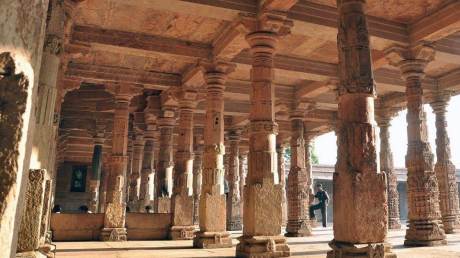
The ASI report states that the archaeological study identifies that many architectural components, such as pillars and beams, were originally part of temple structures before being repurposed for a mosque. – PTI
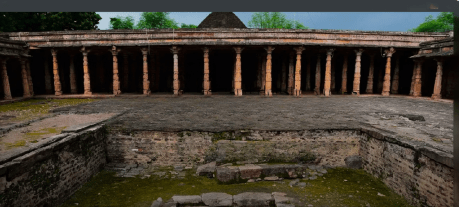
The ASI has told the Madhya Pradesh High Court that a massive structure dating back to the Paramara kings’ rule existed at the disputed Bhojshala temple-Kamal Maula mosque complex, and the current structure was built from the remains of temples.
The Archaeological Survey of India (ASI) made the claim on Tuesday, May 5, based on its 98-day scientific survey and over 2,000-page report.
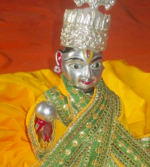
The Hindu community considers Bhojshala a temple dedicated to Vagdevi (Goddess Saraswati), while the Muslim side claims the monument as the Kamal Maula Mosque. The disputed complex is protected by the ASI.
During the hearing before Justices Vijay Kumar Shukla and Alok Awasthi of the HC’s Indore bench, Additional Solicitor General Sunil Kumar Jain, representing the ASI, presented a detailed account of the scientific survey conducted two years ago at the complex.
Referring to the ASI’s survey report, he said, “Retrieved architectural remains, sculptural fragments, large slabs of inscriptions with literary texts, Nagakarnika inscriptions on pillars, etc, suggest that a large structure associated with literary and educational activities existed at the site. Based on scientific investigations and archaeological remains recovered during the investigations, this pre-existing structure can be dated to the Paramara period.”
It can be said that the existing structure was made from the parts of earlier temples, based on scientific investigations, survey and archaeological excavations conducted, study and analysis of retrieved finds, study of architectural remains, sculptures, and inscriptions, art and sculptures, Jain said quoting the report.
Summarising the report, he also drew the court’s attention to the fact that the archaeological study identifies that many architectural components, such as pillars and beams, were originally part of temple structures before being repurposed for a mosque.
“The evidence of this transition includes Sanskrit and Prakrit inscriptions that were damaged or hidden, alongside sculptures of deities and animals that were often mutilated or defaced,” Jain contended.
The report also states that “all Sanskrit and Prakrit inscriptions are older than the Arabic and Persian inscriptions, indicating that users or engravers of the Sanskrit and Prakrit inscriptions occupied the place earlier”.
In light of the Muslim side’s earlier objections, the bench wanted to know why there were some discrepancies in the ASI’s responses regarding the status of the disputed complex in the cases filed over the years.
The Additional Solicitor General argued that earlier studies of the complex involved only officials, while the current survey involved scientists and the use of advanced technologies such as Ground Penetrating Radar (GPR).
The hearing in the Bhojshala case will continue on Wednesday.
The high court has been regularly hearing four petitions and one writ appeal regarding the religious nature of the Bhojshala temple-Kamal Maula mosque complex since April 6. – The Saiasat Daily, 6 May 2026
Filed under: india | Tagged: ASI report, bhojshala complex, kamal maula mosque, temple-mosque controversy, vagdevi temple |






 BHARATA BHARATI
Was Dhar Bhojshala A Saraswati Temple? Here’s What Archeologist K.K. Muhammed Says – Gazi Abbas Shahid – India.com – March 25, 2024
Renowned archaeologist K. K. Muhammed has shared his views over the ongoing dispute over Bhojshala-Kamal Maula Mosque in Dhar district of Madhya Pradesh, claiming that site was a Saraswati temple in the past and was later converted into an Islamic mosque.
“The historical fact about Dhar (Bhojshala) is that it was a Saraswati temple. It was converted into an Islamic mosque.
‘Both sides should abide court’s decision’
However, he asserted that both sides (Hindus and Muslims) should abide by the court’s decision in the matter … and sit together to iron out differences over such places.
“Both sides should stick to the Act. The High Court will take a decision considering all facts. All should follow it (HC decision) as that will be the only solution,” the noted archeologist said.
Muhammed claimed “there is no doubt” that the complex was a Saraswati temple, but urged both communities to refrain from doing anything that could “create problems for all”.
Muslims must respect Hindu sentiments over Mathura, Kashi
He also urged Muslims to respect the sentiments of Hindus over Mathura and Kashi which are as important to them (Hindus) as Mecca and Madina are to the Muslims.
“Muslims should understand and respect the sentiments of Hindus. Kashi is associated with Lord Shiva and Mathura is the birthplace of Lord Krishna. The Hindus can’t shift them to other places but these are only mosques for Muslims, which are neither directly associated with Prophet Mohammed nor ‘aulias’. They (mosques) can be shifted elsewhere,” he said.
Matter must be resolved by dialogue
The eminent archaeologist urged both communities should sit together to find a solution in these matters.
“The Hindus should also consider that they should not come with a list (of places of worship). We need to strengthen the country and take it forward and they (both communities) should sit together (for this),” he stated.
It will be a big problem if both sides do not sort out the disputes, he cautioned.
Notably, K. K. Muhammed was part of the first excavation team led by Professor B. B. Lal at Ayodhya in 1976-77. The Padma Shri awardee had earlier claimed to have first witnessed the remains of a Ram temple under the Babri masjid.
Dhar Bhojshala/Kamal Maula Mosque row
The Archaeological Survey of India (ASI) is carrying out a survey of the disputed Bhojshala complex in MP’s tribal-dominated district following directives issued by the Madhya Pradesh High Court.
The high court had on March 11 directed the the ASI to carry out within six weeks a ‘scientific survey’ of the Bhojshala complex, a medieval-era monument.
The Hindu side claims that the site was previously a temple dedicated to Goddess Vagdevi (Saraswati) while the Muslims presently know it as the Kamal Maula Mosque.
As per an ASI order of April 7, 2003, Hindus are allowed to worship inside the Bhojshala complex every Tuesday, while Muslims are allowed to offer namaz at the site on Fridays.
LikeLike