











Many Western scholars who write about the RSS have got both their facts and their analytical framework wrong. … Their work is marred by factual errors, biases, and a lack of understanding of the organization’s functioning, perpetuating stereotypes and misinformation about Hindu nationalism and the RSS. – Arun Anand
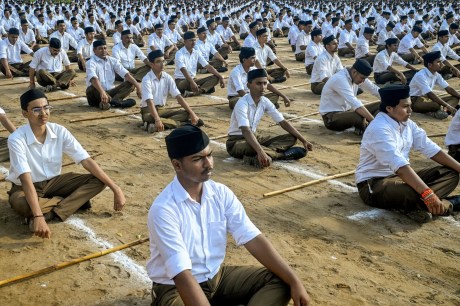
The New York Times has once again carried out a hit job against the Rashtriya Swayamsevak Sangh (RSS). Its latest article, “From the Shadows to Power: How the Hindu Right Reshaped India“, demonises the world’s largest voluntary organisation in its centenary year. The title itself is misleading, reflecting a worldview rooted in a Western lens that tends to think in binaries of “Left vs Right”. Earlier in this column, we have discussed in detail the limitations of such Western “Right-wing” labels.
This is neither the first hit job against the RSS in international media, nor will it be the last. This brings us to a larger question: why does international media—more specifically Western media—persist in promoting a stereotypical image of the RSS as a “fascist, majoritarian, militant Hindu organisation”? Ironically, the phrase itself is an oxymoron. Hindu Dharma is the antithesis of majoritarianism and fascism, and a practising Hindu who believes in Dharma—which is different from religion—is among the most democratic individuals in both Indian and global society.
The RSS worldview, as elaborated by its joint general secretary Arun Kumar in one of his recent speeches (published as part of Hindutva: A Contemporary Perspective, Suruchi Prakashan), states: “Democracy in the world cannot be found outside Hindu society. In Hindu Dharma, there is absolute spiritual democracy. No other religion in the world regards others as equals. They may tolerate another, but they do not accept them as equal. No one is willing to recognise anyone as equal. We alone are the ones who said, “Accept all the paths as equal”. We have regarded all paths as true and have not labelled any as false.”
Historical Roots of the Western Lens
The larger question, however, remains: why is the Western media and academia so focused on targeting the RSS? The problem has deep historical roots. In 1969, Craig Baxter, an American diplomat and political scientist, published a book in the US through the University of Pennsylvania Press titled The Jana Sangh: A Biography of an Indian Political Party. This book played a significant role in wrongly positioning the RSS as a political organisation.
Western academia and media continued to carry forward this lens, which was further cemented over the decades by scholars such as Christophe Jaffrelot, who became a fountainhead for spreading misinformation and disinformation about the RSS. All of Jaffrelot’s works share a common fallacy: they are opinionated and rely on questionable data. Many Western scholars, who wrote about the RSS largely based on Jaffrelot’s work, have also got both their facts and their analytical framework wrong. One recent example is Edward Anderson’s book—Hindu Nationalism in the Indian Diaspora—that is marred by factual errors, biases, and a lack of understanding of the organization’s workings, perpetuating stereotypes and misinformation about Hindu nationalism and the RSS.
A fundamental misunderstanding makes this approach flawed. When examining the RSS’s definition of Hindu Dharma, one must clearly distinguish between “Dharma”—a way of life that has nothing to do with modes of worship—and religion, which is specifically linked to worship. If Western academia and media were to view the RSS through this civilisational lens of “Dharma”, their conclusions would be markedly different.
Politics versus Civilisational Perspective
This leads to another crucial question: why are Western intellectuals reluctant to view the RSS through a civilisational lens? The answer is straightforward. Western intellectual thought is deeply obsessed with the “politics of everything”. One key reason for this is that Western nation-states themselves emerged from intense political churn following the French Revolution. As a result, there has never been a deep engagement with or understanding of civilisational paradigms.
For the Western world, it is politics that drives history. For India, however, what matters most are civilisational values. As a millennia-old civilisation, India’s belief has always been that it is ultimately Dharma—the righteousness that sustains the world—that will shape human destiny.
This Western obsession with politics, and its failure to adopt an appropriate civilisational lens, continues to be reflected in contemporary works by several authors and journalists. From Baxter to Jaffrelot and beyond, there is a persistent tendency to view the RSS only through its political mentees—first the Bharatiya Jana Sangh and now the Bharatiya Janata Party.
The irony is that even those academic works which are considered less biased against the RSS, such as The Brotherhood in Saffron (1987), RSS: A View to the Inside (2018), and Messengers of Hindu Nationalism: How the RSS Reshaped India fail to fully shed this political lens. The picture that another American diplomat, Walter Andersen, and his co-author Shridhar Damle, projected in these works doesn’t do justice to the RSS’s apolitical structure, approach, and functioning.
For foreign academia and political scientists, however, this reality appears too good to be true—that an organisation that boasts of millions of members can stay aloof from politics and talk about not only India’s well-being but also the global good. Unfortunately, many so-called pro-RSS neo-intellectuals are also contributing to the problem by writing op-eds and books using the same flawed framework. In a rush to present themselves as more loyal than the king, there has been a flood of content on the Sangh, especially during the ongoing centenary year.
While one section in India and globally intentionally demonises the RSS, as the recent piece done by NYT did, there is also no shortage of self-proclaimed Right-wing intellectuals who end up doing more harm than good by looking at the RSS from a flawed lens and jumping to conclusions that have nothing to do with ground realities. – MoneyControl, 4 January 2026
› Arun Anand has authored two books on the RSS.
Filed under: australia, canada, EU, UK, USA | Tagged: anti-india sentiment, indian politics, RSS, RSS-BJP, western media |