










 Years of invasions and colonial occupation have stormed and settled so deep into our psyche that we believe that reclaiming our faith, our way of life, our identity, our wisdom, or our demography is a crass, communal act. – Abhijit Majumder
The Places of Worship (Special Provisions) Act, 1991, is a malevolent piece of legislation. It says every place of worship, except the Ayodhya Ram Janmabhoomi site, must be maintained as it stood on August 15, 1947. None can even appeal on such matters in court.
In other words, a state rattled by the Ram Mandir turbulence of 1991 told its citizens that they can claim only one of the thousands of articles which were looted from their house by robbers and invaders. The rest they must forget for the sake of secularism.
The panicked Narasimha Rao government, while hurriedly bringing to life the law on July 11, 1991 (the Babri Masjid was brought down less than five months later), upended even the most commonsensical notions of justice.
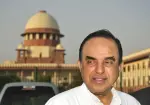
In his petition in Supreme Court against the Places of Worship Act, advocate Ashwini Upadhyay has argued that it offends Articles 14 (equality), 15 (forbids discrimination), 21 (right to protection of life and personal liberty), 25 (freedom of religion), 26 (freedom to manage religious affairs), and 29 (protection of minority interests), besides violating the principles of secularism itself.
“Centre by making the impugned Act, has created arbitrary irrational retrospective cutoff date, declared that character of places of worship-pilgrimage shall be maintained as it was on 15 August 1947 and no suit or proceeding shall lie in Court in respect of disputes against encroachment done by fundamentalist barbaric invaders and law breakers and such proceeding shall stand abated [sic],” his petition notes. “Thus, Centre has barred the remedies against illegal encroachment on the places of worship and pilgrimages and now Hindus, Jains, Buddhists, Sikhs cannot file suit or approach High Court under Article 226. Therefore, they won’t be able to restore their places of worship and pilgrimage including temples, endowments in spirit of Articles 25-26 and illegal barbarian act of invaders will continue in perpetuity [sic].”
Drawing from the same thread of arguments made in the Ram Mandir and Sabarimala cases, Upadhyay says that deity property will continue to be the deity’s property. He quotes the apex court in the 1959 Mahant Ram Saroop Das vs SP Sahi case: “Even if the idol gets broken or is lost or stolen, another image may be consecrated and it cannot be said that the original object has ceased to exist.”
Even if we step out of the legal thickets, three realities stare at us point blank. And all three point to one conclusion: that the Places of Worship Act of 1991 must go.
First, that India’s Constitution and subsequent lawmaking have not been geared to protect the civilisation. In fact, in too many instances, laws have been designed to throttle the right to equality and freedom of the majority community, and punish it for being the torchbearer of this land’s ancient soul. It is a point that those like J. Sai Deepak and Ashwini Upadhyay have been repeatedly making.
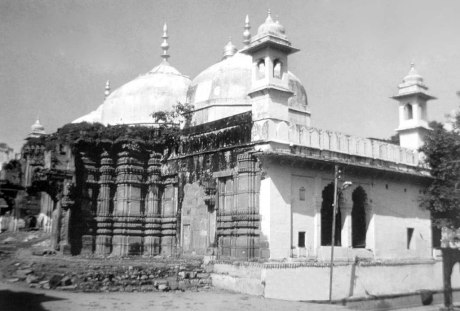
The Places of Worship Act has been bandied about in the ongoing Gyanvapi mandir-mosque case by applicants from the Muslim side, the Anjuman Intezamia Masjid Committee. Even political parties like AIMIM, who would not have a secular code override regressive Muslim personal laws, are suddenly swearing by the Constitution to ensure that water washing the feet of millions of the mosque’s faithful flow to the Shivling taken from the ravaged temple and placed at the wash area seemingly simply to humiliate the ‘other’.
Second, the sinister nexus between the Islamic fundamentalists and the community’s scholars and intelligentsia. It is a symphony of silence and denial.
In courts, on social media, and even in private discussions, there is stubborn stonewalling even when facts are well-known and proudly tabulated by the very Islamist invaders who smashed the idols and butchered the worshippers across centuries.
In his essay ‘Hideaway Communalism’, Arun Shourie, long before he moved into the lap of those whom he boldly took on in his writing, wrote: “The fact that temples were broken and mosques constructed in their place is well-known. Nor is the fact that the materials of the temples—the stones and idols—were used in constructing the mosque, news. It was thought that this was the way to strike at the heart if the conquered—for in those days the temple was not just a place of worship; it was the hub of the community’s life, of its learning, of its social life. Their real significance … lies in the evasion and concealment they have spurred … they have known them, and their impulse has been to conceal or bury rather than to ascertain the truth.”
One of the main reasons that a section of the community cradles such abiding violence and regressiveness worldwide even now is this silence of its so-called intelligentsia. It is either too scared to speak or in connivance with the radicals.
Some of these ‘intellectuals’ in media or academia often rummage through legislations and social norms of the free world to turn those against the very democracies that host them. The Places of Worship Act is one such prop.
The third danger is from ourselves. Years of invasions and colonial occupation have stormed and settled so deep into our psyche that we believe that reclaiming our faith, our way of life, our identity, our wisdom, or our demography is a crass, communal act. Many of us believe that instead of reclaiming our temples, we should build schools and hospitals.
Both can happen simultaneously.
But our places of worship were relentlessly targeted solely to break this civilisation’s resolve. Each razed brick was meant to be a piece of our collective spine. In places that all the temples were turned to dust, our existence vanished. From Afghanistan, most parts of Pakistan. It is why temples are still attacked on Durga Puja and Janmashtami in Bangladesh.
It is a war of existence for this civilisation, and the Places of Worship Act is a weapon we have invented to use against ourselves. It must find no place in a nation rising from slavery and slumber. – News18, 13 September 2022
› Abhijit Majumder is a senior journalist and editor-in-chief at Earshot Media, New Delhi.
Filed under: india | Tagged: gyanvapi mosque, islamic iconoclasm, kashi vishwanath temple, places of worship act, reclaiming usurped temples |