








 Was there … a “mainstream vs. marginal” duality in ancient India? The caste system … built its own categories, but tribals were not regarded as sharply separate from “mainstream” society. Interestingly, there is no word for “tribe” in Sanskrit or, so far as I know, in any Indian language; there are terms equivalent to “forest dwellers” or “mountain dwellers”, but not “tribe”. – Prof Michel Danino
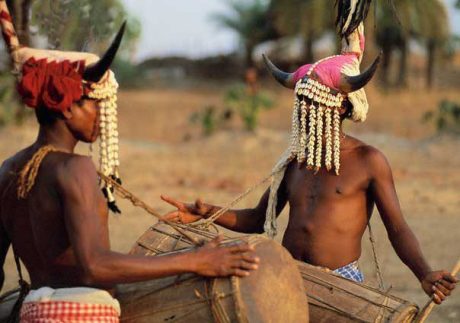
The previous article (“India’s Own Sacred Ecology”) in this series made a passing mention of Bishnois, Bhils, Warlis, Santhals or Todas, in whom the reader will have recognized some of India’s better-known tribes. This land has the privilege—it is one, although few Indians realize that—of having hundreds of tribal communities, most of them struggling with modernity and “civilization” in a losing battle to preserve a semblance of their identity.
But what is a tribe? It used to be defined as a group of families or clans sharing a tradition of common descent, a culture and a language, living as a close-knit community under a chief and holding no private property. In the 20th century, however, anthropologists increasingly preferred the more neutral and elastic term of “ethnic group”. Indeed, “tribe” is tainted by 19th-century racist ethnology, which generally described those groups as primitive, barbarous and belonging to inferior races—a stereotype that has proved tenacious, especially when coupled with “animism”, a derogatory term that does little justice to tribal religions. In any case, the notion remains that such groups are marginal to mainstream society, whatever “mainstream” may mean.
Was there such a “mainstream vs. marginal” duality in ancient India? The caste system, of course, built its own categories, but tribals were not regarded as sharply separate from “mainstream” society. Interestingly, there is no word for “tribe” in Sanskrit or, so far as I know, in any Indian language; there are terms equivalent to “forest dwellers” or “mountain dwellers”, but not “tribe”. “Adivasi” was coined early in the twentieth century in the context of race-obsessed colonial ethnology which labelled every Indian community either as “Aryan” or “non-Aryan”—but India had no concept of “original inhabitant”, and as the sociologist G. S. Ghurye put it long ago, “It is utterly unscientific to regard some tribe or the other as the original owner of the soil.” I mentioned in “Decoding the Idea of India” how the Mahabharata lists 363 communities (janas or jatis) across the map, defined in geographical, political or ecological terms; some of them remain recognizable as “tribes”, such as “Mundas, Savaras, Kokuratas or Korkus, Karushas or Kurukhs, Kollagirs or Kolis, and Nishadas or Bhils,” according to the anthropologist K. S. Singh, who pointed out that the Epic does not seem to distinguish between caste and “tribe”, except that some of the janas happen to live in the mountains or forests: “There is hardly any evidence to show that in the collective consciousness of India there is any difference between the two sets of janas.”
The list of janas rises to nearly 700 if we include all ancient literature. In his Arthashastra (8.4.43), Kautilya states, “Forest tribes live in their own territory, are numerous, brave, fight in daylight and, with their ability to seize and ruin countries, behave like kings.” The word for “tribe” here is atavika, that is, “forest dweller”. Kautilya’s fear of their conquering impulse reflects a historical fact: many tribes took to warfare, expanded their territories and became as many Kshatriya clans. H. H. Risley, who conducted the 1901 Census of India, noted a decade earlier how some tribal groups moved straight towards Brahminhood by claiming descent from a legendary king or rishi, imitating Brahmin rituals and even adopting the gotra system. That illustrates the well-known upward social migration which the sociologist M. N. Srinivas called “Sanskritization” (not an ideal term, as the process has little to do with Sanskrit). In fact, recent genetic studies have failed to find radical differences between today’s scheduled tribes and caste groups, and some geneticists now speak of a “caste-tribe continuum”.
India’s tribal communities adopted the Mahabharata and Ramayana with gusto, often relocating the events in their territories, the better to own them. They welcomed Hindu gods and goddesses into their pantheons, sometimes fusing them with their own. This has led to some intriguing situations, such as tribal communities of western India worshipping the Vedic god Indra (under the name of “Babo Ind”), long after he had faded from “mainstream” Hinduism. Interaction is never a one-way affair: the same Hinduism imported Jagannath, Ayyappa, Narasimha, aspects of the Shakti, possibly too Ganesha and Venkateshwara; fusion and assimilation were the rule with varying degrees. The sociologist André Béteille summed up the process thus: “The thousands of castes and tribes on the Indian subcontinent have influenced each other in their religious beliefs and practices since the beginning of history and before. That the tribal religions have been influenced by Hinduism is widely accepted, but it is equally true that Hinduism, not only in its formative phase but throughout its evolution, has been influenced by tribal religions.” There are of course exceptions, mostly because of geographical isolation. The Todas of the Nilgiris are one such; but even if their god-inhabited geography and eco-sacred rituals are distinct, they remain in tune with “Pagan” Hinduism.
Mainstream India’s perception of her tribes remains blinkered by the colonial approach, on which the missionary agenda rode piggyback, seeking to “detach the considerable masses of non-Aryans from the general body of Hindus,” as Risley approvingly put it. Or a few years before him, Richard Temple, a high officer of the colonial administration: “Hinduism, although it is dying, yet has force … and tribes, if not converted to Christianity, may be perverted to Hinduism. If they are attached, as they rapidly may be, to Christianity, they will form a nucleus round which British power and influence may gather.” A glamorous politico-religious agenda that was diligently carried out, partly by demonizing Hinduism’s organic, syncretic and assimilative—but “pervert”—nature and processes. Those very processes will enable us to attempt an empirical definition of Hinduism. – The New Indian Express, 3 January 2017
» Prof Michel Danino teaches at IIT Gandhinagar and is a member of ICHR. Email : micheldanino@gmail.com.
Filed under: india | Tagged: caste, hindu, hindu society, india, indian caste system, scheduled castes, scheduled tribes, society, tribals |






I wish Prof. Danino writes a book on Hindu civilization, how Muslims and Christians tackled Hindu civilization.. Another book on same topic for10-12 old children.
LikeLike
Reblogged this on Voices and Visions.
LikeLike