









“Modi provides some details of how he handled the situation in the aftermath of the attack on a train carrying mostly kar sevaks from Ayodhya in the early hours of February 27, 2002 in which 59 people were burnt alive.” – PTI
Narendra Modi says that he was “sad” about the 2002 Gujarat riots but has no guilt, and that no court has “come even close to establishing” it.
He has suffered 12 years of public “Modi-bashing” since the time of the riots but says that he had decided early on to “let the media do its work; there will be no confrontation”.
“I never waste my time in confrontation”, the BJP‘s prime ministerial candidate is quoted as saying in a just-published biography written by a British author and TV producer Andy Marino.
Marino says in the book Narendra Modi; A Political Biography, published by Harper Collins, that he was given detailed access by Modi whom he accompanied aboard his helicopter during his campaign rallies and interviewed him over several weeks.
On 2002 riots, Modi says, “I feel sad about what happened but no guilt. And no court has come even close to establishing it.”
The 310-page book deals with the riots in some detail with “hitherto unpublished, authenticated documents”. It discloses that after the riots Modi wanted to resign as chief minister but was prevailed upon by the party to continue.
 Marino says that the BJP strongman had confided in him “possibly for the first time in an on-the-record interview, that he no longer wanted to be the chief minister after the riots because he had decided it was unfair on the people of the state who had been subjected to extreme abuse because of him”.
Narendra Modi had resolved to step down at the BJP National Executive in Panaji on April 12, 2002, about a month after the post-Godhra riots.
The largely-adulatory book quotes Modi as having told the Panaji conclave, “I want to speak on Gujarat. From the party’s point of view this is a grave issue.
“There is a need for a free and frank discussion. To enable this, I wish to place my resignation before this body. It is time we decided what direction the party and the country should take from this point onwards.”
The chief minister told the biographer, “I wanted to leave this position but my party was not ready to leave me, the people of Gujarat were not ready to leave me, this situation is what I had (to deal with).
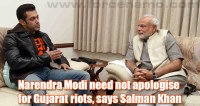 “It was not up to me. And I was not ready to go against party discipline; I don’t want to fight against my party. What my leaders say, I must follow it.”
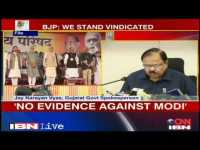
Modi provides some details of how he handled the situation in the aftermath of the attack on a train carrying mostly kar sevaks from Ayodhya in the early hours of February 27, 2002 in which 59 people were burnt alive [see video below].
He says that after he had returned from Godhra to Gandhinagar late at night, “I informally asked my officers to alert the Army”. He was told that the Army was at the border because there was tension between India and Pakistan after the attack on Parliament.
The book states that Modi had appealed to his counterparts in three neighbouring states, Ashok Gehlot in Rajasthan, Vilasrao Deshmukh in Maharashtra and Digvijaya Singh in Madhya Pradesh, to send aid in the form of law enforcement and para-military personnel. He sought 10 companies of armed police from each state. While Maharashtra had sent a very limited number of personnel to help, the other two states had quietly refused, it says. – Times of India, 25 March 2014
Filed under: india | Tagged: BJP, BJP leadership, communalism, godhra train burning, gujarat, gujarat government, gujarat riots, indian muslims, indian politics, lok sabha election 2014, narendra modi, political assassination, politics, politics of communalism, psychological warfare |







Leave a comment