














 “The Steve Jobs who founded Apple as an anarchic company promoting the message of freedom, whose first projects with Stephen Wozniak were pirate boxes and computers with open schematics, would be taken aback by the future that Apple is forging. Today there is no tech company that looks more like the Big Brother from Apple’s iconic 1984 commercial than Apple itself, a testament to how quickly power can corrupt.” – Mike Daisey
Steve Jobs was an enemy of nostalgia. He believed that the future required sacrifice and boldness. He bet on new technologies to fill gaps even when the way was unclear.
He often told the press that he was as proud of the devices Apple killed — in the parlance of Silicon Valley, he was a master of “knifing the baby,” which more squeamish innovators cannot do because they fall in love with their creations — as the ones it released. One of the keys to Apple’s success under his leadership was his ability to see technology with an unsentimental eye and keen scalpel, ready to cut loose whatever might not be essential. This editorial mien was Mr. Jobs’s greatest gift — he created a sense of style in computing because he could edit.
It would be fascinating to know what Mr. Jobs would make of the outpouring of grief flooding the developed world after his death on Wednesday. While it’s certain he’d be flattered, his hawk-eyed nature might assert itself: this is a man who once called an engineer at Google over the weekend because the shade of yellow in the second “O” was not precisely correct. This is a man who responded to e-mails sent by strangers with shocking regularity for the world’s most famous C.E.O. His impatience with fools was legendary, and the amount of hagiography now being ladled onto his life with abandon would undoubtedly set his teeth on edge.
Many of Silicon Valley’s leaders regularly ask themselves “What would Steve do?” in an almost religious fashion when facing challenges, and it is a worthy mental exercise for confronting the fact of his death. I think Mr. Jobs would coldly and clearly assess his life and provide unvarnished criticism of its contents. He’d have no problem acknowledging that he was a genius — as he was gifted with an enormously healthy ego — but he would also state with salty language exactly where he had fallen short, and what might be needed to refine his design with the benefit of hindsight.
Mr. Jobs leaves behind a dominant Apple, fulfilling his original promise to save the company from the brink when he returned in 1997. Because of its enormous strength in both music sales and mobile devices, Apple has more power than at any time in its history, and it is using that power to make the computing experience of its users less free, more locked down and more tightly regulated than ever before. All of Apple’s iDevices — the iPod, iPhone and iPad — use operating systems that deny the user access to their workings. Users cannot install programs themselves; they are downloaded from Apple’s servers, which Apple controls and curates, choosing at its whim what can and can’t be distributed, and where anything can be censored with little or no explanation.
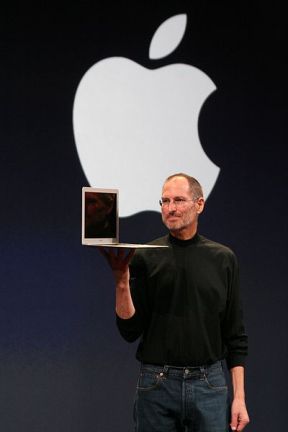 The Steve Jobs who founded Apple as an anarchic company promoting the message of freedom, whose first projects with Stephen Wozniak were pirate boxes and computers with open schematics, would be taken aback by the future that Apple is forging. Today there is no tech company that looks more like the Big Brother from Apple’s iconic 1984 commercial than Apple itself, a testament to how quickly power can corrupt.
Apple’s rise to power in our time directly paralleled the transformation of global manufacturing. As recently as 10 years ago Apple’s computers were assembled in the United States, but today they are built in southern China under appalling labor conditions. Apple, like the vast majority of the electronics industry, skirts labor laws by subcontracting all its manufacturing to companies like Foxconn, a firm made infamous for suicides at its plants, a worker dying after working a 34-hour shift, widespread beatings, and a willingness to do whatever it takes to meet high quotas set by tech companies like Apple.
I have traveled to southern China and interviewed workers employed in the production of electronics. I spoke with a man whose right hand was permanently curled into a claw from being smashed in a metal press at Foxconn, where he worked assembling Apple laptops and iPads. I showed him my iPad, and he gasped because he’d never seen one turned on. He stroked the screen and marveled at the icons sliding back and forth, the Apple attention to detail in every pixel. He told my translator, “It’s a kind of magic.”
Mr. Jobs’s magic has its costs. We can admire the design perfection and business acumen while acknowledging the truth: with Apple’s immense resources at his command he could have revolutionized the industry to make devices more humanely and more openly, and chose not to. If we view him unsparingly, without nostalgia, we would see a great man whose genius in design, showmanship and stewardship of the tech world will not be seen again in our lifetime. We would also see a man who in the end failed to “think different,” in the deepest way, about the human needs of both his users and his workers.
It’s a high bar, but Jobs always believed passionately in brutal honesty, and the truth is rarely kind. With his death, the serious work to do the things he has failed to do will fall to all of us: the rebels, the misfits, the crazy ones who think they can change the world. – The New York Times, New York, Oct. 6, 2011
» Mike Daisey is an author and performer. His latest monologue, “The Agony and the Ecstasy of Steve Jobs,” is scheduled to open at the Public Theater in NYC on Tuesday.
Filed under: india | Tagged: computers, economics, foxconn, iphone, science, silicon valley, steve jobs |












Apple employees feared Steve Jobs – TOI, Mumbai, Oct. 11, 2011
SAN FRANCISCO: In the hours and days following the death of Apple co-founder Steve Jobs, tributes poured in from all over the world, grieving fans held vigils at Apple stores and social networks were flooded with teary accolades to the rock star of the tech world.
A cartoon making the rounds on the internet perhaps best summed up the mood. It showed Moses at the pearly gates of heaven, where God was introducing a new arrival.
‘Moses, meet Steve,’ said God. ‘He’s gonna upgrade your tablets.’
Just five days after his death, the beatification of Jobs is being increasingly questioned. That is not expected to hurt the sales of the iPhone 4S, introduced the day before he died.
But it has at least introduced an element of critical assessment into both his achievements and failings.
“His accomplishments were far-reaching and impossible to easily summarize,” noted the muck-stirring website Gawker.com. “One thing he wasn’t, though, was perfect. Indeed there were things Jobs did while at Apple that were deeply disturbing.”
The article described him as ‘rude, dismissive, hostile, spiteful’ and said that ‘bullying, manipulation and fear … followed him around.’
Anyone who has followed Jobs’ career with even a modicum of interest knows what Gawker was referring to: the tales of his humiliation of employees, not to mention his reported refusal to acknowledge paternity of his daughter Lisa born out of wedlock when he was just 23.
He was widely criticized for authoritarian control over which programmes could appear in the App Store for iPhones and iPads, and his support of a so-called Worldwide Loyalty Team that hunts down anyone who leaks secret Apple information, including people not connected to the company.
Apple has also been widely criticized for its use of Chinese child labourers to make its products, and for grueling working conditions at many of its contract manufacturers.
Gawker’s point was that Jobs may have been a great businessman but he shouldn’t be celebrated or mourned as though he ended world hunger or eradicated poverty and disease.
One of Jobs’ greatest critics wouldn’t even honour his business achievements. Free Software Foundation’s Richard Stallman eulogised Jobs as “the pioneer of the computer as a jail made cool, designed to sever fools from their freedom.”
“We all deserve the end of Jobs’ malign influence on people’s computing,” said the high-tech renegade and father of the free software movement.
“Unfortunately, that influence continues despite his absence. We can only hope his successors, as they attempt to carry on his legacy, will be less effective.”
Even some Apple acolytes thought that the worship of Steve Jobs had gone a bit too far. “Yes, Steve Jobs was a genius, and I love my mac and iPod,” said one Facebook comment. “But his company brainwashes our society into thinking they always need the ‘new and improved’ and completely milks the market by coming out with little improvements on each model while not providing good support/upgrades for the older ones. I would have infinite respect for him and his company otherwise.”
Writing in Forbes, one contributor made a point of celebrating the gnarlier side of Jobs’ persona as every bit as important to his success as the brilliant vision that marked his storied career.
“Steve Jobs was a jerk,” he wrote. “Good for him. Jobs was like the Gestapo … for the good of his company, his employees, his shareholders, his partners.”
LikeLike
I knew about how the Chinese workers were treated. I did not like the Think Different campaign, because it used the Left to serve corporatism.
I was surprised when so many people lauded him as though he was a wonderful politically aware person like Picasso or Einstein.
LikeLike