










 The Rakhigarhi study … while showing absence of any Central Asian/Steppe element in the genetic make-up of the Harappan people, does indicate minor traces of Iranian strains which may point to contact, not invasion. – Anubhuti Vishnoi
The much-awaited DNA study of the skeletal remains found at the Harappan site of Rakhigarhi, Haryana, shows no Central Asian trace, indicating the Aryan invasion theory was flawed and Vedic evolution was through indigenous people.
The lead researchers of this soon-to-be published study—Vasant Shinde and Neeraj Rai—told ET that this establishes the knowledge ecosystem in the Vedic era was guided by “fully indigenous” people with limited “external contact”.
“The Rakhigarhi human DNA clearly shows a predominant local element—the mitochondrial DNA is very strong in it. There is some minor foreign element which shows some mixing up with a foreign population, but the DNA is clearly local,” Shinde told ET. He went on to add: “This indicates quite clearly, through archeological data, that the Vedic era that followed was a fully indigenous period with some external contact.”
According to Shinde’s findings, the manner of burial is quite similar to the early Vedic period, also known as the Rigvedic Era. The pottery, the brick type used for construction and the general “good health” of the people ascertained through the skeletal remains in Rakhigarhi, he said, pointed to a well-developed knowledge system that evolved further into the Vedic era. The study has, in fact, noted that some burial rituals observed in the Rakhigarhi necropolis prevail even now in some communities, showing a remarkable continuity over thousands of years.
Shinde, who is the vice-chancellor of the Deccan College, Pune, was the lead archaeologist in the study while Rai, who is the head of the ancient DNA laboratory at Lucknow’s Birbal Sahni Institute of Palaeosciences, did the DNA study.
Minor traces of Iranian strains
According to Rai, the evidence points to a predominantly indigenous culture that voluntarily spread across other areas, not displaced or overrun by an Aryan invasion. “The condition of the human skeletons, the burial … all show absence of palaeo-pathology symptoms which could indicate ailments due to lack of medical care. The persons here were healthy; denture morphology showed teeth free of any infection; bones are healthy, as is the cranium,” Rai told ET.
He also discounted the notion of any violent conflict. “There are no cuts and marks which would be associated with a population subjected to warfare. All this indicates that the people were receiving well-developed healthcare and had full-fledged knowledge systems.” The excavations in Rigvedic phase, he said, corroborate this. “This points to greater continuity rather than to a new Aryan race descending and bringing superior knowledge systems to the region,” Rai said.
The Rakhigarhi study, he said, while showing absence of any Central Asian/Steppe element in the genetic make-up of the Harappan people, does indicate minor traces of Iranian strains which may point to contact, not invasion.
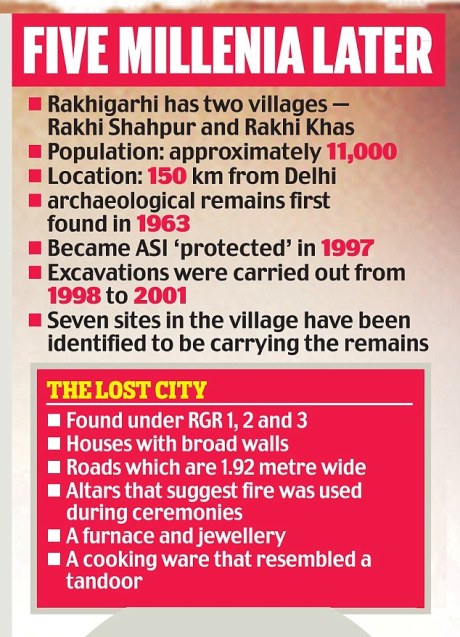
The Aryan invasion theory holds forth that a set of migrants came from Central Asia armed with superior knowledge and arms and invaded the existing settlements to establish a more sophisticated civilisation in India and pushed the original inhabitants down south. Rakhigarhi is one of the biggest Harappan civilisation sites spread across 300 hectares in Hisar, Haryana. It’s estimated to be 6,000 years old and was part of the mature phase of the Harappan period.
Rai disclosed that 148 independent skeletal elements from Rakhigarhi were screened for the presence of DNA molecules at the Centre for Cellular and Molecular Biology in Hyderabad. Of the 148 skeletal remains, only two samples yielded any relevant DNA material.
Meanwhile, hectic last-minute efforts are on to get additional genetic details of the DNA material. One of the DNA samples recently faced contamination in a Seoul laboratory and efforts are on to segregate it. Samples were sent to laboratories in Seoul and Harvard for establishing accuracy. The contamination, Rai said, is unlikely to have any major bearing on the study’s primary findings. – The Economic Times, 13 June 2018
» Anubhuti Vishnoi is a journalist with The Economic Times in New Delhi.

Filed under: india | Tagged: AIT, DNA, india, rakhigarhi, sindhu saraswati civilization | 1 Comment »