









 “The organization of the Kumbh Mela could provide useful lessons for the lower tier cities that are being built from scratch around India to accommodate the rapidly urbanizing population. And by focusing on the roads and electricity, the organizers ensured that the basic infrastructure was in place. ‘If the land is allocated, the roads are available, and electricity is at hand, the non-government actors will figure out the rest,’ Mr. Macomber of the Harvard Business School said.” – Joanna Sugden
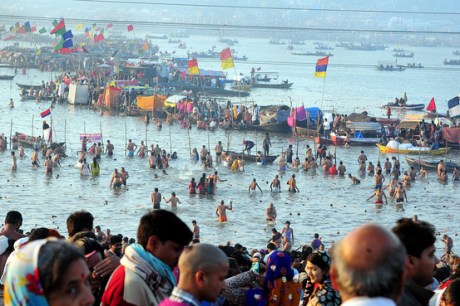
 The Kumbh Mela, probably the largest religious gathering on Earth wraps up Sunday in Allahabad.
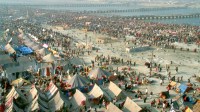
It will take about 10 days to collapse the tented-city built on the Ganges riverbed, where up to 80 million pilgrims have come to bathe over the past two months, according to the organizers.
Thousands of tents that have housed pilgrims will be dismantled, 40,000 toilets removed, 25,000 street lamps and an electricity grid with 2,081 miles of cable will be shut down. Temporary road surfaces and bridges will disappear.
Raj Shekhar, the executive district magistrate of Allahabad and one of the three main organizers of the Kumbh Mela, said overall it had been a success, apart from “the incident at the railway.” On Feb. 10, the busiest day of the festival, 36 people died in a stampede at Allahabad’s railway station.
“The mela site itself has been quite peaceful and successful,” Mr. Shekhar said.
The staging of the Kumbh Mela this year attracted the attention of researchers from Harvard Business School who came to the site in January to examine how the festival came together.
 John Macomber, senior lecturer in the finance unit of Harvard Business School, described the site as a “pop-up megacity” and suggested that it is unique.
“There are other megacities of tens of millions of people but they took years to emerge,” Mr. Macomber told India Real time.
The entire site is submerged underwater six months before the mela begins and is used on this scale only once in 12 years. Other agglomerations that arise quickly include refugee camps and informal housing on the edge of existing cities, Mr. Macomber said. “But these don’t compare to the Kumbh Mela.”
“The objective of this city is pilgrimage and devotion…. That leads to a commonality of purpose between all involved that does not exist very often,” he said.
Part of Harvard’s research was aimed at exploring how cities of the future will be constructed as the world urbanizes. “30 years from now there will be twice as many people living in cities,” Mr. Macomber said.
 India’s urban population is projected to grow from 340 million in 2008 to 590 million by 2030, according to the McKinsey Global Institute.
“This urban expansion will happen at a speed quite unlike anything India has seen before,” the MGI’s 2010 report said. “It took India nearly 40 years (between 1971 and 2008) for the urban population to rise by nearly 230 million. It will take only half the time to add the next 250 million.”
The organization of the Kumbh Mela could provide useful lessons for the lower tier cities that are being built from scratch around India to accommodate the rapidly urbanizing population. And by focusing on the roads and electricity, the organizers ensured that the basic infrastructure was in place.
“If the land is allocated, the roads are available, and electricity is at hand, the non-government actors will figure out the rest.” WSJ, 10 March 2013
» Joanna Sugden is freelance journalist living in Delhi. Before coming to India in 2011 she spent four-and-a-half years as a reporter at The Times of London, covering religion and education. You can follow her on Twitter @jhsugden.

See also
-
Ten things about the Kumbh Mela that you never knew – Avinash Sharma
-
Sannyasis and Nagas begin to depart Mahakumbh – Rajiv Mani
-
‘Mahamandaleshwar’ Nithyananda skips Kumbh bath, will be stripped of bought title – Deccan Herald
-
Kumbha Mela: At Prayag Hindus put aside their differences and bathe together – Omar Rashid
-
The Divine Pot – Devdutt Pattanaik
Filed under: india | Tagged: akharas, allahabad, ashrams, culture, environment, festivals, god, goddess, hindu, hindu pilgrimage sites, hinduism, india, kalpavasis, kumbh mela, kumbh mela 2013, naga sadhus, pandit | panda, panentheism, pilgrims, prayag, psychological warfare, puranas, religion, rituals, sadhus, saints, sanatana dharma, sannyasi, sannyasis, triveni sangam, yatris | Leave a comment »