











 The real problem in the Sabarimala case is not the so-called lack of “constitutional morality” where some women are excluded from entering the temple, but the larger exclusion of Hindu institutions from the protections available to them under Articles 25-30. – R. Jagannathan
Given the sharp divisions in Hindu society that the Supreme Court judgment in the Sabarimala case has engineered, the 4:1 verdict that opened the doors of the temple of Swami Ayyappa, a celibate deity, to women in the 10-50 reproductive age needs quick reconsideration.
A seven-judge constitutional bench needs to review the September verdict, since it is unlikely that the three judges remaining on the current bench, and who wrote the majority view, will change their views just because one new judge is added to a review bench. (The judge to be replaced is former Chief Justice Dipak Misra). For fairness, the previous majority verdict needs balancing with a larger presence of new judges who are not beholden to the old verdict.
A lot of red herring arguments are being offered in the meanwhile, to ensure that the temple is forced to comply with the flawed judgment even before it is taken up for review.
One is that whether you agree with the judgment or not, you have to comply with it. You cannot allow public sentiment to nullify a court judgment. This may seem unexceptionable logic, but Indian history is littered with examples of how judicial verdicts, even in constitutional cases, are overturned by the executive and the legislature, based on political predilections.
Starting with the Nehru era, when court judgments started going against the government, especially in holding that freedom of speech and private property rights are unfettered, the Congress government passed its first amendment to the Constitution placing restraints on both these fundamental rights.
When the Tamil Nadu government opted for 69 per cent job and education quotas, going against a Supreme Court judgment which held that reservations cannot exceed 49 per cent, the government of the day at the Centre put this law in the Ninth Schedule so that it could not be challenged in courts.
And we need not go that far. This year, a Supreme Court judgment saying that atrocities under the SC/ST Act cannot lead to immediate arrests without due process (March 2018) was annulled by Parliament to restore the status quo, thanks to heated protests by Dalits and almost all political parties.
In 2017, when the apex court banned the Tamil Nadu bull-taming sport of jallikattu, the state government—with the nod of the Centre—issued an ordinance to nullify that judgment under pressure from angry crowds on Chennai’s Marina beach.
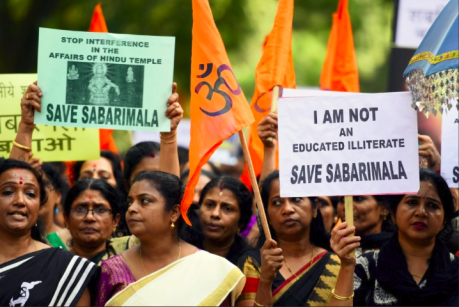
Those who argue that the Supreme Court order on Sabarimala must first be implemented before it can be reviewed are being too clever by half: once a precedent is set and all women allowed to enter the shrine even for a brief period, the old practice would have been effectively abrogated. This would make the review itself futile, since women would already have made their entry. It would be like bolting the stable door after the horse has bolted. It is about changing the status quo and indirectly defeating the arguments of the women who are #WillingToWait.
If the Modi government has its political and social antennae in working condition, it should use this judgment to move constitutional amendments to articles 25-30, which apply largely to protect minority religions and practices. The majority judgment in the Sabarimala case specifically ruled out the application of Article 26 to Ayyappa devotees, making it amply clear that the protections of these articles are only for so-called minorities, and hence discriminatory against Hindus. Little wonder that many Hindu groups now seek minority status.
What the Modi government should do is adopt junior minister Satyapal Singh private member’s bill that will make majority community members and institutions eligible to the same autonomy that minority institutions get. Alternatively, it should adopt a simple one-line omnibus amendment that says that the protections given in articles 25-30 will be equally applicable to any community seeking it, including the majority, and the Ayyappa devotees would benefit. Not only that, it will pave the way for the state to get out of managing Hindu temples and charitable institutions—a glaring inconsistency in India’s pluralist traditions. The amendments may or may not pass muster in the Rajya Sabha (who knows, a Hindu-wooing Congress party may well allow it to pass), but at least the Modi government would have proved its bona-fides with its core Hindu voter base. The RSS has already indicated that it is in tune with this reality, with Mohan Bhagwat mildly critiquing the Supreme Court on its Sabarimala judgment.
The real problem in the Sabarimala case is not the so-called lack of “constitutional morality” where some women are excluded [from entering the temple], but the larger exclusion of Hindu institutions from the protections available to them under Articles 25-30.
As Arghya Sengupta argues brilliantly in an article in The Times of India (19 October), Justice D. Y. Chandrachud, who has been celebrated by many as “the liberal judge”, seems to have been reading the wrong constitution.
Sengupta quotes Justice Chandrachud’s judgment on Sabarimala and observes: “The fulcrum of Justice Chandrachud’s view is that ‘the founding faith on which the Constitution is based is the belief that it is in the dignity of each individual that the pursuit of happiness is founded.’ This is a laudable proposition but one that is certainly not evident from reading the Indian Constitution, let alone capable of being its founding faith.”
The phrase “pursuit of happiness” comes from the US Declaration of Independence in 1776, where Thomas Jefferson wrote: “We hold these truths to be self-evident, that all men are created equal, that they are endowed by their Creator with certain unalienable rights, that among these are life, liberty and the pursuit of happiness.”
Maybe, if Justice Chandrachud had put more faith in the innate plurality of the Indian Constitution than in the American one, he may have come to a different conclusion in the Sabarimala case. – Swarajya Magazine, 19 October 2018
» R. Jagannathan is a senior journalist and the editorial director of Swarajya magazine.
Filed under: india | Tagged: constitution of india, hindu rights, sabarimala temple entry, supreme court of india, temple rituals | 6 Comments »