







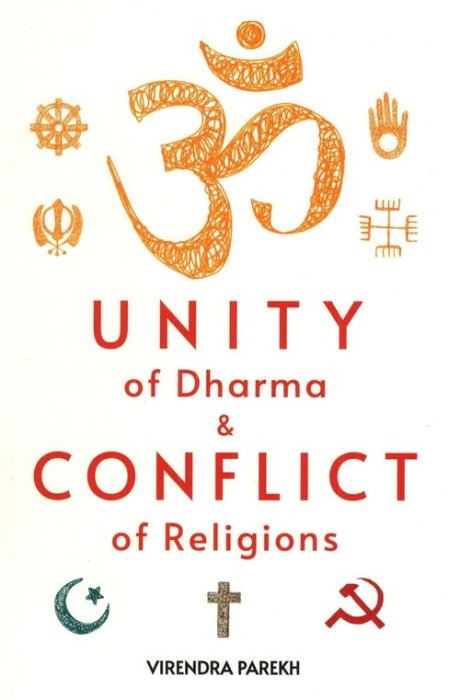
 Hinduism is the last major natural religion standing against the onslaught of world-conquering Abrahamic faiths. Indigenous traditions in Asia, Africa and Latin America are bearing the brunt of their advances. An argument for Hinduism, therefore, is equally an argument for all ancient indigenous pacifist traditions across the continents. Hinduism can provide inspiration and guidance for all those in the West who seek to rediscover their ancient traditions which were overwhelmed by Christianity. – Virendra Parekh
For long, Hinduism has been defined for the Hindus by its inveterate enemies. Hindus were told what kind of depraved religion and society they had and how they should conduct themselves in a modern secular state. In the telling phrase of Ram Swarup, an educated Hindu was expected to behave as if he was making amends for being a Hindu. No longer. This book, Unity of Dharma and Conflict of Religions, looks at Hinduism and others with open and clear eyes.
If all religions preach love, brotherhood and kindness, why do we see so much hatred, strife and violence in the name of religion? This question has often baffled not just atheists and agnostics, but also quite a few devout souls. This book is an attempt to answer it in the light of Indian spiritual tradition i.e. Sanatana Dharma. It seeks to show what unites religious traditions going beyond their apparent differences. It also tries to show what spawns intolerance, discord and conflict among different religious groups.
While the whole discussion here is rooted in the Indian experience, past and present, there is nothing geographical or temporal about the deep truths it highlights. The ideas, ideals and truths it refers to are not exclusively Indian or Western, ancient or modern. They have a universal appeal because the quest for truth is innate to human nature, just as hunger and thirst. Then again, what is discussed here are ideas and ideologies, not peoples and communities. It is Islam, not Muslims; it is Christianity, not Christians. That is because the mind of a man may be broader or smaller than the tradition he is born into. Also, at individual level, what matters is not what the Book says, but what one picks up from it. And religion, let us remind ourselves, is an intensely personal affair.
Public discourse in post-independence India has suffered from a double distortion. Any attempt to bring out and emphasize the essential unity underlying Hinduism and other Indic traditions such as Buddhism, Jainism and Sikhism is condemned as a shrewd plot to swallow up minority religions which arose as a revolt against ‘Brahmanism’. At the same time, pointing out fundamental differences between Sanatana Dharma and Abrahamic religions is run down as hate speech designed to foment communal discord. There is an insistence on treating the same as separate and vice versa. Ironically, all the talk about “essential unity of all religions” is firmly yoked to the service of this distortion. This has confused our intellect, clouded our vision and paralyzed our will to adopt right attitudes, frame proper policies and undertake appropriate actions.
This book is an humble endeavor to set the record straight on both the counts. Essentially, it discusses two types of religious traditions, as ably articulated by Sita Ram Goel. They proceed from entirely different premises and lead to very different mindsets and behavior patterns. One of them may be called the Biblical or Abrahamic traditions and the other, Vedic/Indic/Pagan traditions. There is a large body of literature discussing each of the Abrahamic faiths on a standalone basis in great detail. Instead of repeating the exercise, the effort here is to focus on a few characteristics which they share in common and which separate them from what they contemptuously look down upon as kufra or falsehood.
As is known, the Bible-derived creeds are founded on a central figure (Jehovah, God, Allah) who commands the exclusive and overriding allegiance of the believers. He is jealous, cruel and brooks no rival. He deals with his people through an intermediary, messenger, prophet or the sole savior. His teachings are contained in the Book. The Book is the sole repository of Ultimate Truth. Since this is the Absolute Truth, since it alone can lead to Heaven or permanent bliss, mankind must be awakened to it for its own good, at any cost, in whatever way. No sacrifice is too great for holding on to it; no means are unfair for converting others to it. As can be surmised, the very idea of an absolute monopoly of ultimate truth contains within itself seeds of intolerance, aggression, strife, and authoritarianism.
The Vedic tradition, on the other hand, is centred on human consciousness, which can be explored, purified progressively and elevated till it attains complete unity with the ultimate reality underlying the entire creation. In this tradition, the same goal can be attained through several paths and the same reality may be described by different sages in various ways. A seeker can choose any path or discipline that suits his inclination and adhikara (stage of moral-spiritual preparation). The essential points are three: First, it is the individual who must strive for himself; second, different ways will suit different persons; and third, the striving or the search is directed inwards. The Vedic tradition does not divide mankind into ‘us’ and ‘them’. It recognizes every spiritual endeavor as valuable and draws into a fellowship all those who accept the law of the right and earnestly seek for the truth. It is by its very nature broadminded, tolerant and liberal.
Hinduism is the last major natural religion standing against the onslaught of world-conquering Abrahamic faiths. Indigenous traditions in Asia, Africa and Latin America are bearing the brunt of their advances. An argument for Hinduism, therefore, is equally an argument for all ancient indigenous pacifist traditions across the continents. Hinduism can provide inspiration and guidance for all those in the West who seek to rediscover their ancient traditions which were overwhelmed by Christianity. That is why it strikes a chord in hearts far removed from one another culturally and geographically. When the Ram Janmabhoomi movement was at its peak in 1990s, Sita Ram Goel received a card from Europe depicting a pre-Christian shrine with the caption “our Ayodhya”.
In this battle for the soul of mankind—for that is what Hinduism represents—our strongest weapon is truth. Truth must be told both about Hinduism as well as about others. But truth, however blunt and bitter, has to be said in a non-offensive manner. In Indian tradition, a debate is intended to spark realization, and not provoke retaliation. That is the spirit pervading this discussion. The study ends with the message of optimism and conciliation brought by the consecration of Ram Temple in Ayodhya and inauguration of a grand Hindu temple in Abu Dhabi.
The ideas, ideals and the truths highlighted in this book have been expressed in a myriad way by sages and saints through the ages. In modern times, savants, scholars and writers like Swami Vivekananda, Maharshi Aurobindo, Dr. S. Radhakrishnan, Sita Ram Goel, Ram Swarup, Koenraad Elst, Arun Shourie, el al, have articulated them clearly and forcefully. I have drawn on their works and have acknowledged my gratitude to them at the end of each chapter.
My special thanks are due to Dr. Koenraad Elst for writing an erudite Foreword putting the book in an appropriate context and wider perspective. – Excerpted from the Preface to Unity of Dharma and Conflict of Religions, Voice of India, 14 January 2025
› Virendra Parekh is a senior journalist and editor in Mumbai.

Filed under: india, world | Tagged: abrahamic religions, hindu dharma, religion books, virendra parekh, voice of india | Comments Off on Unity of Dharma and Conflict of Religions – Virendra Parekh