















 Krishna the Purushottama is no less important than Krishna the Divine Teacher. Take away his divinity, he is none the worse for the loss. The purushottama remains achyuta, imperishable and indestructible. – Dr N. S. Rajaram
The mystery
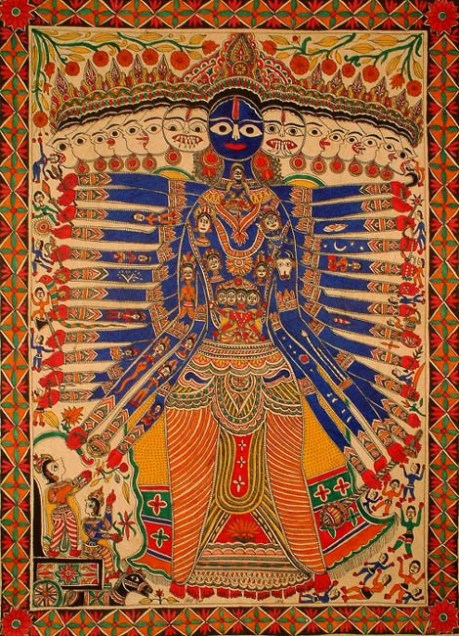
What is the mystery of Krishna? What is it that makes him keep his hold on the people of India and now the world thousands of years after he departed from this world? To make things more interesting, his followers include not only the bhaktas who see him as a divinity but also people who consider themselves rationalists and even atheists that do not accept the divine. To follow this, we need to recognize that Krishna was both an avatar (incarnation) and purushottama (supreme man). Krishna the man was as inspiring as Krishna the avatar of Vishnu. This holds the key to his universal appeal.
But first, we must answer the question: was Krishna a historical figure or was he a creation of the imagination of his devotees? Thanks to research over the past century and more, beginning with Bankim Chandra Chatterjee, it is possible to say that Krishna was indeed a historical figure who lived some five thousand years ago and whose life can be reconstructed in essentials. He is mentioned in many ancient works, many of which have nothing to do with religion or historical tradition.
Krishna was a key figure in the Mahabharata War though he remained a non-combatant. Panini, in his ancient work on Sanskrit grammar Ashtadhyayi, mentions Vasudeva (Krishna) and Arjuna as well as several other Mahabharata figures like Kunti, Yudhishtira and Nakula. He mentions also the Mahabharata War. Ashwalayana, another ancient writer, mentions the Mahabharata along with Vaishampayana, who first recited it in the presence of Janamejaya. The Chandogya Upanishad also mentions Krishna Devakiputra (Krishna, son of Devaki). There are many other references in Vedic and Buddhist literature. Unlike the Mahabharata, the Bhagavata and other Puranas, these are not part of the Itihasa Purana literature concerned with the worship of Krishna. The only reason they mention him at all is because of familiarity, which shows that Krishna must already have been a famous figure.
Krishna’s date
As far as the date of Krishna is concerned, tradition has always held that he lived at the end of the Dwapara Yuga and that Kali Yuga began with his death. This date is taken to be 3102 BC. Until recently, this date was thought to be impossible because scholars held that the invading Vedic Aryans came to India only after 1500 BC. Before the discovery of the Harappan (Indus Valley) Civilization, it was held that there was no civilization in India prior to that date. But now many scholars are beginning to recognize that the Harappan Civilization was itself Vedic and there was no Aryan invasion. Thus, tradition places Krishna and the Mahabharata War in what we now call the Early Harappan period.
This date can be supported both by science and literature. We have astronomical statements in Ashwalayana’s work that allow us to place the Mahabharata War, and therefore Krishna, in the centuries around 3000 BC. Greek records of the time of Alexander also tell us that the Indian Heracles (Hari Krishna), who was greatly honored by the Shurasenas of Methora (Mathura) lived 138 generations before Alexander’s contemporary Sandracottos (Chandragupta). Taking 20 years per generation, places Krishna 2760 years before Alexander, or about 3080 BC. This is in remarkably close agreement with the traditional date of 3102 BC for the Mahabharata War.
Next, to understand the appeal that Krishna had from his times to our own, we must recognize that in his time Vedanta offered a rational way of looking at the world just as science does today. The greatness of Krishna lay in the fact that he was not only a great teacher, but also supremely great as a human being, who always strove to protect dharma. This made him purushottama.
Vedantic view
His contemporaries like Bhisma and Veda Vyasa explained it in Vedantic terms. According to Vedanta every living being is endowed with both divine (daivic) and demonic (asuric) traits. The Bhagavad Gita has a chapter on this. They saw that a purushottama like Krishna must be dominated by daivic traits.
Later followers of Krishna lacked this Vedantic view, but saw him as a supernatural figure and therefore a God. They translated his daivic traits into supernatural powers. So Krishna the Supreme Man became Krishna the God who could work miracles. No matter how we view him, God or purushottama, Krishna remains an inspiration for all.
Why study the historical Krishna?
The personality of Krishna is so rich that it leads to different perceptions in different minds. Although I am convinced that the elevation of Krishna to divinity is not the handiwork of the original poet (Veda Vyasa or Krishna Dvaipayana), it really does not matter. The complexity of the Krishna phenomenon—and the fact that his life and personality defy all attempts to reduce him to simple terms—has existed for centuries and millennia. It is a living reality today. None of us can change it or take away the mystery that surrounds him. What we need to understand therefore is the process by which this elevation to divinity came about, and how to deal with this reality today, when we are faced with a vast Hindu population that believes in his divinity and also thousands of “educated” Hindus like me that consider themselves “rationalist”.
My own view, based on the Gita, Sri Aurobindo and the Mahabharata is that two fundamental concepts have had a role in the process: the apaurushya quality of a great truth and the Vedantic concept of divinity in everyone. But this has changed with the times, for we no longer live in the Vedantic milieu—an age in which Vedanta offered a rational way of looking at the world. To Krishna’s contemporaries like Vyasa and Bhisma, Vedanta was a reality, part of their everyday thinking, much as science is to us today. Their world-view was shaped by Vedanta, just as ours is shaped by science. This allowed them to combine history and spiritual vision into a true synthesis. Let me try and expand on this a little bit.
Sri Aurobindo on Krishna’s divinity
My first point is that we cannot ignore the history behind the Gita and treat it as a purely abstract philosophic work. On page 12 of Essays on the Gita, Sri Aurobindo acknowledges as much: “The teaching of the Gita must therefore be regarded not merely in the light of a general spiritual philosophy or ethical doctrine, but as bearing upon a practical crisis in the application of ethics and spirituality to human life.” And again on page 13, “There are indeed three things in the Gita which are spiritually significant, … they are the divine personality of the teacher, his characteristic relations with his disciple and the occasion of his teaching.” The Gita cannot therefore be divested of its Mahabharata setting. So the history is there, never to be ignored.
Let me take up the issue of the divinity of the Teacher. What makes the teacher divine? I have at different times emphasized the apaurusheya concept in Hinduism: it is the message and not the messenger that counts. This is an idea that lies at the heart of the spiritual basis of Vedic civilization. It is the greatness of his teaching that makes Krishna a divine teacher.
Sri Aurobindo expresses the same idea more concretely, by drawing on Jesus Christ (p. 15): “Such controversies as the one that has raged in Europe over the historicity of Christ, would seem to a spiritually minded Indian largely a waste of time. … So, too, the Krishna who matters to us is the eternal incarnation of the Divine and not the historical teacher and leader of men.”
There is a seeming contradiction in these two stands: the history does matter, but the historicity of the teacher (Krishna) is immaterial, more of which later. This is because of the divinity of Krishna as seen by his devotees has two sources: his teaching, of which most of his followers have only the vaguest notion, and the personality of Krishna, the Purushottama or the Best of Men. I think this is a point of cardinal importance: Krishna was not only a great teacher, but was also purushottama. Vishwamitra of the Gayatri Mantra was also a great teacher, but no one worships him as divine, for he was no purushottama. On the other hand Sri Rama is worshipped, though he has no claims to a scripture like the Gita. But he too was a purushottama.
I feel it would leave a vacuum in our understanding of Krishna if we looked at him strictly as a great teacher, while leaving out his exemplary life of sacrifice and as sarva-guna-sampanna, as Bhisma called him. If we look strictly at his teaching, to be truly great, it has to be apaurusheya, so the personality behind the teaching should not matter. But here the personality does matter, for Krishna is no mere teacher: he did not just teach karma yoga—his own life exemplified it. This is what made him purushottama—or human par excellence.
This is where Krishna towers the over the other great teachers in history. Moses, Jesus and Muhammad are held up as great teachers, but none of them was a purushottama. Their teaching is also not apaurusheya, for without the authority of the claim (unsupported) as being the “Medium of God”, their teaching has no validity. It is the very paurusheya claim as the Only Son of God or the Final Prophet that legitimizes their teaching, but that is a different story.
Let us look more closely at the basis for Krishna’s divinity. This too has multiple sources. The first person to raise the possibility of the divine in Krishna was Bhisma on the occasion of the Rajasuya (Sabha Parva). This I believe to be part of the original Mahabharata of Vyasa. To understand this we must grasp the Vedantic concept of divinity present in everyone and everything: ishavasyam idam sarvam. The Gita itself talks about the daivic and the asuric traits in man. In Krishna, the daivic had attained full dimension. So, to men like Bhisma steeped in the Vedantic, Krishna was a divine figure by virtue of the daivic dominance. Within the framework of Vedanta this is a perfectly rational position. You can call it avatar or whatever you like, but I see it as the domination of the daivic that is present in all of us. In Krishna it manifested itself in spirituality. In Tyagaraja, it was in music; in Ramanujam in mathematics, in Einstein, in science and so on. This does not invoke the supernatural, nor is it superstition. The phenomenon is there, only the explanation is wanting. This explanation is provided by Vedanta as a manifestation of the divine.
Let us now move to later times, especially the present. We no longer live in a Vedantic milieu. We don’t look at the world with Vedantic eyes as Bhisma and Vyasa did. Most of us calling ourselves “rational” do not see the world in daivic and asuric terms. With that we have lost the rational basis for spirituality or “avatar”. This has given us also a division between “faith” and “reason”. Krishna’s devotees still see him as divine. Among intellectuals this may be because of his teaching. But I suggest that with the overwhelming majority people it is Krishna the Prushottama that is the real object of adoration and worship. I also feel this is closer to the Vedantic view because it doesn’t give rise to the split between faith and reason. Only, in the case of modern devotees, faith has taken the place of the Vedantic view.
Vedantic view and the supernatural
And how do these worshippers see divinity? They obviously don’t see it in Vedantic terms like Bhisma or as the teacher of the divine Gita. They see the divine by endowing him with supernatural powers. This is what the later poets made of Krishna. This has no historical or even Vedantic validity, but it made his divinity accessible to the simplest soul. In their eyes Krishna the Purushottama becomes Krishna the Miracle Worker. This explains how predominantly erotic works like Jayadeva’s Gita Govinda are seen as divine prayers.
Alexander, an asuric divinity
Incidentally, the elevation of a human figure to godhood is common in other Pagan traditions also. The Greeks even elevated Alexander to be a God, but he was an asuric God. No one would call him purushottama.
Biblical religions on the other hand draw a clear line between man and God. This essentially reverses the process by which a teacher is equated with God as a pseudo-god calling himself prophet. The prophet becomes the instrument of God and allows no one else to encroach on his territory. In reality God becomes the monopoly tool of the prophet—many in Judaism, but single in Christianity and Islam.
Best of men and divine teacher
In summary, Krishna the Purushottama is no less important than Krishna the Divine Teacher. Take away his divinity, he is none the worse for the loss. The purushottama remains achyuta, imperishable and indestructible. (This is not true of other great religious teachers. H.G. Wells called Muhammad a man of “altogether common clay”.) Thousands of Hindus who have difficulty in grasping the notion of divinity can still admire and adore him as purushottama. Highlighting this I believe will broaden rather than weaken his appeal. I for one would have difficulty accepting the Krishna of Puranic myths, but never fail to be inspired by purushottama.
At a different level, this has practical consequences also. Note that anti-Hindu demagogues like Christian missionaries and communists attack the personality of Krishna, rarely his message. On the other hand, they try to appropriate his Gita, with some even claiming to see Biblical influence on it! (This is palpably absurd even on basic chronological grounds.) My hope is that our educated young people also, when they see Krishna the Purushottama, might stop being defensive about him. They will see Krishna the Purushottama whose life as a man was as a great a lesson as anything he or anyone ever taught. He was also the grand synthesis of the human and the divine with no conflict between faith and reason. – Vijayvaani, 2 September 2018
» Dr N. S Rajaram is a mathematician who has taught in American universities. He lives in Bangalore and has published with Voice of India.
Filed under: india | Tagged: avatar, krishna, purushottama | 1 Comment »











