









 “What is most striking, is the civilisational continuum of this land and its civilisational goal. Vivekananda saw this ‘current of national life flowing at times slow and half-conscious, at others, strong and awakened,’ moving towards fulfilling a glorious destiny for ‘my motherland.'” – Dr Anirban Ganguly
 The observance of Republic Day is often an occasion for looking back and for national stock-taking. An assessment of the national trajectory is something that the occasion offers. In the oath that he administered on January 26, 1930, Mahatma Gandhi spoke unsparingly of the “inalienable right of the Indian people to enjoy the fruits of their toil and have the necessities of life, so that they may have full opportunities of growth.”
Gandhi’s oath of January 26 also spoke of how subjection and alien rule had “ruined India economically, politically, culturally and spiritually”, and how only “purna swaraj” was the way out and towards salvation. Years earlier, Sri Aurobindo, then in his active revolutionary phase, had given a similar call—of complete independence.
While defining the dimensions of his “swaraj”, Gandhi noted on another occasion that his “swaraj” would keep “intact the genius of our civilisation”. “I want to write many new things,” noted Gandhi, “but they must all be written on the Indian slate.” The general trend and national atmosphere today point to this effort to write many new things on the Indian civilisational state—an effort that must be made with an unapologetic and bold spirit.
Gandhi’s January 26 declaration also spoke about how “culturally, the system of education (had) torn us from our moorings”, one of his most forceful advocacy was for realising the intellectual and spiritual devastation caused by this deracination and to work towards a completely new education vision and direction.
 Sri Aurobindo, in his days as one of the originators of the national education movement, strove to evolve a national system of education for India, a true education that would essentially express and give space to the manifestations of the civilisational dimension.
At least, the present liberated atmosphere allows and encourages a free discussion on the need to examine our educational framework and to evolve a fresh vision for a new India, accepting that such a vision ought to be inspired and initiated by our civilisational memory of a rich educational past.
Discussing Indian culture and external influence, about a century ago, Sri Aurobindo proffered a crucial national direction and challenge when he noted the necessity of living “in one’s self, determining one’s self-expression from one’s own centre of being in accordance with one’s own law of being, swadharma”. An inability to do this, argued Sri Aurobindo, would mean collectively, “languor, weakness, inefficiency” with the danger of being “overborne” and “oppressed by environing forces”. A “fidelity to our own spirit, nature, ideals” was required, but it had to be supplemented with a capacity for a “strong and masterful dealing with external circumstances”. The recognition of the need to create with foundations going deep into our civilisational root is a realisation that is increasingly governing the ship of the state.
One can almost hear the echoes of Swami Vivekananda’s call to make “this, our great Mother India, our keynote” and to dedicate and focus ourselves in the next five decades to making her great, prosperous, high-seated in the comity of nations. It is in this call that is 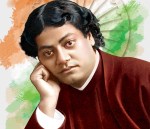 blended Sri Aurobindo’s advice to workers for the nation, to “work that she (India) may prosper, (to) suffer that she (India) may rejoice”.
What is most striking, is the civilisational continuum of this land and its civilisational goal. Vivekananda saw this “current of national life flowing at times slow and half-conscious, at others, strong and awakened”, moving towards fulfilling a glorious destiny for “my motherland”.
The essential task then is to ride and guide that national current towards realising that destiny—such a march has now begun. – The New Indian Express, 1 February 2015
» Dr Anirban Ganguly is Director of the Dr Syama Prasad Mookerjee Research Foundation, New Delhi. Follow him on Twitter @anirbanganguly.
Filed under: india | Tagged: civilization, genius of india, hindu, hindu civilisation, india, m.k. gandhi, national culture, national identity, sri aurobindo, swami vivekananda | Leave a comment »