











 Two great Mughal armies, led by Shah Jahan’s eldest son Dara Shikoh and his third son Aurangzeb, clashed on a dusty plain 20 km southeast of Agra. It was not only a battle for the Mughal throne, but a battle for the very soul of India. – Murad Ali Baig
On May 29, 1658, India’s history changed forever. Aurangzeb’s victory over his brother Dara Shikoh marked the beginning of Islamic bigotry in India that not only alienated Hindus but the much more moderate Sufis and Shias as well. Aurangzeb’s narrow Sunni beliefs were to make India the hotbed of Muslim fundamentalists, long before the Wahhabis of Saudi Arabia sponsored the fanatics of Taliban and Islamic State.
Two great Mughal armies, led by Shah Jahan’s eldest son Dara Shikoh and his third son Aurangzeb, clashed on a dusty plain 20 km southeast of Agra. It was not only a battle for the Mughal throne, but a battle for the very soul of India.
It pitted Dara, an eclectic scholar who respected all religions, against Aurangzeb who was an orthodox Sunni Muslim. Dara had translated the Bhagwad Gita and Upanishads from Sanskrit into Persian, to make them known to the public for the first time. The fact that he had been a Sanskrit scholar shows that there had been considerable Hindu-Muslim amity in the time of Shah Jahan.
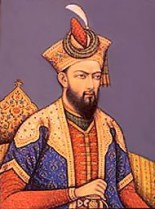 But Dara had been a pampered prince who faced a smaller battle-hardened army that Aurangzeb had marched up from the Deccan, after defeating an Imperial army at Dharmat near Indore. Blocked at the Chambal River, Aurangzeb quietly slipped behind Dara’s lines to reach a secret ford across the Chambal by non-stop double marches over two days.
Dara now realised that Aurangzeb’s armies had outflanked his army and come very close to Agra, so he had to rush east without most of his cannons. The two armies met on a flat dusty plain east of a village called Samugarh, on an unbelievably hot day with the sun like a furnace in a cloudless sky. There was not enough water so many soldiers and horses collapsed of heat and sun stroke.
The battle was more than just a contest between Dara and his rebel brother. It was becoming a religious war with the Hindus supporting Dara and many Muslim nobles supporting Aurangzeb.
Dara was on the brink of victory when he was betrayed by one of his commanders, Khalil Ullah Khan. He then retreated to Lahore and then down the Indus. Eventually, he was brought to Delhi and put on trial.
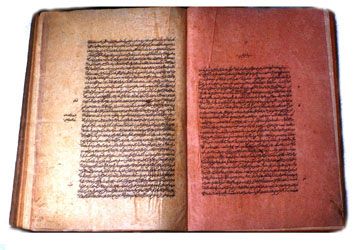
He had written a book called the The Mingling of the Two Oceans [PDF] showing the many similarities between the Quran and the Brahma Shastras. At the trial the imperial Qazi asked Dara to hand him the jade thumb ring that was still on his left hand. He is reported to have turned it over and asked why the green stone was inscribed with the words ‘Allah’ on one side and ‘Prabhu’ on the other.
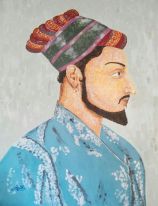 Dara evidently replied that the creator was known by many names and called God, Allah, Prabhu, Jehova, Ahura Mazda and many more names by devout people in many different lands. He added that it is written in the Quran that Allah had sent down 1,24,000 messengers to show all the people of the world the way of righteousness and he believed that these messengers had been sent not only to Muslims but to all the people of the world in every age. Aurangzeb casually signed the order of execution after the Qazis found Dara guilty of heresy.
Aurangzeb’s inflexible religious bigotry made him lose the support of his influential Shia subjects as well as his many Hindu and Rajput followers. By persecuting his own Rajput followers he cut off his arms and weakened his military power. The Maratha leader Shivaji initially had no anti-Muslim sentiment and had been quite willing to become a Mughal Amir. Aurangzeb’s obstinate pride however alienated him and gave him a weapon to turn a purely political war against the Mughals into a religious war.
If Dara had won at Samugarh his rule might have promoted harmony between India’s turbulent peoples. A united Mughal empire may have prevented India from becoming so easily colonised by European powers. Samugarh marked the beginning of Islamic bigotry that led over the centuries to the Partition of India, the creation of Pakistan and the backlash of radical Hinduism. Samugarh was a tipping point in India’s history. – The Times of India, 28 May 2016
» Murad Ali Baig subscribes to Sankhya philosophy and writes about Indian history and religion.

Filed under: india | Tagged: agra, aurangzeb, aurangzeb alamgir, dara shikoh, moghuls, religion, religious pluralism, sanskrit literature, universalism | 4 Comments »