









 Sydney Smith attacked the missionaries as not being gentlemen scholars of the clergy but rather “devout tinkers who set off for the East”. He castigates them for their intolerance of the religions they find there: “The missionaries complain of intolerance. A weasel might as well complain of intolerance when he is throttled for sucking eggs.” – Farrukh Dhondy
The Old Testament prophet Isaiah predicted that “navigation, especially that which is commercial, shall be one great means of carrying on the work of God.” Having lived a few thousand years before the East India Company began to trade and annex parts of India, he couldn’t have known, except through miraculous prophecy, that the 18th and 19th century evangelists of Britain would take their proselytising mission to the subcontinent.
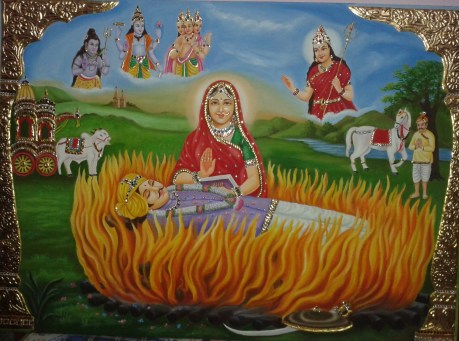
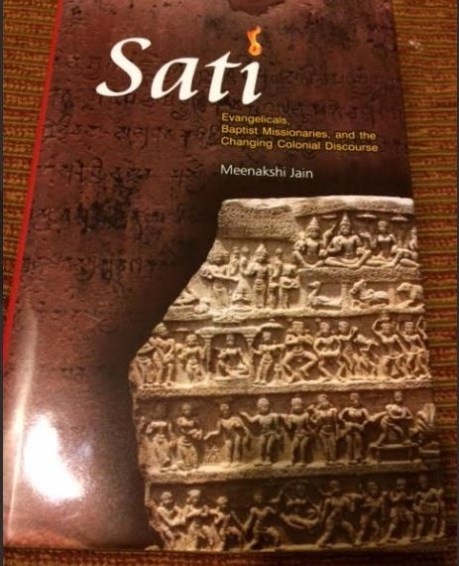
Meenakshi Jain’s enlightening historical account is, in the words of her introduction, “not a work on sati per se. It does not address in any depth, issues of the possible origins of the rite; its voluntary or mandatory nature; the role if any of priests or family members; or any other aspect associated with the actual practice of widow immolation.” The focus of the work is instead “the colonial debate on sati” and the role of Christian missionaries and their attempt to defeat the resolve of the merchants of the East India Company to refrain from interfering with the religious beliefs and practices of the native populations of what had become their imperial territories.
 Between 1801 and 1802, the Baptist missionary William Carey was commissioned by the Governor General Lord Wellesley to research and prepare a report on child sacrifice as a religious rite. In 1802 an ordinance against the practice was passed. It was the first regulation issued by the British rulers which directly forbade a “religious” practice. There was no rebellious reaction to it. Jain contends that this was probably because child sacrifice was rarely practised and the law was aimed, not at the protection of children, but at altering the opinion of the British public back home. Calling attention to what the missionaries labelled “barbaric practices” would further their cause of conversion.
Jain, throughout her account of this central ideological battle, quotes the Indologist and Orientalist current of opinion which went against the missionary attempt. The Sanskrit scholars H. H. Wilson and William Jones vociferously contended that child sacrifice and female infanticide were rare occurrences and had no religious sanction in Hinduism.
The argument between the missionaries and the orientalists continued and resulted in a partial defeat for the latter when the Charter Act of 1813 allowed missionaries to operate in India.
The abolition of sati in 1829 by Governor General Lord William Bentinck was among the final acts of interference in religious practices. Again the ordnance met with no resistance. “No sepoy shot at his colonel; nowhere were magistrates or missionaries mobbed, treasuries plundered or bungalows fired,” wrote William Carey.
The Hindu religion, if not the practice of sati, had very many defenders and indeed admirers. Jain quotes Colonel Stewart of Bengal who writes that Hindus invented immortality. Stewart is also quoted as saying that he admired the heroism of Hindu widows who immolated themselves while disapproving of the delusion that prompted them to it.
 Sydney Smith attacked the missionaries as not being gentlemen scholars of the clergy but rather ‘devout tinkers who set off for the East’. He castigates them for their intolerance of the religions they find there: “The missionaries complain of intolerance. A weasel might as well complain of intolerance when he is throttled for sucking eggs.”
The first half of Jain’s meticulous account is devoted to this intellectual battle, by and large confined to British opponents. Her account doesn’t confine itself to the battle over the rights and wrongs of sati or to the preponderance of the phenomenon but covers the clear, but in my judgement failed, attempt by a particular brand of missionary to convert India to Christianity and to denigrate the religion and practices of Hindus.
The latter half of the book reproduces accounts of sati and verbatim descriptions of reactions to its occurrence through the ages. The accounts substantiate Ms Jain’s arguments – and of course they would as she has chosen them! But they also tell a different story or perhaps several different stories and it’s a credit to Ms Jain’s historical objectivity to have included them.
In another historian’s hands a book about the contentious practice of widow burning could have produced something completely contrary. A Marxist account may have attributed the practice to the laws of property tracing its origin in the conventions of property and inheritance.
A psychological account may insist that “voluntary” sati is akin to the voluntary suicide-bombing with the bomber fervently believing that his act will guarantee an instant place in Islamic heaven with 72 virgins thrown in.
A consideration of why a trading enterprise turned to the Imperial tasks of converting the subject peoples would consider how industrial Britain was evolving from its feudal past. But these are not the focus of Ms Jain’s engaging and single-minded perspective, which illustrates in-depth the changes and conflicts of attitude that accompanied this evolution. – Vijayvaani, 26 June 2016
» Farrukh Dhondy is an author, playwright and columnist in London.
» Prof Meenakshi Jain is an author, political scientist and professor of history at Gargi College, Delhi.
Filed under: india | Tagged: christian propaganda, india, meenakshi jain, missionaries, propaganda, sati, self-immolation | Leave a comment »