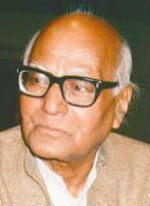










 “The difference of outlook between polytheism and monotheism boils down to being open and being closed. Because religions have a hold on people’s imaginations and their sense of right and wrong, religious outlooks define societies. Modern Hindus, instead of being apologetic about the polytheism inherent in their tradition, should seek to embrace it” – Vijayendra Mohanty
 Since religiosity of one manner or another pervades all societies, there has always been an ongoing intellectual discourse between cultures in the form of religious debate. Since a culture’s religious views often shape its approach towards the world, these debates practically decide how the world works by shaping the course of human civilisation.
When religions interact, they compare notes. They discuss differences in approach to common issues — god, the afterlife, morality. They assess the value of each other’s philosophies, spiritual values, and cultural perspectives. Ideally, these debates should serve to enhance the quality of man’s understanding of his place in the universe. But often enough — and this has been seen historically — there is an element of aggression in such debates. One of the tools that proselytising religions of the Judaeo-Christian tradition use in order to justify converting people to their faiths is arguments that set out to ‘prove’ that one religion is superior to another.
Because religion has always been a very real presence in India, its native traditions — particularly Hinduism — have been the subject of similar debates for a long time. The Hindu way has been assessed by parties with conversion as an agenda and more often than not, such assessment has sought to undermine the validity of Hindu traditions. The debate is obviously most welcome, since Hinduism makes space for a lot of different conflicting philosophies within its folds, but it is also true that many elements of this discourse are not exactly fair.
I want to point out a certain asymmetry in this discourse.
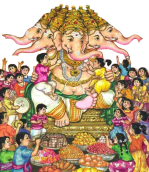
One question that gets asked often is why Hindus worship so many gods. The question is a valid one and an obvious one as well. It deserves a proper answer too. But that is not the point being made here.
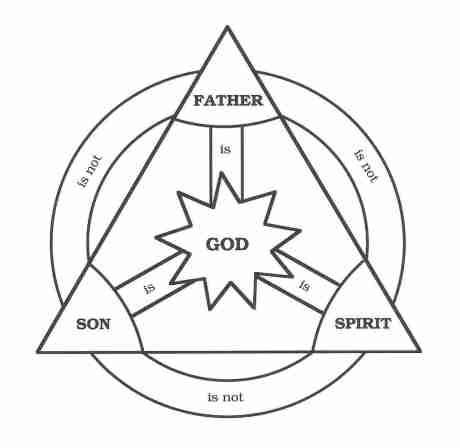 The point is the absence of the counter-question. Have you ever heard Hindus ask why Christians or Muslims worship only one god?
So deep and ingrained is the asymmetry in this discourse that the first time you look at it, the question looks downright funny. But it shouldn’t because this too is a perfectly valid question and deserves to be answered in all sincerity.
The monotheistic position is too often assumed to be the default standard against which all other traditions must be judged. Why must this be so?
This lack of response shows on many fronts. The Hindu is asked why he does not have a prophet or a messiah (why does he need one?). He is asked who will ‘save’ him (what’s there to be saved from?), why he worships images of stone (why shouldn’t he?). All these questions stem from the assumption that the monotheistic view of the world is a sort of universal reference point.
Given the lack of understanding even Hindus have of their own traditions, one finds them not questioning such questions. Instead, many seem eager to measure up to the standards that monotheism presents. This is perhaps why one keeps hearing woolly-headed agreement of the sort that responds to the question of polytheism with, “Oh no! God is ONE. Hindus also worship one god. Hindus are also monotheistic.” This apology might seem accurate when you take it at face value. But things reveal themselves to be trickier when you go deeper into the roots of monotheism as an ideology.
 Technically, monotheism simply means the acknowledgment of one god. But what it means in the case of modern monotheistic religions is acknowledgment of one god only. This particular variety of exclusivist religiosity is utterly alien to the Hindu view, since Hinduism thrives upon the infinite variety inherent in the world and sees each speck as divine. Monotheism — at least the variety that guides religions like Christianity and Islam — is exclusivist. It prohibits the worship of the divine in any form other than the ‘official’ version. It is rooted in the idea of ‘only one’.
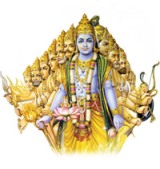
Once we get this distinction clear, it becomes clear that Hinduism does not worship ‘One God’. Instead, Hinduism worships the oneness of all gods and indeed, the oneness of everything in existence. Arguably, the only thing alien to Hinduism is exclusivist religiosity, since it goes against the grain of its pluralist approach to the divine.
The one-centric view of god turns religious discourse into an uncomfortable place. To quote George W Bush, you are either with us, or against us. Notions of good and evil turn the world into a black and white space. You are either in the camp of noble people who have been ‘saved’, or you are in the other camp — the one with devil-worshippers, heathens, kaffirs, and ‘lost’ souls. In such an intellectual atmosphere, things turn binary very quickly.
 The Western variety of atheism is a case in point. It seeks to replace the unforgiving religious value of one with an equally unforgiving value of zero. In order to counter the influence of the Abrahamic religions’ claim that god exists, these atheists take to asserting that there is no god — One versus Zero. This variety of atheism falls prey to the nature of the aforementioned intellectual atmosphere. The black and white nature of this discourse clouds out all options except one and zero, thereby making sure that the debate is fruitful for neither party.
At the end of the day, the difference of outlook between polytheism and monotheism boils down to being open and being closed. Because religions have a hold on people’s imaginations and their sense of right and wrong, religious outlooks define societies.
Modern Hindus, instead of being apologetic about the polytheism inherent in their tradition, should seek to embrace it. – The Pioneer, New Delhi, Oct. 5, 2011
» Vijayendra Mohanty is a comic book writer and co-creator of Ravanayan.
Filed under: india | Tagged: atheism, christianity, god, goddess, hinduism, islam, many gods, monotheism, one god, panentheism, pantheism, religion | 4 Comments »