














 “We Indians need to remember, as Bernard Cohn famously put it, that “The conquest of India was a conquest of knowledge”. No wonder, the cultural and historical memory of our own struggle against foreign domination is still fresh. What is not equally obvious is that the battle to regain India’s civilisational poise, equilibrium, and self-confidence is far from over. In matters of culture, education, and thought, we are still largely colonised and subservient. The Indian mentality, particularly that of the elites, remains a prisoner of Western categories.” – Prof Makarand Paranjape
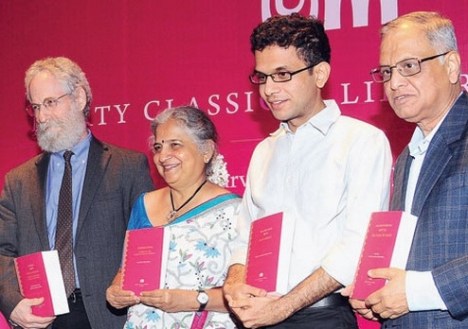
 I signed the petition for the removal of Sheldon Pollock as mentor and general editor of Murty Classical Library, first of all, because the project did not seem to score well on the commonsensical scale of home economics. Handing $5.6 million to elite US universities reverses the very logic that made Infosys rich. If brainpower, not to mention manpower, is at least five times cheaper in India, wouldn’t we get more bang for the buck here? The annual income from the bequest works out to a very substantial $2,80,000 per annum at the modest rate of 5 per cent returns. This is the equivalent of almost Rs 2 crore. If this is how much it costs to produce the reported five volumes per year, then the cost per volume is a whopping Rs 40 lakh. Until the details of the spends are known, we can’t verify the math, but it seems likely that we could have ensured greater cost-effectiveness in India.
The second reason is more ideological and anti-colonial. In the heyday of imperialism, the West’s study of the rest was not always benevolent nor impartial.
Instead, it was involved in the West’s agenda to conquer, subdue, exploit, and even exterminate several nations, societies, and cultures. We Indians need to remember, as Bernard Cohn famously put it, that “The conquest of India was a conquest of knowledge”. No wonder, the cultural and historical memory of our own struggle against foreign domination is still fresh. What is not equally obvious is that the battle to regain India’s civilisational poise, equilibrium, and self-confidence is far from over. In matters of culture, education, and thought, we are still largely colonised and subservient. The Indian mentality, particularly that of the elites, remains a prisoner of Western categories. Not just the clash, but the clasp of civilisations, is as much a struggle over epistemic categories and representations, as it is over economic and political interests.
Paradoxically, even as India has powered ahead in the latter spheres, its educational and cultural institutions have deteriorated. Regretfully, the politicisation of academics by caste, language and regional lobbies has eroded the credibility of our universities. The possibly related emigration and relocation of lakhs of gifted Indian intellectuals to Western countries has only exacerbated our sense of inferiority. Indian knowledge production, especially in humanities and social sciences, lacks global recognition. No wonder, Rohan Murty preferred the prestige and brand value of Columbia and Harvard for his Library. He is not the only one; many Indian business leaders have chosen similarly to endow foreign universities  rather than Indian ones.
In a recent article, Murty laments that we have allowed “our institutions, manuscripts, and scholarship … to fall into a state of disrepair. And this I am going to help rebuild.” How? By giving $5.6 mn to the likes of Pollock at Columbia and Harvard? How will they help rebuild Indian scholarly institutions and traditions? Murty could have been visionary and courageous, trying to set up an editorial collective in India itself, even if it were not housed at a conventional university. Such a move might have been a game-changer in Indian academics, perhaps inspiring copycat endowments, in addition to instituting best practises in Indian critical and cultural production.
To reverse the situation for argument’s sake, suppose a library of 500 best books of American culture, with an endowment from, say, Bill Gates, was handed over to Chinese scholars to produce, wouldn’t interested Americans protest? The analogy may not be entirely apt, but shows Murty’s lack of confidence in our own abilities to read, translate, and publish books of our culture. There could have been other models, more participatory and collaborative than the present, which I am not sure were fully explored.
Moving to the more controversial demand to sack Pollock, in his 1985 essay, “The Theory of Practice and the Practice of Theory in Indian Intellectual History,” the learned professor damns the entire shastric tradition, which he considers co-extensive with Sanskritic culture, as authoritarian.
The basis for such a sweeping indictment is a reductive misreading of the Vedas not only as fixed, transcendental signifiers and authorisers of chaturvarga, but as also responsible for the wholesale and systematic blocking of critical thinking through the entire course of Indian civilisation. Anyone with even a rudimentary understanding of India would balk at such an egregiously arrogant impeachment.
From such a perspective, pre-modern India becomes an object of modern rectification, if not rejection. We did nothing for thousands of years except oppress one another: Now “a great white man” must, messiah-like, take charge of our tradition to rescue us from our own oppressive legacies. Isn’t it obvious how such demonisation of Indian pasts serves to re-authorise neo-Orientalism, almost requiring an outsider from the dominant Western academy to help set us right? And doesn’t our history demonstrate that where scholars lead the charge against Indian culture, missionaries are only too ready to follow through?
Indeed, Pollock has increasingly identified himself with left-liberal, even Hinduphobic causes, signing various petitions, working to nix positions in Indic studies that diaspora philanthropists wished to endow in the United States, in addition to advising the government of India reportedly to end “its authoritarian menace” on Indian campuses. This smacks of politically motivated hegemonic practices, which are ideological rather than academic. Aren’t such attitudes bound to influence the content, translations, and outputs of the Murty Library? – The Indian Express, 21 March 2016
» Prof Makarand R. Paranjape is a poet and teacher of English at JNU, New Delhi.
Filed under: india, USA | Tagged: academics, hinduphobia, india, make in india, murty classical library of india, orientalism, political academics, psychological warfare, rohan narayana murty, sanskrit, sanskrit literature, sheldon pollock, USA, western academics | 2 Comments »







 BHARATA BHARATI