














 There is, in reality, no Hindu majority; it is a construct of the colonial powers, who never missed a chance to pit Hindus against Muslims. – Prof Michel Danino
In a previous article (The Great Secular Confusion, March 19), I challenged the secular definition of the Indian nation: there is, in fact, no such definition, nor are the nation’s institutions and Constitution genuinely secular, since they discriminate among the followers of different religions. At the core of the issue lies a binary that has been accepted as a political axiom, though occasionally challenged as we will see: that of majority vs. minority, inherited from the colonial era and enshrined in Articles 28 and 29 of our Constitution. On the face of it, minorities appear to be identifiable enough: no one doubts the existence of a Parsi or Jewish minority.
Christians claim to be a minority, too—but are they? Numerically, no doubt, but should that be the sole criterion? When I lived in the Nilgiris of Tamil Nadu in the 1980s and 1990s, the largest and most beautiful estates and bungalows belonged to Christian individuals or institutions; so did most of the hospitals and schools; my own town had over 40 churches, against three or four Hindu temples; foreign-funded Bible “colleges” kept mushrooming.
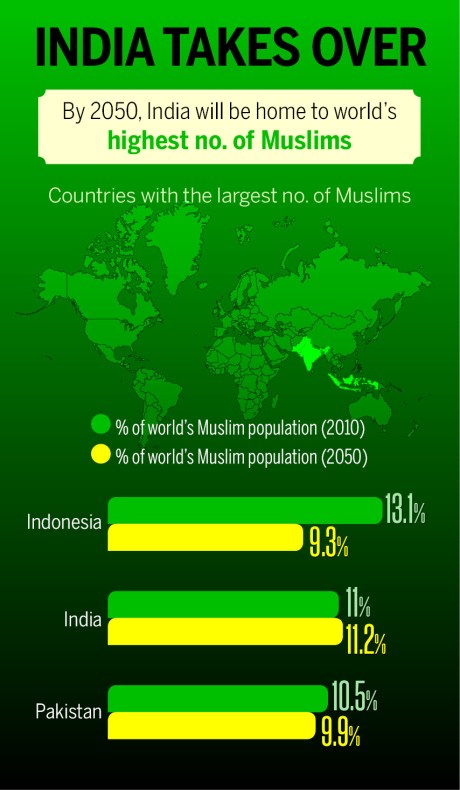
Whether such an economically and culturally dominant group qualifies as a “minority”, with the attached tag of vulnerability, is problematic (and proselytising Christian groups are known to play the vulnerability card to the full among their well-wishers abroad: no other fund-raising is required). Equally ambiguous is the concept of a Muslim “minority” of about 195 millions (extrapolating from the 2011 Census), nearly three times the population of UK.
But the concept of majority is even more problematic, as the word suggests a monolithic Hindu population, primarily identifying itself as Hindu. This is contrary to India’s ground situation, where an assumed Hinduness is just one strand of a complex identity, others strands being community, language and region; for some Hindus, caste matters more than religion; for others, it is their region; for yet others, language. Their identity is but the ever-changing interplay of those four strands. That explains why Hindus have never reacted en bloc to any issue; even the Ayodhya movement, which possibly saw the largest Hindu mobilisation in recent times, involved only a small fraction of Hindu Indians.
There is, in reality, no Hindu majority; it is a construct of the colonial powers, who never missed a chance to pit Hindus against Muslims. It is true, as Swami Vivekananda, Sri Aurobindo, Tagore and even Nehru pointed out (apart from most Western Indologists) that Indic schools of thought and belief gave Indian civilization a unique cultural stamp, but those never translated into political power centres. It is also true that the religious strand comes to the fore at critical junctures, especially at times of inter-religious conflicts, but this does not mean that “majorityism” rules India, as is often glibly and irresponsibly asserted.
If it did, why should groups claiming to defend Hindu causes, such as the Rashtriya Swayamsevak Sangh (RSS), continue to voice the same demands decade after decade, with no sign of their ever being granted? Intriguingly, some of those demands have been impeccably secular in their spirit: abrogation of special Constitutional rights to minorities, of Article 370, implementation (as suggested by the Supreme Court on several occasions) of a Common Civil Code. One may add, if we are serious about building a truly secular nation, that there should be no room for a National Commission for Minorities or a Ministry of Minority Affairs with its special “schemes for welfare of minorities.”
The RSS is not isolated in making such demands. In his presidential address to the 53rd session of the Indian National Congress at Ramgarh in 1940, Abul Kalam Azad asked, “Can anyone who has any conception of the actual working of a democratic constitution, allow himself to be led astray by this false issue of majority and minority?” Eight years later, the Constituent Assembly initiated a long and vigorous debate on special rights for minorities. Tajamul Hussain, a Muslim member from Bihar, felt compelled to intervene: “I want to tell the House, Sir, that there is no minority in this country. I do not consider myself a minority.
In a secular state, there is no such thing as minority. I have got the same rights, status and obligations as anybody else. I wish those who consider themselves as the majority community would forget that there is any minority today in this country.” Damodar Swarup Seth, a member from United Provinces, concurred, “I feel, Sir, that in a secular state minorities based on religion or community should not be recognised. If they are given recognition then I submit that we cannot claim that ours is a secular state. Recognition of minorities based on religion or community is the very negation of secularism.” H. C. Mookherjee, a member from West Bengal, asked, “Are we really honest when we say that we are seeking to establish a secular state? … If your idea is to have a secular state it follows inevitably that we cannot afford to recognise minorities based upon religion.”
Finally, on 25 May 1949, Sardar Vallabhbhai Patel, to the applause of the Assembly, concluded, “In the long run, it would be in the interest of all to forget that there is anything like majority or minority in this country and [to accept] that in India there is only one community.” Perhaps the tragedy of post- Independence India is that such sane voices—both Muslim and Hindu—were ignored, although they spoke for true secularism, and have since been sidelined by our self-styled “secular”, “liberal” statesmen and intellectuals. I will examine in later articles some of the perverse consequences of this choice. – The New Indian Express, 2 April 2018
» Michel Danino is an author, guest professor at IIT Gandhinagar and a member of the Indian Council of Historical Research.
Filed under: india | Tagged: constitution of india, india, indian constitution, majoritarianism, majority-minority, majority-minority dichotomy | 1 Comment »











