











 “Contrary to recent mythology, JNU wasn’t ever the bastion of free, open and convivial debate. There was a pre-determined view of what was acceptable and what was beyond the pale. In political terms, openness meant a dialogue that involved all the 57 varieties of Marxism … and the new fangled ‘alternative’ currents emerging from Left orphanages. In recent years, and partly as a response to bleeding hearts in Western universities, even Islamism has been accommodated under the radical roof. What has been consistently shown the door are India’s indigenous conservative traditions and their contemporary expressions.” – Swapan Dasgupta
 During the course of the acrimonious exchanges over a series of incidents that originated in Delhi’s Jawaharlal Nehru University, some commentators alluded to a controversial motion—“This House would not in any circumstances fight for King and Country”—that was passed by the Oxford Union in 1933. The argument was that universities are natural centres of heretical and unconventional views and that the authorities should not overreact.
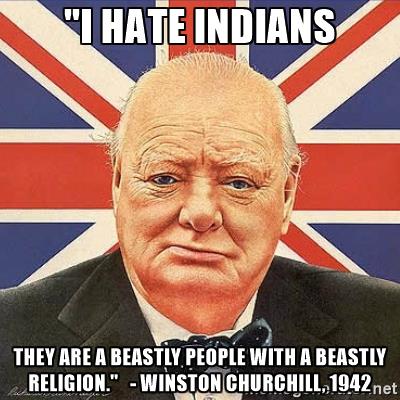
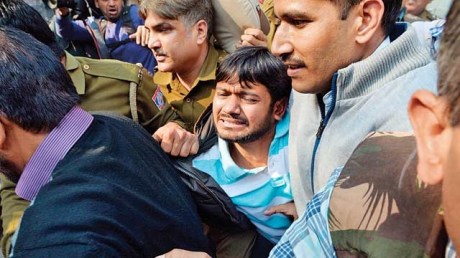
Whether or not the Union home ministry and Delhi police were guilty of astonishing stupidity by charging an excitable student politician with sedition for hobnobbing and sharing a platform with separatists is an issue that will prompt different responses. In 1933, for example, Winston Churchill described the Oxford students who voted for the grandstanding motion as “abject, squalid, shameless and nauseating”—sentiments that many who don’t possess the same measure of erudition would echo in the case of the JNU radicals. Indeed, the reaction of British society to the Oxford poseurs was unwaveringly hostile and evidence of universities harbouring spoilt brats. Likewise, there is little doubt that had the provocative slogans championing the breakup of India been chanted in public—and not within the safe haven of the campus or, indeed, the Delhi Press Club—the street reaction would not have been couched in niceties.
Echoes of a similar town-gown divide appear to be quite evident in the furore over the sedition charges levelled against a student—not that this excuses the disgraceful behaviour of some lawyers in Delhi’s Patiala House court. But what has complicated the situation is that the political opponents of the Narendra Modi government ranging from the Congress to the Maoists have joined hands to scream fascism. The assault on the government has been complemented by the international rent-a-cause brigade that has become accustomed to circulating pious petitions on issues that range from who Indians should not vote for to the state of higher education in India.
 Part of the problem stems from the caricatured views the Indian Right and Left-Liberals have of each other, a process the civil war of journalists has added to.
In the normal course, universities should have been a forum for informed and intelligent conversations. Even if a dialogue didn’t narrow the political divide, it would have prevented demonology and the near-complete absence of social interaction and the ostracism of those who violate a consensus—Arnab Goswami is the most recent target.
To blame this ghettoisation on the Modi regime is being disingenuous. Contrary to recent mythology, JNU wasn’t ever the bastion of free, open and convivial debate. There was a pre-determined view of what was acceptable and what was beyond the pale. In political terms, openness meant a dialogue that involved all the 57 varieties of Marxism, Nehruvian and Lohiaite thought and, the new fangled ‘alternative’ currents emerging from Left orphanages. In recent years, and partly as a response to bleeding hearts in Western universities, even Islamism has been accommodated under the radical roof. What has been consistently shown the door are India’s indigenous conservative traditions and their contemporary expressions.
This exclusionary process was confirmed in a recent article upholding the ‘idea’ of JNU by an alumnus, Professor Peter DeSouza: “the liberal persuasion was not allowed the space it should have been given by the Stalinist Left. The political spectrum was wide but could have been wider. Analytical thinking was feeble and ideological camps gave protection to the less capable.” JNU reproduced itself ideologically over decades, a reason why its intellectual establishment initially thought there was nothing odd about students being associated with divisive slogans. The ‘sedition’ overkill provided an escape route from troubling questions centred on JNU’s relationship with nationhood.
 The ideological bubble that sustained JNU was shaken by the post-2014 political change. The exclusion of its stalwarts from the new establishment has bred insecurity and added to its determination to paint the ‘outlanders’ as cretinous, semi-educated and aesthetically suspect. This phenomenon was also in evidence last week in the post-modernist ghettos of Jadavpur University.
The ‘sedition’ stir will pass but the partition pangs of Indian academia will have to be addressed. The question of whether India is merely a geographical mass or is also blessed with sacredness will be a basis of a wider polarization.- The Times of India, 21 February 2016
Filed under: india | Tagged: anti-national, free speech, india, indian scholars, indian universities, islamism, JNU, left vs right, marxism, sedition | 1 Comment »