














 “Often situated on the margins of high Hinduism, Kali remains much sought after by those in distress. Her petitioners include women and men in all walks of life, throughout the Hindu world, be it in Bangladesh, India, Nepal, Singapore, Sri Lanka or elsewhere.” – Romesh Jayaratnam
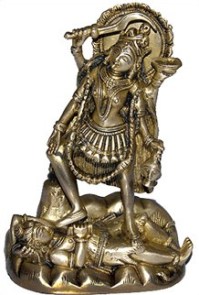 If one were to look at the map of Sri Lanka, one would see shrines dedicated to the Goddess Kali in all four directions. The veneration of the deity goes back more than a thousand years in the island’s history.
The famed British archeologist of the late 1800s CE, H.C.P. Bell, had excavated 16 small Hindu shrines between the Jetavanaramaya and Vijayaramaya Buddhist monastic institutions in the northern enclave of Anuradhapura. He termed these the ‘Tamil ruins’. One was dedicated to the Goddess Kali. These shrines could be tentatively dated to the 9th century CE. Hindu iconography, that included a statue of Bhadrakali, was unearthed. The temples of modest proportions were built of brick in the Pallava style of architecture. There were two Tamil language inscriptions which recorded a mercantile guild that had borrowed money from a Tamil trader to light a perpetual lamp.
In nearby Polonnaruwa, on the west of the road leading from the Thuparama to the Rankot Vihara, four Hindu shrines were excavated, one of which appears to be a Kali temple. These two sites were in Sri Lanka’s North Central Province.
In the deep South of the island, one witnesses a cluster of Hindu shrines of unknown antiquity in Kataragama/Kathirkaamam next to an age-old Buddhist temple. King Rajasinghe 1 of the 16th century had patronized the Hindu shrines, one of which was a Kali temple behind the more famous main shrine dedicated to the God Skanda.
On Sri Lanka’s West coast, one likewise observes the presence of a noteworthy Siva Temple of some antiquity known as Munneswaram, next to which is a much sought after Kali temple. Parakrama Bahu VI had patronized this Siva Temple in the 1400s CE. The Portuguese had destroyed the Munneswaram complex in 1600 CE and transferred the temple lands to the Jesuits. However, King Kirti Sri Rajasinghe rebuilt the temple complex around 1753 CE. While the Siva temple belongs to the realm of high Hinduism and is patronized by the old landed Tamil establishment, the Kali temple is frequented by the upwardly mobile and entrepreneurial mercantile and artisan castes of more recent antecedents.
An earlier Kali temple in Bentota in the South West of the island was consecrated by King Parakrama Bahu II in the 1200s CE. This too was destroyed by the Portuguese in the 16th century.
Sri Lanka’s East Cost had the famed Siva temple in Trincomalee or Tiru-koneswaram that perhaps dated back to the 4th century, if Sanskrit literary evidence is to be accepted. A kilometer or two away lies an equally sought-after Kali temple that adjoins the Trincomalee Hindu College. This is known as Nagara Kali or the guardian deity of the town. Legend, albeit unsupported by inscriptional evidence, traces the origins of the latter temple to the Chola era in Sri Lanka.
Sri Lanka’s far North had the Vira Ma Kali Amman temple on Point Pedro Road in Nallur. This was reportedly constructed either by Magha of Kalinga between 1215 and 1240 CE or by Pararajasekeram between 1471 and 1518. The Vira Ma Kali Amman Temple was the location of an early battle between King Sangili and the Portuguese, one that the Portuguese initially lost. The Portuguese subsequently captured Jaffna and destroyed the temple in 1621, a place of worship which was rebuilt in the 1800s.
 Faith
Faith
So what accounts for the pervasive popularity of the Goddess in Sri Lanka since early medieval times? The Goddess is referred to in the Sri Lalita Sahasranama, chanted to this day in several of the island’s Kali temples, as Sri Maharajni, the Great Empress, as Kama-dayani, one who grants all prayers, as Bhaya-paha, who dispels all fear, as Dukkha-hantri, who puts an end to all sorrow, as Dharma-adharma vivarjita, who transcends both good and evil, as Anadhi-nidhana, who exists without a beginning or an end, and as Vijaya who is ever-victorious.
Kali grants us protection while we are in danger and shows us a way out when we are trapped in a quagmire. Often situated on the margins of high Hinduism, she remains much sought after by those in distress. Her petitioners include women and men in all walks of life, throughout the Hindu world, be it in Bangladesh, India, Nepal, Singapore, Sri Lanka or elsewhere. Kali negates conventional day-to-day morality and responds to the instinctive pleas of the dispossessed, the sidelined and victims of injustice. She is the solace for those who have no option where all else has failed. In short, she is the last resort for a person in need of a respite during the harsh trials and tribulations of life.
Kali did not derive Her power or authority from any male consort. Her iconography and religious practice refused to concede male conceptions of propriety, hierarchy and restraint. Her strength lay in a directness of approach, not to mention an immediacy of succor provided to the defeated.
The Sadharma Ratnavaliya, a 13th century Sinhalese translation of the Dhammapada Attakatha with popular stories conveyed to illustrate a Buddhist moral, in turn recasts the fierce Goddess Kali to embody Buddhist concepts of redemption. This illustrates that Dharmasena Thera, the medieval Sri Lankan monk-author of the poem was familiar with the veneration of the Goddess in the Sinhalese heartland and sought to transform her into a guardian deity guided by Buddhist principles.
May Sri Kali continue to direct and guide the residents of this fair isle as they navigate life’s manifold and often treacherous currents. – Sri Lanka Guardian, Kandy, Dec. 4 , 2011
Filed under: india | Tagged: archaeology, art, goddess, hindu, hinduism, kali, religion, sri lanka | Leave a comment »











