










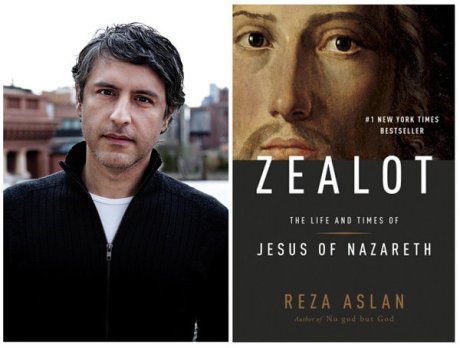
 Dr. Reza Aslan is an Iranian-American writer and scholar of religions. He is an Associate Professor of Creative Writing at the University of California, Riverside, a Research Associate at the University of Southern California Center on Public Diplomacy, and a contributing editor for The Daily Beast. His books include the international bestseller No god but God: The Origins, Evolution, and Future of Islam, which has been translated into 13 languages, and Zealot: The Life and Times of Jesus of Nazareth, which offers an interpretation of the life and mission of the historical Jesus.
On 26 July 2013, Aslan was interviewed on … a Fox News webcast by anchor Lauren Green about his book Zealot: The Life and Times of Jesus of Nazareth. Green was “unsatisfied with Aslan’s credentials,” and she pressed Aslan with a “but-why-would-a-Muslim-write-about-Jesus line of questioning.” The interview lasted about ten minutes and focused “on Aslan’s background more than the actual contents of the book.”
In the end, Green claimed that “Aslan had somehow misled readers by not disclosing his religion”, whereupon he pointed out that his personal religious faith “is discussed on page two of his book.”
The video clip of the interview went viral within days and the book, which was up to that point selling “steadily”, appeared at the 4th place on the New York Times print hardcover best-seller list. By late July 2013, it was topping the U.S. best-seller list of Amazon. – Wikipedia, 6 August 2013
 What Reza Aslan actually says about Jesus – Stephen Prothero
As you might have heard, Lauren Green at Fox didn’t do a very good job interviewing Reza Aslan on his new book about the historical Jesus.
Instead of asking him about “Zealot,” she asked him why, as a Muslim, he would presume to write a book about Jesus. He responded by citing (and re-citing) his academic credentials.
The interview went viral, and Aslan went to No. 1 on Amazon.com (ahead of J. K. Rowling).
But what does the book actually say? Here are seven of Aslan’s key arguments in “Zealot”:
1. Jesus was a violent revolutionary
Many scholars have argued that Jesus was a political figure. After all, he was crucified by Rome, and crucifixion was at the time a punishment for political offenses. But these scholars often claim, as John Dominic Crossan did in “Jesus: A Revolutionary Biography,” that Jesus was a nonviolent revolutionary.
Aslan portrays Jesus as a man of war who worshiped the “blood-spattered God of Abraham, and Moses, and Jacob, and Joshua” and who knew full well that “God’s sovereignty could not be established except through force.”
2. Jesus’ kingdom was worldly
In the Gospel of John, Jesus famously says, “My kingdom is not of this world” (John 18:36). Aslan begs to differ. Jesus’ kingdom was neither purely nor predominantly spiritual. He preached “a physical and present kingdom: a real kingdom, with an actual king that was about to be established on earth.”
3. Jesus revolted against Roman and Jewish authorities
Jesus didn’t just take on Rome. He took on Jewish authorities, in particular those who ran the Jerusalem Temple.
“There can be no doubt,” writes Aslan, “that Jesus’s main antagonist in the gospels is neither the distant emperor in Rome nor his heathen officials in Judea. It is the high priest Caiaphas, who will become the main instigator of the plot to execute Jesus precisely because of the threat he posed to the Temple’s authority.”
4. Palm Sunday is the key moment in the Jesus story
Every Jesus biographer has a key moment in the life of Jesus when his essence is revealed. For Aslan, that moment comes when Jesus mounts a donkey and rides into Jerusalem.
In this celebration, commemorated in the Christian world every year on Palm Sunday, Jesus is not demonstrating his humility. Instead, he is announcing his kingship.
The “unmistakeable” message of this scene, according to Aslan, is that “the long-awaited messiah — the true King of the Jews — has come to free Israel from its bondage.”
5. The early church turned Jesus into a pacifist preaching a spiritual kingdom
In 66-73 CE, a bloody Jewish revolt against Rome left Jerusalem in ruins and chastened the early Christians, who reinvented Jesus as an apolitical figure in order to make nice with Rome.
Those who wrote of Jesus in this way (Paul included) never met the man, and, in Aslan’s view, they badly mischaracterized him, turning “their messiah from a fierce Jewish nationalist into a pacifistic preacher of good works whose kingdom was not of this world.”
6. The idea that Jesus was God also originated with the early church
As a Jew, Aslan observes, Jesus would have rebelled against any notion that God is incarnated in human flesh.
Therefore, the elevation of Jesus to divinity must have come after his crucifixion, at the hands of Greek-speaking Jewish Christians who “transformed Jesus from a revolutionary zealot to a Romanized demigod.” *
* [Jesus was raised from the position of mortal prophet to that of immortal God by an ecclesiastical vote of 218 for, 2 against diefication at the Council of Nicea called by Emperor Constantine in 325 CE. The bishops who said nay were from Libya and were soon assassinated. Constantine then sanctioned the confiscation and destruction of all works that challenged “orthodox” Christian teaching. Five years later he commissioned and financed new editions of the Bible, and as there were no longer any original documents to work from—Emperor Diocletian had destroyed most Christian writings in 303 CE—the bishops, intent on promoting the Pauline salvation cult in their own interest, were free to revise, edit, and rewrite the Bible in accordance with their own tenets. — IS]
7. The Bible isn’t to be believed (as history)
In “Zealot,” Aslan repeatedly refers to passages in the New Testament as “preposterous,” “fanciful,” “obviously contrived,” “riddled with the most basic errors,” “simply ridiculous,” and “absurd to the point of comedy.”
Here the Bible is a source for data about Jesus’s life, but that data must be carefully sifted through a scholarly lens, and in particular through the socioeconomic realities of life in the ancient Mediterranean at the time of Jesus.
At least as Aslan sees it, Jesus probably didn’t tell his followers to turn the other cheek. He probably did say, “Do not think that I have come to bring peace on earth. I have not come to bring peace, but the sword” (Matthew 10:34). – CNN Belief Blog, 31 July 2013

Jesus driving the merchants and money changers from the Temple in Jerusalem: According to Dr. Aslan, this event in the life of Jesus the Zealot reveals his true nature as a violent revolutionary.
Filed under: india | Tagged: bible, gospel stories, history, jesus, jewish law, new testament, palestine, psychological warfare, religion, revolutionaries, reza aslan, scholarship, theology, west asia | middle east, zealot | 2 Comments »