













 “No one disputes that human life is precious and the right to life is the most fundamental of rights. But no right can be treated as absolute. When terrorists, serial murderers or rapists kill without any compunction for the sanctity of life of their victims, they have themselves rejected the principle of sanctity of life. The fundamentality of the right to life only means that restrictions imposed on its enjoyment must be rigorous, foolproof and not amenable to subjective readings. The greater good of the society is more important than the life of one individual.” – Yogesh Vajpeyi
 The execution of the Mumbai blasts convict Yakub Memon has once again renewed the age-old debate on the constitutionality and morality of the death penalty. While no one can find fault with Yakub and his family for trying their best till the last minute to save him from the noose, the emergence of some self-appointed human rights and civil society activists, who tried to hijack the issue, gave the debate a bizarre twist. Now that Yakub is buried, it is perhaps the best time to discuss the issue dispassionately.
The roots of the current campaign for abolition of capital punishment can be traced to the writings of European theorists Montesquieu, Voltaire and Bentham. However, it was Italian jurist Cesare Beccaria’s 1767 essay, On Crimes and Punishment, that seriously raised the issue as a legal and moral one in administration of the criminal justice system. He theorised that there was no justification for the state’s taking of a life.
In the past, capital punishment has been practised by most societies as a punishment for criminals, and political or religious dissidents. Today, 36 countries actively practise capital punishment, 103 countries including the United Kingdom have completely abolished it de jure for all crimes, six have abolished it for ordinary crimes while maintaining it for special circumstances such as war crimes, and 50 have not used it for at least ten years under a moratorium.
The United Nations General Assembly has adopted non-binding resolutions in 2007, 2008, 2010, 2012 and 2014 calling for a global moratorium on executions with a view to eventual abolition.
Although many nations have abolished capital punishment, four of the largest—China, the US, India and Indonesia—accounting for over 60 per cent of the world’s population practise it. Each of them has consistently voted against the General Assembly resolutions.
The constitutional challenges to the death penalty have been rejected by the Supreme Courts of both the US and India. But the US Supreme Court has stipulated a slew of procedural safeguards based on the Eighth Amendment’s ban on cruel and unusual punishment. Similarly, the Indian Supreme Court has issued a set of guidelines that must be applied in the ‘rarest of rare’ case, when the option of awarding the sentence of life imprisonment is ‘unquestionably foreclosed’.
 The arguments in favour of the abolition of capital punishment appear appealing at first glance. First, in a civilised society, the state should not be party to taking precious human life. Second, sentencing someone to death when facts may later prove him or her innocent means irreparable injustice will be done. Third, death is never a deterrent. And, a fourth, that retribution should never be the aim of capital punishment. It is primitive and barbaric to seek death even for the worst crimes.
None of these arguments can be rejected summarily. But none of them are as strong as they appear. No one disputes that human life is precious and the right to life is the most fundamental of rights. But no right can be treated as absolute. When terrorists, serial murderers or rapists kill without any compunction for the sanctity of life of their victims, they have themselves rejected the principle of sanctity of life. The fundamentality of the right to life only means that restrictions imposed on its enjoyment must be rigorous, foolproof and not amenable to subjective readings.
The greater good of the society is more important than the life of one individual.
The abolitionists refer to the possibility of arbitrary and unreliable application of capital punishment to justify their case. There may be some substance in these arguments, as no system of justice can produce results which are 100 per cent certain all the time. The inevitability of a mistake, however, cannot be a ground to abolish the death penalty any more than the risk of having a fatal wreck should make automobiles illegal.
In the last analysis, the question of crime and punishment has to be decided by a nation in accordance with the perceptions of the threats to national security and public tranquillity. In the current global scenario, when threats from non-state actors working as terror groups of various hues are increasing, the debate has acquired a new salience in the face of the fact that the latter observe no human rights when attacking the state and its innocent citizens.
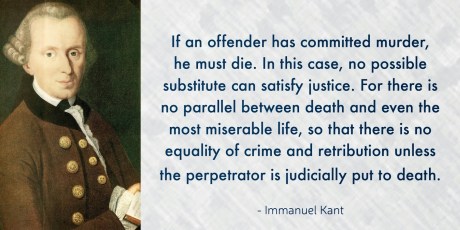
The rationale for capital punishment is not in its deterrent efficacy. To the contrary, there is appreciable consensus among jurists that evidence of deterrence is far too inconclusive to justify the death penalty. They argue that retribution is sufficient justification for legal execution. The abolitionists are wrong when they equate retribution with revenge. As eminent jurist Ernest van den Haag said, “Retribution is to restore an objective order rather than to satisfy a subjective craving for revenge.” – The New Indian Express, 22 August 2015
» Yogesh Vajpeyi is a freelance journalist. Contact him at yogesh.vajpeyi@gmail.com
Filed under: india | Tagged: capital punishment, hanging, indian courts, indian government, indian judicial system, indian state, indian supreme court, state executions | Leave a comment »