










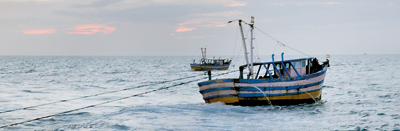
 “The genesis of the problem can be traced to late 1960s when the government of India encouraged the use of trawlers in the Palk Bay to promote exports and earn foreign exchange. Export of prawns definitely went up, but it was an illustration of penny wise, pound foolish. The trawlers played havoc with marine ecology. It swept away everything from the seabed. As a result, there is no fish in the Indian side of the Palk Bay.” – Prof V. Suryanarayan
 In an interview to Tamil TV channel Thanthi TV, Sri Lankan prime minister Ranil Wickremesinghe, in a startling statement, remarked that if Tamil Nadu fishermen persisted in intruding into Sri Lankan waters, they “may be shot”. The threatening tone has sent shock waves among fishermen living in the Indian side of the Palk Bay. The timing was significant. It was made on the eve of foreign minister Sushma Swaraj’s visit, to be followed immediately by prime minister Narendra Modi.
Poaching by fishermen in another country’s waters is a civilian economic offence. Article 145 of the UN Law of the Sea stipulates: “Measures will be taken to ensure effective protection of human life.” Article 73 mentions that a coastal state “can take measures including boarding, inspection, arrest and judicial proceedings to ensure compliance with the laws and regulations.” Shooting and killing of fishermen violates all canons of natural justice. Fishermen from neighbouring countries, including Sri Lanka, regularly poach into Indian waters, but there had been no occasion when the Indian Coast Guard had resorted to shooting them.
Wikremesinghe is aware of the UN Law of the Sea provisions. Then, why did he hold out the threat of “shooting”? He obviously is practising “brinkmanship” to highlight the seriousness of the problem and impress upon New Delhi the necessity to find an immediate solution. The fishermen issue has figured in bilateral discussions for several years, but has eluded a viable solution. The complicating factor had been the attitude of the government of Tamil Nadu. Instead of restraining fishermen from entering Sri Lankan waters, Chennai had been raising the issue of ownership of Kachchatheevu and traditional fishing rights of Indian fishermen. What is not realised is the fact that Indian fishermen go far beyond Kachchatheevu and fish near the Sri Lankan coast.
A ray of hope was provided in July 2003. In July 2003 during the foreign secretary-level meeting the government of Sri Lanka, for the first time, agreed to consider proposals for licensed fishing by Indian fishermen in Sri Lankan waters. The offer was based on an earlier precedent. In the 1976 maritime boundary agreement, India agreed to permit licensed Sri Lankan fishermen to fish in , near Kanyakumari, for a period of three years. The government of Tamil Nadu should have availed of this opportunity to persuade New Delhi to make reasonable proposals. It is unfortunate that no follow-up measures were taken either by New Delhi or by Chennai.
 There is a symbiotic relationship between fishermen and the sea. Just as fish respects no maritime boundaries, fishermen also move wherever there is fish. As far as 1974 and 1976 maritime boundary agreements are concerned, these were signed by two governments without taking into consideration ground reality. Two aspects of the problem should be taken into consideration. First, the livelihood of fishermen of both countries; second a solution from below, involving fishermen of both countries, has a better chance of success than one imposed by Colombo and New Delhi.
Can India and Sri Lanka work out a permanent arrangement which safeguards the livelihood of fisher folk of both countries, promote and enrich marine ecology and pave the way for harmonious relations? If the present crisis is to be converted into an opportunity it is necessary that we think in terms of out of the box solutions.
The genesis of the problem can be traced to late 1960s when the government of India encouraged the use of trawlers in the Palk Bay to promote exports and earn foreign exchange. Export of prawns definitely went up, but it was an illustration of penny wise, pound foolish. The trawlers played havoc with marine ecology. It swept away everything from the seabed. As a result, there is no fish in the Indian side of the Palk Bay.
Ethnic conflict in Sri Lanka was godsend for Tamil Nadu fishermen. In order to safeguard Sri Lankan security, Colombo banned fishing in the Palk Bay. The fishing villages in Northern Province were targets of savage attack. Lankan fishermen began to pour into Tamil Nadu as refugees. The void was filled by Tamil Nadu fishermen who began to fish in Lankan waters. Sri Lanka’s Navy could not distinguish between a fisherman and a Tiger and they resorted to indiscriminate shooting, resulting in the killing many Indian fishermen. Naturally, there was indignation in Tamil Nadu and the Centre-state relations were subjected to severe stresses and strains.
The Sri Lankan Tamil fishermen are the worst victims. They suffered a lot during the war years; what is worse, when they resumed fishing after the war, they realised the presence of Indian trawlers to be a major hindrance to their livelihood. It is necessary to highlight the fact that use of trawlers is banned in Sri Lanka. The fishermen in the Delft Island told this author that on three days when Indian fishermen enter into Sri Lankan waters they do not venture into the sea, because Indian trawlers will cut their nets. They also expressed the fear that if indiscriminate trawling continues there will be no fish in the Sri Lankan side also.
 The ball is in New Delhi’s court. Fortunately, Pon Radhakrishnan, the minister from Tamil Nadu, is committed to find a just solution and is fully conscious of all complexities. First and foremost, an immediate decision should be taken to withdraw trawlers from the Palk Bay in a phased manner. Second, New Delhi and Chennai should promote deep sea fishing and fishermen should be encouraged to switch over to the new vocation. While fishermen have deep attachment to the sea, they are not so much attached to land. In fact, a majority of fishermen in Rameshwaram have migrated from villages in the Gulf of Mannar. According to fisheries experts, the trawlers, after some modifications, can be used as feeder boats to the mother ship in the deep-sea.
With the trawlers out of the scene, the Palk Bay will become tranquil. The dialogue among fishermen should begin immediately. A Palk Bay Authority, consisting of government representatives, fisheries experts and marine ecologists, should be constituted to determine the ideal sustainable catch, number of days fishing can be undertaken, fishing equipment that can be used and joint efforts to enrich the sea. From being a contested territory, the Palk Bay could be converted into a common heritage. Let us remind ourselves that Palk Bay throughout history was a bridge, not a barrier, between two countries. – The New Indian Express, 14 March 2015
» V. Suryanarayan is Nelson Mandela Professor for Afro-Asian Studies, Mahatma Gandhi University, Kottayam. His email id is suryageeth@sify.com


Filed under: india, sri lanka | Tagged: bottom trawlers, diplomacy, fishing, fishing rights, india, india-srilanka relations, indian fishermen, kachchatheevu, sri lanka, tamil nadu | 1 Comment »