














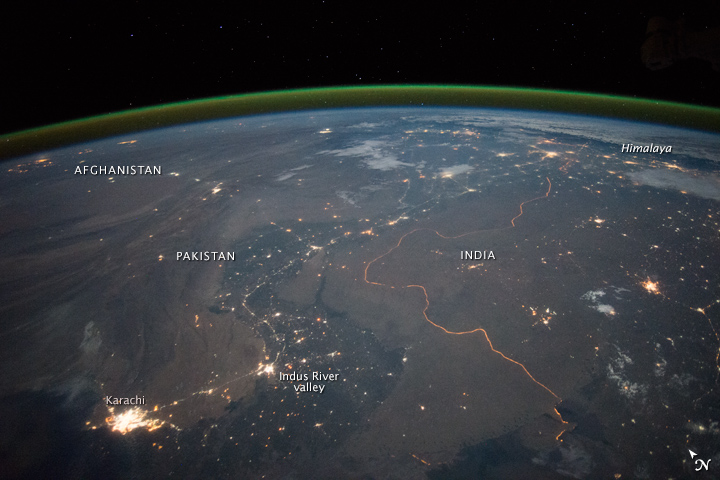
 An astronaut aboard the International Space Station took this nighttime panorama while looking north across Pakistan’s Indus River valley. The port city of Karachi is the bright cluster of lights facing the Arabian Sea, which appears completely black. City lights and the dark color of dense agriculture closely track with the great curves of the Indus valley. For scale, the distance from Karachi to the foothills of the Himalaya Mountains is 1,160 kilometers (720 miles). This photograph shows one of the few places on Earth where an international boundary can be seen at night. The winding border between Pakistan and India is lit by security lights that have a distinct orange tone. Another night image (next below) shows the border zone looking southeast from the Himalaya. A daylight view would show the vegetated bends of the Indus Valley winding through the otherwise desert country. More than two millennia ago, Alexander the Great entered the Indus plains in 327 BCE from the northwest. He then spent many months leading his army and navy down the length of the Indus valley shown in this view. From near Karachi, he then began the desert march back to Mesopotamia (modern Iraq). By contrast, it takes the space station just three minutes to travel this distance.
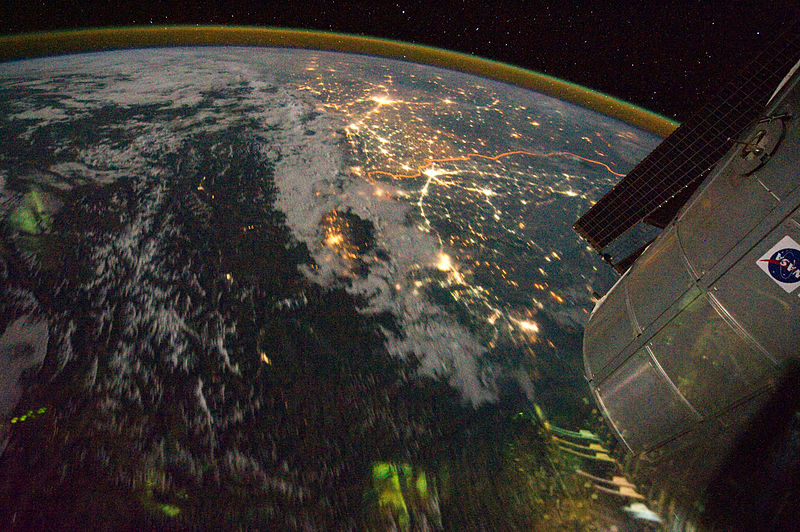
Clusters of yellow lights on the Indo-Gangetic Plain reveal numerous cities large and small in this astronaut photograph of northern India and northern Pakistan.
Of the hundreds of clusters, the largest are the capital cities of Islamabad, Pakistan, and New Delhi, India. (For scale, these metropolitan areas are approximately 700 kilometres apart.) The lines of major highways connecting the cities also stand out. More subtle, but still visible at night, are the general outlines of the towering and partly cloud-covered Himalayas to the north (image left).
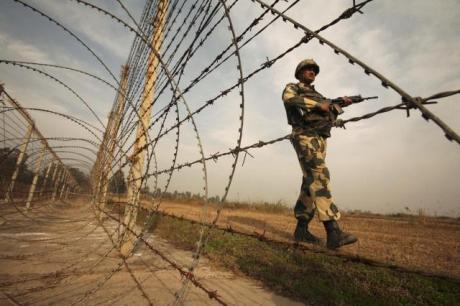
A striking feature is the line of lights, with a distinctly orange hue, snaking across the centre of the image. It appears to be more continuous and brighter than most highways in the view. This is the fenced and floodlit border zone between India and Pakistan. The fence is designed to discourage smuggling and arms trafficking. A similar fenced zone separates India’s eastern border from Bangladesh (not visible).
This image was taken with a 16 mm lens, which provides the wide field of view, as the International Space Station (ISS) was tracking towards the south-east across India. The ISS crew took the image as part of a continuous series of frames, each with a one-second exposure time to maximize light collection. Unfortunately, this also causes blurring of some ground features.
The distinct, bright zone above the horizon (visible at image top) is air-glow, a phenomena caused by excitation of atoms and molecules high in the atmosphere (above 80 kilometres) by ultraviolet radiation from the Sun. Part of the ISS Permanent Multipurpose Module and a solar panel array are visible at image right. – Extracted from Wikipedia, 7 October 2015
Here are some details about the five crossing points between India and Pakistan along the 2,900-kilometre long border.
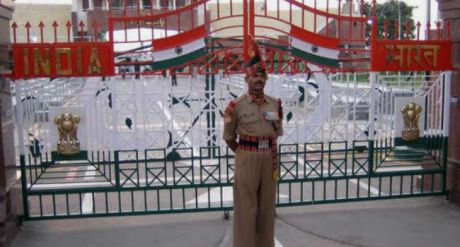
1. Attari: Situated 25 kilometre from Amritsar, Attari village is the last Indian railway station that connects Lahore and Delhi. An Integrated Check Post (ICP) was set up at Attari on April 13, 2012, to allow easy trade between the two countries. The famous train service between India and Pakistan, the Samjhauta Express, runs through this station.
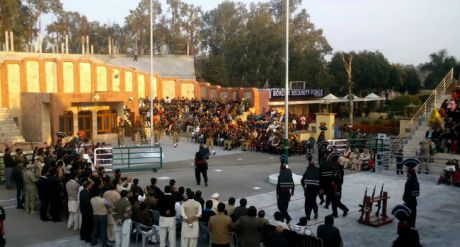
2. Ganda Singh Wala: Ganda Singh Wala falls under the district of Kasur in Punjab. The crossing point here is now closed but it used to be the primary point of link between the two nations in the 1960s and 70s. The border crossing point holds a Retreat Ceremony similar to that of the Wagah border. However unlike Wagah, the ceremony here is more intimate and less tense with fewer attendees from both the sides sitting in close proximity. A proposal to reopen the point was put up in 2005 but did not yield any result.
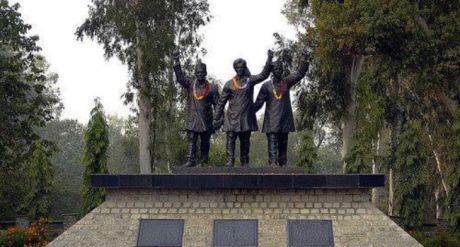
3. Hussainiwala: Right opposite the point of Ganda Singh Wala, lies the village of Hussainiwala in Firozpur district, Punjab. The village forms a part of the bank of River Sutlej that defines the Indo-Pak border. The famous martyr memorial of Bhagat Singh, Sukhdev and Rajguru stands near the bank as this was the place the rebel trio were cremated on March 23, 1931. The point is closed for travellers, however, a daily retreat ceremony takes place here as well.
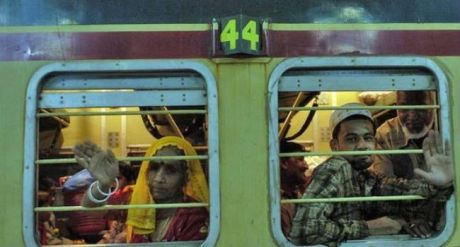
4. Munabao: The village is situated at Barmer district in Rajasthan. It is famous for the railway station through which, the Thar Express runs. The crossing point had been lying closed ever since the 1965 war. It was reopened in February 2006 and since then, the Thar Express operates from Bhagat Ki Kothi in Jodhpur to Karachi, Pakistan, through this station.
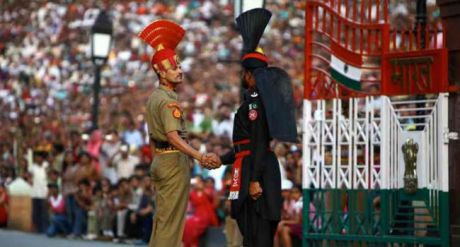
5. Wagah: This is the most famous and the most prominent border crossing point between India and Pakistan. The point is located 32 kilometres from Amritsar and 24 kilometres from Lahore. The Retreat Ceremony here is very popular and is attended by thousands of citizens from both nations. The Wagah border is also prominent because it was used as one of the major transit point during the 1947 migration. – India Today, 7 October 2015
Filed under: india, pakistan | Tagged: india, india-pakistan border, india-pakistan LoC, ISS, NASA, pakistan | Leave a comment »











