















 “The only solution for India is to seek a treaty of defence with the United States, the Commonwealth countries and Israel and such other countries that appreciate Indian concerns vis-a-vis China. The recent announcement by the defence minister that India and China would resume joint military exercises resonates a comic, if not suicidal, move, paving the way for the nation’s further humiliation. Does China, given its past and present diplomatic and military behaviour, qualify for such trust and confidence by India?” – Ram Jethmalani
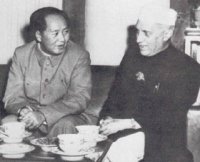 A threat as serious as terrorism faced by India is that of the expansionist and hegemonic actions of our formidable northern neighbour China. Though the former threat is immediate, the latter (of which we get regular periodic previews) will hit us with full force only later, unless we demonstrate intelligent and effective action, in the interest of our nation.
We have no quarrel with the people of China, and we should logically be natural friends. Our great and ancient civilisations and philosophers are revered across the world. Unfortunately, the Communist China that emerged in 1949 has never demonstrated any intent of promoting co-existence between the two ancient giants.
The first indicator of this intent was the invasion and annexation of independent and autonomous Tibet, leading to the flight of the Dalai Lama. It is indeed a redeeming factor that India granted him and the fleeing Tibetans asylum. After having made its aggressive military and political point in Tibet, China succeeded in inflicting the most humiliating military defeat on India in 1962. Pandit Nehru made Parliament pass a grandiloquent resolution accusing China of ingratitude and aggression, and grabbing thousands of square miles of Indian territory. The Indian nation was told that no respectable Indian will rest until every square inch is conquered back from the Chinese. Of course, this resolve remains unredeemed even today, with no successive government having taken any steps to retrieve our national honour.
 The Chinese foreign minister Qian Qichen made a brief stopover in India on one of his travels abroad in 1994. We treated him like royalty with admirable obsequiousness and due servility, but he was neither impressed nor moved. He neither displayed friendship in words nor any accommodation in his actions. He literally treated us like a defeated nation. Our foreign ministry bureaucrats put on a cheerful smile and held the visit as one more ‘significant step’ in enhancing bilateral ties, a familiar phrase in diplomatic jargon peculiar to the Indian foreign ministry. While we completely lacked the courage to tell him that China is in occupation of enormous areas of Indian territory, Qian Qichen took the lead by stating that while the border dispute between our two countries would be resolved eventually, as India was the aggressor in the 1962 war, the country that made the first advance should be the first to withdraw. So much for the achievements of our foreign policy.
Nehru died a broken man with his policies in shambles and the honour of India in the dustbin of history. Except for Indira Gandhi who took on Pakistan despite support, overt and covert, of the Chinese government, every successive prime minister, whether it was Rajiv Gandhi, Narasimha Rao or even Atalji brought back nothing except more humiliation every time they visited China.
Yes, we have created working groups of officers on both sides who are still exchanging maps. While we do not display any courage whatsoever to claim our lost territory, China is now claiming the entire Arunachal, and questioning the accession of Sikkim to India, thereby totally turning the tables on us on our own soil, and accusing us of being the aggressors.
Important analysts and think-tanks across the world suggest that the Chinese are planning further aggression. ‘Non Alignment 2.0’, a paper prepared by eminent political analysts Pratap Bhanu Mehta, Nandan Nilekani and Siddharth Varadarajan warns us of Chinese aggressive and insulting postures on our borders and threats of grabbling more Indian territory. They see no immediate prospect of the border issue being settled. These views are matched by Gautam Sen, in his article, ‘India must prepare for war with China without delay’ posted on September 9, in which he states that ‘the Chinese are publicly discussing the feasibility of attacking India before 2018, when they consider that India might be better prepared’. The Long Term Strategy Group, a Washington DC-based defence think-tank led by Jacqueline Deal, Stephen Rosen, (Beton Michael Kaneb Professor of National Security and Military Affairs at Harvard University) and Shivaji Sondhi, (faculty at Princeton and director, Centre for International Security Studies) echo similar views in their articles published recently in the Indian Express.
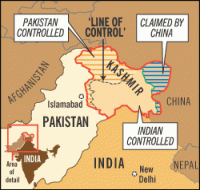 I firmly believe that we have been wasting our time for the last 50 years in trying to settle this dispute, that China has no intention of settling. On the contrary, it has already armed Pakistan with nuclear weapons. I believe India must break this stalemate, in its national interest. We must in no uncertain terms insist with the Chinese that the entire border dispute between the two countries must be settled by the International Court of Justice, unless the Chinese are prepared to accept arbitration by some world dignitaries enjoying the confidence of both countries.
I do not accept the conclusion reached in ‘Non Alignment 2.0’ that India has an edge in terms of maritime capabilities though China is catching up rapidly and therefore India must assert its maritime superiority. We must frankly tell the Chinese that they must stop their support of Pakistan both diplomatic and military, and advise their friend to settle all disputes on the basis of international law and justice. I don’t believe that the Chinese are going to respond. I also suspect that the Chinese have a long term plan of breaking up India and converting it into a third-rate power, military and economic.
 We cannot act on the advice of para 41 of ‘Non Alignment 2.0’ that: ‘India’s China strategy has to strike a careful balance between cooperation and competition, economic and political interests, bilateral and regional contexts. Given the current and future asymmetries in capabilities and influence between India and China, it is imperative that we get this balance right. This is perhaps the single-most important challenge for Indian strategy in the years ahead.’ I mean no disrespect to the distinguished authors but this is not even easily intelligible.
Frankly, the only solution for India is to seek a treaty of defence with the United States, the Commonwealth countries and Israel and such other countries that appreciate Indian concerns vis-a-vis China. The recent announcement by the defence minister that India and China would resume joint military exercises resonates a comic, if not suicidal, move, paving the way for the nation’s further humiliation. Does China, given its past and present diplomatic and military behaviour, qualify for such trust and confidence by India? – The New Indian Express, 3 October 2012
» Ram Jethmalani is an eminent jurist and Rajya Sabha member
See also
Filed under: india, USA | Tagged: aksai chin, arunachal pradesh, border security, china-india war, communism, defence treaty, geopolitics, hegemony, history, india, india border, india-china border dispute, indian air force, indian army, indian navy, indian politics, israel, kashmir, kashmir conflict, militaristic, nation-state, politics, psychological warfare, terrorism, USA, war | Leave a comment »










 BHARATA BHARATI