














The new water treaty with Bangladesh should have a shorter tenure, say 10-15 years, cover water sharing as well as river rejuvenation and must contain provisions for quick adjustments in response to changes in hydrology and other factors. All this will take time. Let it. It is time India reminded Bangladesh, as it did Pakistan, of the potency of weaponised water. – Virendra Parekh
The proverbial camel is coming under the mountain (Ab aayaa unt pahad ke niche).
The India-Bangladesh Ganga water treaty is completing its 30-year term in December. Bangladesh is naturally keen to renew it. Ganga (Padma in Bagladesh) is the lifeline of its south western part, sustaining farms, fisheries and livelihoods. However, there is no reason for India to oblige it. India would be better off to allow the treaty to lapse and design a new one that will protect its interests more comprehensively. There are sound political, economic and environmental imperatives for adopting such a course of action.
Bangladesh does not deserve any favour, concession or leniency. Its attitude to India is arrogant and hostile. It depends on India for diesel, power, cotton yarn and sugar and many other important commodities. It has nothing to offer India. It cannot even think of going to war with India. Yet, it talks and behaves as if India survives on its sufferance. It is getting close to Pakistan and China in utter disregard of India’s interests and sentiments. Although Bangladesh is not a member of BRICS, the Modi government has graciously invited its Prime Minister Tarique Rahman to attend the BRICS summit scheduled on September 12-13. Bangladesh is yet to confirm acceptance of the invite. Tarique seems to have linked it to the extradition of former Bangladesh prime under Sheikh Hasina. Bangladesh is considering buying J-10 fighter planes from China “since they outperformed Rafael planes during Operation Sindoor.” For whatever it is worth, Bangladesh has evinced interest in joining the Mecca pact, signed recently by Pakistan, Saudi Arabia and Turkey. Historically (as also currently), Tarique Rahman and his Bangladesh Nationalist Party (BNP) have been close to Jamaat-e-Islami, the party that had violently opposed Bangladesh’s independence from Pakistan and radical outfits such as Harkat-ul-Jihad-al-Islami (HuJI-B).
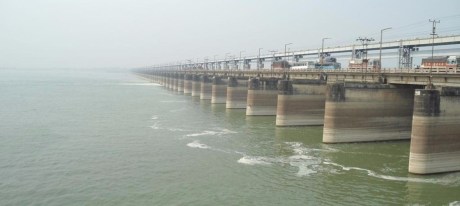
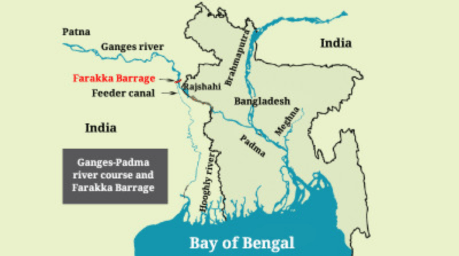
It is neither feasible nor desirable for India to continue this treaty in its present form. Signed in 1996 between the Indian prime minister H.D. Deve Gowda and his Bangladeshi counterpart Sheikh Hasina, it was designed to regulate the sharing of Ganga waters at Farakka barrage during the lean season so that both countries get adequate water for agriculture and other purposes. In early 1970s, India built a barrage on the river Ganga at Farakka in Murshidabad district of West Bengal, which became operational in 1975. The main objective of Farakka barrage was to prevent siltation of the Calcutta port and sustain its navigability by diverting 40,000 cusecs of water into canal of the river Hooghly.
Earlier Pakistan and later Bangladesh objected to the construction of the barrage, saying it will deprive it of much-needed river water. After some short term arrangements which did not work, the two countries signed this agreement, following tortuous negotiations, for sharing of Ganga water during the lean season. It says, in short, that when the Ganga’s flow is low, India and Bangladesh split it equally. However, when the flow is higher, India gets a fixed share. More specifically, if the flow at Farakka is 70,000 cusecs or less, both countries split it equally. When the flow is between 70,000 and 75,000 cusecs, Bangladesh gets 35,000 cusecs while India gets the remainder. When the flow is larger than 75,000 cusecs, India retains 40,000 cusecs and the remainder goes to Bangladesh. Moreover, the treaty stipulates that each country gets a minimum of 35,000 cusecs of Ganga water in alternating 10-day periods during the driest part of the season, that is, between 11th March and 10th May. These guaranteed allotments in late spring are aimed at preventing extreme shortages of water, especially at the time of highest irrigation demand.
Despite mutual complaints and allegations (“we do not always get our fair share of water”, “not enough water is left for us after giving the committed amount to Bangladesh”), the treaty has worked more or less satisfactorily during the preceding decades. However, it is no longer feasible to work it in its present form.
For one, there is simply not enough water in the Ganga. The treaty formulas are based on the average flows recorded between 1949 and 1988. Over the decades, climate change has been disrupting Himalayan glaciers, monsoon patterns and river flows across the region. Glaciers which feed the river during the summer are contracting since the accretion of snow during the winter is no longer sufficient to make up for what is lost to melting in summer. Monsoon patterns have become highly irregular. With increasing frequency, periods of excessive rainfall and floods are followed by long dry spells. With far greater upstream water consumption and accelerating groundwater extraction in the Indo-Gangetic plain leading to sinking water levels, it is no longer possible to predict accurately water availability during the dry season. One might say that the treaty pertains to a river that increasingly does not exist.
At the same time, India is facing rising demand for water for irrigation, industry and urban consumption. Bihar leaders are complaining that as against the state’s requirement of 2000 cusecs in 1996, it was allotted only 900 cusecs. Its population has increased almost 60 per cent since then. West Bengal says that since it must release large quantities of water to Bangladesh during the dry months, there is siltation and lower navigability in Kolkata’s harbour, as well as cooling water shortages at the power plant in Farakka.
There is a reverse problem, too. The Ganga once delivered large sediment loads that sustained floodplains and the delta. The Farakka Barrage now traps much of this sediment upstream, making the riverbed shallow and creating a major imbalance. Some experts have linked the Farakka barrage to increased flood risks in parts of Bihar due to sediment build-up upstream between Patna and Bhagalpur, which can reduce river capacity and intensify flooding during heavy monsoon periods. Simultaneously, in downstream areas sediment depletion weakens the delta’s capacity to resist erosion, sea-level rise and water salinity. Intensified riverbank erosion, land subsidence, and habitat loss now threaten long-term river stability.
Add to this the massive, reckless pollution of the river and its impact. Pollution from industrial waste, sewage and agricultural runoff continues to degrade river system. Industrial clusters along the Indian stretch discharge effluents containing heavy metals such as chromium and cadmium, while agricultural runoff adds nitrates and phosphates that degrade water quality. During low-flow months, they sharply lower dissolved oxygen levels and weaken the river’s capacity for natural self-purification.
All this means that India must redouble its efforts to rejuvenate the Ganga which it has revered for millennia as its most sacred river. Also, the government must assess anew the Ganga water requirements of Uttarakhand, Uttar Pradesh, Bihar, Jharkhand and West Bengal and resolve to retain enough water for domestic use. The remainder may flow to Bangladesh. The new treaty should have a shorter tenure, say 10-15 years, cover water sharing as well as river rejuvenation and must contain provisions for quick adjustments in response to changes in hydrology and other factors. All this will take time. Let it. It is time India reminded Bangladesh, as it did Pakistan, of the potency of weaponised water.
› Virendra Parekh writes on economics and politics, also on issues related to Indian civilization, history and cultural nationalism.
Filed under: bangladesh, india | Tagged: farakka barrage, ganga river, india-bangladesh water treaty 1996, padma river, weaponising water | Comments Off on Time to weaponise water against Bangladesh – Virendra Parekh











