







 “Researchers believe that instead of a new population invading south Asia, both populations were already present in India. Thus, the mixing doesn’t represent a surge of newcomers, but more likely the breakdown of some cultural or traditional barrier that had led to a natural separation between the two groups.” – Carolyn Y. Johnson
 A large genetic study of hundreds of people in South Asia has allowed scientists to probe important transition points in the population’s history, pinpointing when two different groups of people mixed widely and then stopped. The study provides a genetic signature of cultural changes that occurred as the caste system was put in place in India.
Researchers have long known that at some point in history, South Asia was a melting pot for two different groups of people. The clues have been scattered in various scientific fields: the history, language, and ancient farming traditions of South Asia all bore the imprint of different origins. Sanskrit and Hindi, spoken in the north, are thought to be related to European languages, while Tamil and Telugu, spoken in the south, are unrelated. Agriculture in the north started earlier, some 8,000 years ago, and was distinctly related to the crops first domesticated in West Asia; farming in the south initially involved native plants.
But when did these two populations mix, and when did they stop?
 Harvard Medical School professor of genetics David Reich specializes in analyzing genetic information from modern people to understand how populations interbred in the past, previously revealing that present-day humans have a little bit of Neanderthal in them and that the ancestors of Native Americans arrived in North America in successive waves.
Now, in a partnership with researchers in Hyderabad, India, Reich has examined hundreds of thousands of regions in people’s genomes and found evidence that the northern and southern populations mixed around 1,900 to 4,200 years ago. That period was well after the arrival of agriculture in the region and around the same time as Indo-European languages began to be used, the researchers reported Thursday in the American Journal of Human Genetics.
“From genetic data, remarkably, you see this picture emerging of cultural change,” Reich said. The population mixture didn’t happen in pockets—it was a profound mixing that has left traces in the DNA of people in all areas of India today. But that came to an abrupt halt around 2,000 years ago, likely due to the implementation of the caste system, Reich said.
 Supporting evidence for the genetic interpretation comes from an unlikely source: the Rig Veda, an ancient text dating back to about 1500 B.C. Different portions of the text are thought to have been written at different times, and the most ancient ones do not include references to the caste system. Those mentions come in later versions.
“The big news is that a lot of the stratification in India seems to be set down in the last few thousand years. The date estimates they give correspond to what we think is the arrival of the Indo-European languages,” said Spencer Wells, director of National Geographic’s Genographic Project, which is aimed at untangling the origins of indigenous populations. “There’s been a big debate in archeology about how that happened.”
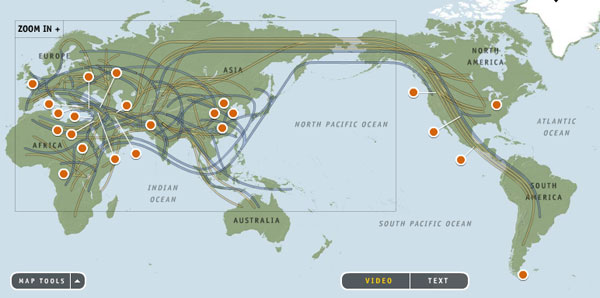 The researchers believe that instead of a new population invading south Asia, both populations were already present in India. Thus, the mixing doesn’t represent a surge of newcomers, but more likely the breakdown of some cultural or traditional barrier that had led to a natural separation between the two groups.
What most interests Reich for future research, however, are the health implications of these ancient patterns of mixing. The caste system, which restricts marriage to people of different groups, gave rise to populations that were genetically isolated, and therefore may be more likely to harbor rare genetic diseases.
“That is not really well appreciated in India,” Reich said. “An important medical thing is to document this and characterize it.” – The Boston Globe, 9 August 2013
» Carolyn Y. Johnson is a science reporter for the The Boston Globe.
See also
- 1 & 2 – Indo-Europeans: Their origins and the natural history of their languages – N.S. Rajaram
- 3 – Indo-Europeans: Pashupati’s animals on the march – N.S. Rajaram
- 1 – Indian Third Wave West: Fertile Cresent and mathematics – N.S. Rajaram
- 2 – Indian Third Wave West: From language to thought – N.S. Rajaram
Filed under: india | Tagged: archaeology, aryan, caste, civilization, creation, creation timeline, dravidian, genetics, human migration theory, india, indian society, out of africa theory, out of india theory, vedic civilisation | 2 Comments »