














There are many immensely strong Hindu women, who take great offence to Westerners who promote a misogynistic view of Hinduism and of Hindu men. – Sean Bradrick
Due to a biased and superficial Western media, controlled by either right-wing Christians or anti-Hindu liberals, many in the West think Hinduism is anti-woman. There are many millions of strong, bold, and independent Hindu women who would disagree. However, due to various factors, all religious traditions have steered towards some form of patriarchy.
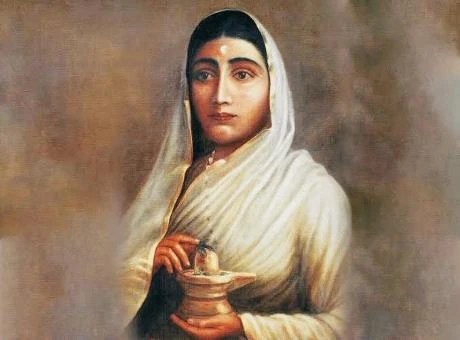
There is an extensive line of female Hindu sages and warriors alike. There is no parallel of this in Christianity or Islam. Hindu women dress in colourful sarees and jewellery, not in burkas. This reveals their natural beauty and royal nature. The female form is unapologetically depicted on the outside of many Hindu temples. Christians and Muslims tend to see this as obscene, lewd, and sinful. Hindus see it as beauty and power.
There are no major male Hindu deities without a female counterpart. Without such a royal and divine consort, the male deity is considered inert and infirm. In one school of Indic philosophy, the masculine is related to energy. The feminine is related to nature or matter. As we know, the Universe must consist of both energy and matter. The feminine primordial matter is the first cause, from which all manifestation occurs. So, in this sense, the creator of the cosmos and our natural world, is the Goddess.
There are three main Hindu sects. There are the devotees of Vishnu (Vaishnavas) and the devotees of Shiva (Shaivites). The third main sect is Shaktism. Shaktas are Hindu men and women who view the apex of divine power, supremacy, and metaphysical reality, as the great Goddess. This includes many aspects and individual personalities of the Goddess, and/or various individual goddesses. They are all one with Mahadevi (the great Goddess).
The Hindu Goddesses are seen as being more graceful, as well as more fierce than male deities. Besides being perceived as being more powerful than male deities, they are also seen as being more artistic and intellectual. Hindus recognise the powerful nature of women. There are many immensely strong Hindu women, who take great offence to Westerners who promote a misogynistic view of Hinduism and of Hindu men.
Twice a year, Hindus celebrate the festival of Navratri. This is a ten-day and nine-night festival, celebrating the goddesses and womankind. Each day, Hindus recognise a different goddess and her qualities or attributes. Such qualities are believed to be shared by all women. This Navratri custom recognises and celebrates everything a woman is: powerful, peaceful, prosperous, brave, chaste, calm, blissful, tranquil but also vigorous, beautiful, creative, caring, strong, protective, intelligent, optimistic, generous, magical, and charitable.
Pre-invasions, Indian women were strong and respected members of society. There was no corrupt tradition of dowry prior to colonial influences. Women would inherit wealth from their mothers and grandmothers. In the 600 years of Muslim rule in India, women could not vote. In the 200 years of colonial-Christian rule in India, women could not vote. After India’s independence, women immediately gained the right to vote. It took almost 100 years for women to attain that right in the US. Indira Gandhi was elected India’s PM in 1966 and served until 1977. She was re-elected in 1980. We are still waiting for a female president in the US. – News 18, 2 October 2025
› Sean Bradrick is an American poet, yogi, and Dharmi. The above article is an edited extract from his book A Hindu’s Guide for Advocacy & Activism: Fighting the Narrative War.

Filed under: india | Tagged: hindu society, indian history, indian women, misogyny, warrior queens | Comments Off on It’s wrong to portray Hinduism as patriarchal or misogynistic – Sean Bradrick










 BHARATA BHARATI