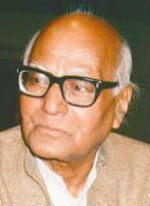










 “The term Silk Route is a misnomer,” says indologist Prof Lokesh Chandra at a seminar on ‘Sanskrit on the Silk Route’ at Bharatiya Vidya Bhawan, New Delhi. “Silk never travelled on this route. The Chinese used silk only as part of political diplomacy; to get horses, they supplied bales of silk,” he adds. The silk route was more of a ‘sutra route’ as monks and pilgrims journeyed on it carrying Sanskrit manuscripts and disseminating Buddhist wisdom. Sanskrit was the cultural bridge between Central Asian countries joined by complex networks of ancient routes. Sanskrit manuscripts were preserved in monasteries and caves across the region. Fragments of these interesting manuscripts have been discovered along the Silk Route and are a subject of intense study among scholars of Brahmi script in Germany, China and Japan.
“Sanskrit is the heritage of many Asian countries, including India. China has one of the largest collections of Sanskrit manuscripts and the study of Sanskrit in China goes back to days of yore,” says Prof Chandra.
 Complex Network
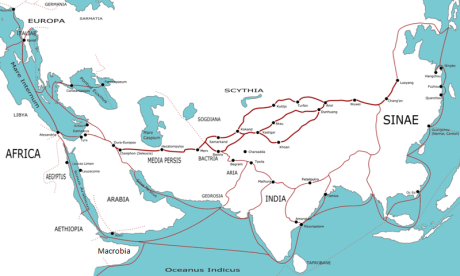
The Silk Route connected China to the Mediterranean Sea. It traversed great civilisations including Persian, Indic and Chinese. The ancient route bifurcated at Kashgar, an oasis city located close to Tajikistan and Kyrgyzstan and met at Dunhuang in China.
In 1890, Lieutenant Hamilton Bower discovered the first Sanskrit manuscript in the city of Kucha at the Taklamakan desert’s edge. He went there in search of a murderer and instead, came back with an antique manuscript. For years, this fifth century manuscript — written on birch bark in Brahmi script — was the oldest specimen of Sanskrit writing; it became famous as the Bower Manuscript.
Inspired by the find, the Russian consul in Kashgar, Nikolai Petrovsky, collected similar manuscripts and handed over the collection to St Petersburg’s imperial library. A German expedition reached the oasis of Turfan and carried out excavations and investigations there. This was followed by three more German expeditions.
“The Sanskrit manuscripts in the Petrovsky collection in St Petersburg consist of well-preserved, though incomplete folios, while manuscripts in other collections are generally fragmentary. This may be due to the advantageous position of the Russian consul at that time,” says Prof Seishi Karasimha, professor of Sino-Indian Buddhist philology, Soka University, Japan. He runs a first-of-its kind Brahmi club on Skype. “There is a Kharoshthi club in Seattle, University of Washington. I decided to create a Brahmi club. Through Skype, we read Buddhist fragments from Central Asia; people join in from Russia, China, France and several other countries. We read tiny fragments in Sanskrit,” he says. Sanskrit was earlier written in the Brahmi script and had variations like Ashokan Brahmi, Gupta Brahmi and post-Gupta Brahmi.
 Indologist-linguist Prof Raghu Vira discovered the Gayatri Mantra on the Silk Route in four Asian scripts: Manchurian, Chinese, Mongolian and Tibetan. Kucha and Kashgar were important centres of Sanskrit studies. Two Indian Sanskrit scholars, Kasyapa Matanga and Dharmaraksa were invited by the Chinese Emperor perhaps in the second century CE. The emperor is said to have built the White Horse monastery for their stay so that they could comfortably translate Sanskrit sutras for the Chinese.
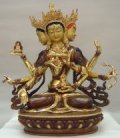
“The Chinese were intrigued that secular gains could be gotten through religion — that mantras could be used for political empowerment, consolidation of power and wellbeing of people. Combining power with virtue was a new concept for them,” says Prof Sashibala, Sanskritist and expert on Buddhist art. She points to Usnisavijayadharini — an inscription in Sanskrit, on the wall of the Chu-yung-kuan pass of the Great Wall of China — a prayer to Goddess Usnisavijaya for protection of Beijing as an example of Indic cultural influence on China. She says that on the Silk Route, there were texts related to dance, drama, music, metallurgy, chemistry and linguistics. The Chinese invited Indian scholars to share Indic philosophy, and the scholars carried texts with them.
 Monasteries also doubled up as academic institutions across the region and Sanskrit was studied as a subject. “Much information on Tantric Buddhism is there in the Silk Route Sanskrit manuscripts. There’s the Ramayana in Tibetan, in 9th to 10th century manuscripts, with local interpretations. Most translations of Sanskrit texts were done by monks; some of these texts were Prajnaparamita, Manjushree Paripeksha and Matangi Sutra,” says Sanskritist Kamal Kishore Mishra.
Shared Culture
Sanskrit was the foundation of many cultures across Asia. Tibetan language evolved with Sanskrit as idiom so that Buddhist texts in Sanskrit could be easily translated into Tibetan. The entire body of Buddhist wisdom — almost all of which is lost in India — is available in Tibetan as Kangyur and Tengyur. Uighurs monks introduced a large number of Sanskrit words in Mongolian. Chinese emperors used cups and saucers blessed by Sanskrit mantras; they also recited Sanskrit dharanis or small mantra-like prayers.
“The Silk Route tradition is the tradition of sharing,” says Prof Chandra. He adds, “Sanskrit and Pali traditions belong to us as well as to other peoples and countries. We’re not Big Brother — in fact we are cosharers and inheritors of a rich, eclectic, common heritage.”
 Cultural Cohesion
In the past, Buddhism was widely practised in India, Afghanistan, Pakistan, Uzbekistan, China and Japan and there’s so much more to discover in terms of sourcing information from documents. Japan is still a Buddhist country, so there are plenty of documents there, mostly Buddhist texts. Japan became Buddhist in the seventh century, to gel better with other countries in Asia; Buddhism provided the cohesive culture and was cosmopolitan, too, points out Prof Karashima.
Perhaps one way of bringing peace, prosperity and intellectual growth back into the region that stretches from Central Asia to China is to revive the cultural cohesion of the Silk Route model of cosmopolitanism. – Speaking Tree, 14 December 2013
Influence of Indian Language and Thought on:
- China http://www.esamskriti.com/essay-chapters/China-Korea-Japan-1.aspx In Nalanda Bihar is the Hieun Tsang Memorial which shows the route taken by Hieun Tsang to come to and return from Bharat http://www.esamskriti.com/photo-detail/Hiuen-Tsang-Memorial.aspx
- Korea http://www.esamskriti.com/essay-chapters/China-Korea-Japan-2.aspx
- Japan http://www.esamskriti.com/essay-chapters/China-Korea-Japan-3.aspx
- Harmonious blend of Hinduism, Buddhism and Shinto strains in Japan http://www.esamskriti.com/essay-chapters/Harmonious-blend-of-Hinduism,-Buddhism,-Shinto-strains-in-Japan-1.aspx
» Sonal Srivastava is an urban gypsy and arm-chair philosopher who blogs at Speaking Tree
Filed under: india | Tagged: bhikkhus, buddhism, devatas, hindu goddess, hinduism, india, sanskrit, sanskrit literature, sanskrit manuscripts, sanskritisation, silk road, trade, transasia trade routes, usnisavijaya devi | 1 Comment »