















 There is a simplicity in the Hanuman story; yet, there also exists the symbolism of plurality. Hanuman is called Ram dasa, the servant of Ram. The whole idea that a servant can become a god is something. It reflects that God is in everybody. There are temples where he is a dasa and then there are temples where he stands alone. – Dr. Devdutt Pattanaik
If you travel in any public transport in India, you may chance upon the sight of people sitting or standing in a corner, reading from a tiny chapbook. These books are usually sold in roadside shops near temples. The most popular among these is the Hanuman Chalisa. It is the most powerful expression of personal Hinduism that one can encounter on India’s streets.
Tulsidas popularised the idea of Hanuman. Across India, at the start of roads that wind up hills and mountains, one frequently finds temples of Hanuman. People driving past throw money at these temples. They become offerings to the great hero so he can help them keep away obstacles from their path. At the frontier of most villages, and in most Hindu crematoriums, we find red-orange images of Hanuman. The images protect the village from the wild, from diseases and demons, ghouls and ghosts.
Hanuman embodies the positive side of masculinity (strength), but not its negative side (domination). So people began reading the Hanuman Chalisa. Its language—Awadhi—is an old dialect of Hindi, one of the many languages of India. But do the people reading it understand what they are reading? Or does the gentle poetic rhythm calm the nervous heart, as it prepares to face the day? Or, is it simply a ritual exercise, where the point is to do, not think or feel?
Yes, many are unfamiliar with the crux of the text. Primarily because most people do not do “darshan” of what they chant or recite. Darshan is about moving from sight to insight. This is how knowledge spreads in India. It happens organically. Somebody who feels something shares it with people.
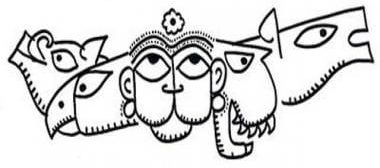
Hanuman’s appeal lies in the fact that there is nothing complex about him. He is popular among Shaivites, Vasihnavites. He is worshipped in the Vedic, as well as Tantric traditions. We tend to forget that Hanuman speaks Sanskrit but does not claim to be a Brahmin (as Ravana does). He is a mighty warrior who does not call himself Kshatriya, nor yearn to be a king (like Vali or Sugriva). He is powerful but does not seek wealth or fame. He is content serving Ram. And by serving Ram discovers he is more than a monkey-headed Vanar, he is Mahabali depicted in art with additional heads: that of a lion, boar, horse and lion. It makes us contemplate on the value of effort and aptitude. The monkey, a creature of the forest, has Vedic gyan. When Ram meets him for the first time, he speaks Sanskrit. Later when the situation demands he speaks to Sita in Prakrit. So he is adaptable—both in form and thought.
There is a simplicity in the Hanuman story; yet, there also exists the symbolism of plurality. Hanuman is called Ram dasa, the servant of Ram. The whole idea that a servant can become a god is something. It reflects that God is in everybody. There are temples where he is a dasa and then there are temples where he stands alone.
The Chalisa, essentially, is a poem of 40 verses (chalis means 40 in Hindi). Hanuman Chalisa, but has 43. The main 40 verses are chaupai, or quatrains (verses with four short, rhythmic segments). Framing these are three dohas, or couplets (verses with two long, rhythmic segments)—two at the beginning and one at the end.
Each line of the Chalisa allows us to leap into the vast body of Hindu thought. This thought process spans a heritage of over 4,000 years ago. Each line becomes an ascension. It is an allusion to the leap Hanuman took from his cradle to the sun, or across the sea towards Lanka, or over land towards the mountain bearing the Sanjivani herb. And he always returns to Ram. From the particular, we traverse the universal, and finally return to the personal.
As you read the 43 verses in this book, you will notice how sensitively the poet has structured his work. It creates a temple in the mind, and enshrines a deity in that temple. The verses take us from ideas of birth, through ideas of adventure, duty and glory, to the ideas of death and rebirth.
Sankat kate Mite sab peera.
Jo sumirai Hanumat Balbeera.
Problems cease, pain goes away.
When one remembers Hanuman, the mighty hero. – Chaupai 36
This chaupai reiterates what Hanuman can do for us: remove problems and take away pain. In the Ramayana, Hanuman solves Ram’s problems. He finds Ram’s missing wife, Sita, by leaping across the sea to the kingdom of Lanka. He saves Ram’s injured brother, Lakshman, by carrying a mountain of herbs across the sky. He even saves Ram from being sacrificed by Mahiravana to Patala Bhairavi. If he can help God, surely he can help humanity. Perhaps this explains Hanuman’s mass appeal.
When Hanuman was flying over the ocean to Lanka, he defeated many monsters. But he did not stop to rest. Thus Hanuman also embodies selflessness, commitment, and integrity. He is the one who completes the most arduous task without resting. We yearn to have someone like Hanuman on our side. And to have him on our side, we need to invoke Ram in our hearts.
The Hanuman Chalisa is a religious work through which a Hindu god is made accessible to the masses. Thus it becomes extremely popular. Reading this chapbook is completely voluntary, as in all things Hindu. Its popularity is organic. Its ordinariness makes it sublime.
In my book on the Hanuman Chalisa, I have avoided the academic approach. Scholars are too busy seeking ‘the’ truth while I am interested in expanding ‘my’ truth and the truth of my readers. If you seek 100 per cent perfection, you lose 99 per cent of readers in cantankerous and often self-serving debates. If you seek 90 per cent perfection, you are able to reach out to over 90 per cent of readers through thought-provoking elaborations. These provocations seek not to convince but to enrich.
That is good enough for me. – Firstpost, 26 April 2022
› Dr. Devdutt Pattanaik is a medical doctor by education, a leadership consultant by profession, and a mythologist by passion.
Filed under: india, world | Tagged: hanuman, hanuman chalisa, hindu dharma, hindu gods, hindu mythology | Comments Off on Why Hanuman matters – Devdutt Pattanaik











