








 Sanatana Dharma represents the world’s most ancient continuously practised, indigenous spiritual and philosophical tradition, which focuses on inner knowledge over outer belief and finds its basis in timeless truths and natural law. – Sean Bradrick
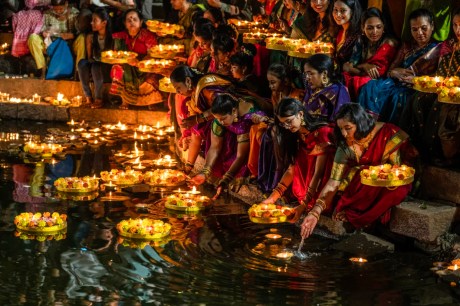
Sanatana Dharma provides various multicultural paths to religion, philosophy, metaphysics, and altruism. Not only through the vast beauty of Hindu Dharma but through its sister religions. Deepawali is a truly magnificent and magnanimous celebration of the divine and of our divinity in the form of light. It is not limited to the adherents of one spiritual tradition, but many. It is a Hindu festival also celebrated by Sikhs, Jains, Buddhists, Western yogis, and other spiritual seekers. For non-Hindus, it can simply be a celebration of light, brilliance, or whatever illuminates. We take this time to let more light and all good qualities inward while removing that which no longer serves our higher or more spiritual pursuits in a world that is largely material and in a time of much strife.
Different narratives from different regions of Bharat and its cultural realm abound. Many share the common theme of dharma overcoming adharma, good overcoming evil, and light overcoming darkness. This makes Deepawali all-inclusive. Even many thousands of Indian Muslims and their mosques light diyas (oil lamps).
This does not mean non-Hindus can make Deepawali into anything they like. It means all of humanity shares a similar existential struggle of redemption and virtue vs vice. All of humanity needs light to see. Even a blind man can sense the light of Surya. The universal nature of Sanatana Dharma indeed reigns supreme.
For Hindus, Diwali reminds us of the assurance that truth, light, dharma, and knowledge always prevail over darkness, ignorance, and adharma. Just as a spark or a small flame peers outward and penetrates many square miles of prior darkness. During Deepawali, we are also reminded of the epic battle won over Ravana. Afterwards, Sita, Rama, and Lakshman reached their true home of Ayodhya, after 14 years of banishment.
During Deepawali, we also give our obeisance to Goddess Lakshmi. We are drawn to the image of the goddess rising from the ocean of milk, churned by the Devatas and Asuras. The devotee churns his or her own mind, containing both light and darkness. Ultimately, we find that abundance of the purified mind, enlightenment, and the atma or true self. An inner light, not separate from Goddess Lakshmi. In this image, She represents and awakens this aspect of ourselves, from within and from without. She is both transcendent and immanent, esoteric and material.
Being the Deepawali season, I’d like to write more about light, specifically inner light. The word ‘enlightenment’ has lost definition, and is used by many who unfortunately do not understand its meaning. It is not something we just read about in Eckart Tolle’s books. It is an attainable reality.
One Vedic path towards enlightenment is simply being with nature. The five elements of matter correspond with our five senses and affect our mental state. Energy and Brahman as pure consciousness, correspond to our sixth sense, which is the mind itself. The Vedas also speak of the essential psychological and psychic forms of matter, light and energy known as ojas, tejas and prana. Physical, mental and holistic or spiritual health, all rely on becoming aware of them and balancing them within one’s being.
The Sanatani also holds dear the great wisdom of Lord Krishna. In the Bhagavad Gita, we find the roadmaps to life through jnana, karma, and bhakti yoga. Krishna does not seem to focus on Raja Yoga or the path to enlightenment through ashtanga or the eight limbs that lead to meditation and samadhi. However, this is also an important and attainable path in this age. Remember, true and comprehensive yoga is fully Hindu. One doesn’t need to be Hindu to benefit from it, but every Hindu should know it as Bhagwan’s gift to us and it is our gift to the world. This is especially true of the indigenous Hindustani.
Long ago, the rishis and yogis of Vedic times recognised the existence of chitta or subconscious mind. The Sanskrit word ‘chitta’ means mind-stuff or conditioned consciousness. They found that during meditation, what seemed to be foreign and forgotten thoughts, memories, emotions, fears, impulses and desires, would bubble up or suddenly start to seep from chitta, the subconscious mind, into manas or the normative mental field. They found that this kept them from reaching higher states of consciousness or ‘chit’, the transcendent conscious mind, or unconditioned consciousness. They called these impressions ‘samskaras’, meaning recollections or psychological imprints. They theorised that thought itself was a form of subtle matter. A quiet mind creates space for matter from the unconscious mind to emerge. In between the waking and meditative states, the yogis recognised what they called ‘vrittis’ or resurfacing thoughts. The Sanskrit word ‘vritti’, literally means whirlpool. These Vedantins realised that meditation could act as a sort of mental medium that could process hidden or subconscious impressions, as they became known in the more perceptive conditions of mind we use in the everyday waking state.
Of course, the pressures of everyday life, along with the pressures from our past karma, can appear at any time. A verse in the Upanishads says “This mind is like a chariot yoked to wild stallions”. These stressors can be more easily dealt with in mindful and meditative states than in anxious states or chaotic situations. These pressures can erupt in an emotional meltdown, or they can be released after the mind has had time to calm and quiet down.
Regular practice of meditation can relieve the pressures of life. As such, meditation can take the power out of stressful situations, though it isn’t meant to replace addressing the underlying causes of our various issues. It can help us cope with certain situations by allowing us to respond to them in a more effective and efficient manner. It can make us less impulsive and less likely to turn to anger, rage, substance abuse, violence, or other compulsive behaviours. Meditation is, after all, a modality for overall health found within a larger school of practical metaphysics and holistic medicine (Ayurveda). Meditation is to be respected for the powerful effects it can have, and not taken for granted. It’s no wonder that the end result of meditation is historically known to be what we call ‘enlightenment’. When we trace the word ‘enlightenment’ back to its Sanskrit origins, we find quite a few etymological terms. One is the word ‘bodhi’. Bodhi means ‘awakened intellect’ or more simply ‘clear perception’. It is where we get the word ‘Buddha’.
By practising meditation, we can gain this clear perception. We can learn to discern between what is true, constant and eternal, as opposed to what is fleeting or limited by time and space. This is not about being in a so-called ‘eternal now’ or in the present moment, which does not persist even for an instant. It is about being mindful of the presence itself. It is a matter of paying attention to what is, and as a result, we can see that which is not.
Sanatana Dharma represents the world’s most ancient continuously practised, indigenous spiritual and philosophical tradition, which focuses on inner knowledge over outer belief and finds its basis in timeless truths and natural law. These truths have been recorded in the great scriptures of Bharat, throughout the ages. The wisdom of the Vedas comes from the ancient rishis, nagas and yogis who observed nature and the mind in various states of consciousness, including the state of samadhi or super consciousness.
This Deepawali, I want to wish the world spirit, joy, health, wealth and peace. I am an American Sanatana Dharmi. Hindu Dharma is my religion. Sanatana Dharma is my way of life. I thank the indigenous Hindus of India and its cultural realm. – News18, 14 Novemeber 2023
› Sean Bradrick is a former Catholic who adopted the Hindu Dharma over 37 years ago. He is a teacher of Buddhi Yoga, Samkhya, Ayurveda, and author of the book A Hindu’s Guide to Advocacy & Activism.

Filed under: india, USA | Tagged: diwali, good vs evil, hindu dharma, jnana yoga, meditation | Comments Off on Significance of Diwali from an American Hindu’s perspective – Sean Bradrick