








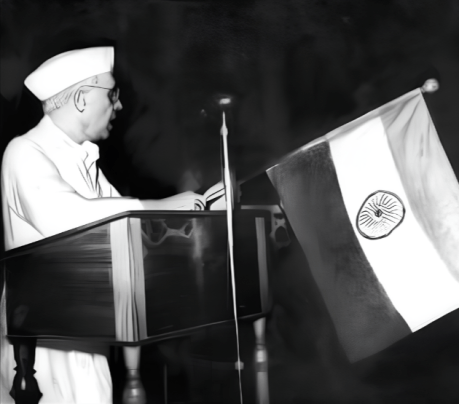
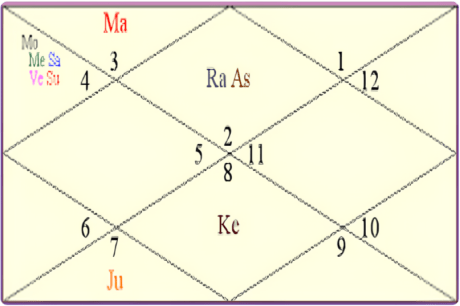
According to astrologers, August 15, 1947, was a day to be avoided at all costs. … Thus, an innovative compromise formula was struck: by scheduling the transfer before the sunrise of August 15, they successfully avoided the inauspicious dark Chaturdashi and Amavasya under Hindu reckoning. Meanwhile, under the Gregorian calendar, August 15 would technically begin immediately after midnight. It was this ingenious tightrope walk that necessitated the midnight ceremony, and the rest is history. – B.P. Acharya
As we celebrate the 79th anniversary of our Independence, one is inevitably reminded of the grand festivities during the Golden Jubilee. I fondly recall the numerous midnight functions organised to mark our “Freedom at Midnight”, along with the concomitant inconveniences of participating with groggy eyes! Mercifully, this time around, we are spared such nocturnal celebrations. Yet, a question continues to linger in our minds: why on earth did we choose to be free at such an unearthly hour? Was it by choice or by compulsion? What was so special about that midnight hour for our “tryst with destiny”? If you have ever wondered, there hangs a fascinating, lesser-known tale that I recount below.
To answer these questions, I must jog my memory back to the 1980s, when I had a gap year as a research scholar at Jawaharlal Nehru University (JNU). Having completed my MPhil coursework with a high grade-point average, I was eligible to fast-track directly into a PhD programme. I registered for it, though it was not my immediate priority, simply because I was still underage to appear for the Civil Services Examination.
Since I was relatively free, my professor and research guide asked me to assist the internationally celebrated authors Larry Collins and Dominique Lapierre—of Freedom at Midnight fame. They needed help editing a vast archive of personal papers and private documents belonging to Lord Louis Mountbatten, the last Viceroy of India, which they had gathered for their bestseller. That was how I found myself swamped with huge loads of primary historical material. My task was to ferret out insights for new publications, which were later brought out in two separate volumes: Mountbatten and the Partition of India and Mountbatten and Independent India.
It was during this deep archival dive that I stumbled upon a fascinating interview with Lord Mountbatten, conducted by the authors during their research for Freedom at Midnight. This recorded interview was published in the first volume of Mountbatten and the Partition of India. Characterised by his trademark arrogance and insouciance, the story is best heard straight from the horse’s mouth, as Mountbatten recollects the events in these interview excerpts:
Question: The ceremony of August 15 had no precedent. Who invented and engineered it?
Answer: Well, I discussed it with Nehru. The first and most amusing thing, of course, is that I had selected August 15 because it was the date of the Japanese surrender to me as the Commander of the Allied forces in Singapore – which, don’t forget, had taken place only two years prior. However, I had not consulted the astrologers.
As you know, Indians are deeply invested in astrology. I did not realise it at the time, but on an inauspicious day, they would do nothing. While Nehru himself did not believe in astrology, he mentioned that so many others did, and that I had chosen an unpropitious day. I suppose it was silly of me not to consult the astrologers, but it had slipped my mind.
He then suggested, “Never mind. If you agree, we can hold a midnight meeting. Just before the clock strikes midnight, we will transfer power, which will make it all the more auspicious.”
I thought to myself—what a marvellous, dramatic idea, to hold a midnight meeting while the rest of the world sleeps! As you will remember, this was done not because we deliberately sought a dramatic moment, but simply because I had chosen the wrong day! It happened entirely because the astrologers insisted the date was not propitious. – Viceroy Louis Mountbatten
So, there you have it. That is how we were permanently saddled with freedom at midnight—an uncomfortable compromise between Viceregal arrogance and an astrological adjustment, or upay, as it is often called. While the date was fixed arbitrarily by an egotistical Viceroy, what remains surprising is that the Indian leaders rather meekly submitted to his whims and fancies.
When Nehru broached the subject with other leaders, there was apparently stiff resistance, particularly from Sardar Patel and J.B. Kripalani, both of whom wanted to avoid the inauspicious day. Ultimately, it was left to an ingenious astrological subterfuge to resolve this conundrum. This is how it was done.
As per the Hindu calendar, tithis (days calculated based on the solar/lunar cycle) begin at sunrise, whereas the Western (Gregorian) calendar dictates that a new date commences at midnight. This crucial difference afforded a slim window of opportunity to work out an astrological solution (upay) to a difficult dilemma.
According to astrologers, August 15, 1947, was a day to be avoided at all costs. It fell on the 14th day (Chaturdashi) of the dark fortnight (Krishna Paksha), with the most inauspicious new moon day (Amavasya) also setting in. Thus, an innovative compromise formula was struck: by scheduling the transfer before the sunrise of August 15, they successfully avoided the inauspicious dark Chaturdashi and Amavasya under Hindu reckoning. Meanwhile, under the Gregorian calendar, August 15 would technically begin immediately after midnight. It was this ingenious tightrope walk that necessitated the midnight ceremony, and the rest is history.
This apparently win-win formula was actually a difficult compromise born out of compulsion rather than choice. We had no option when confronted by a supercilious Viceroy’s arbitrary choice of date, which smacked of scant regard for the people’s sentiments. However, what was indeed disappointing was the meek submission of Indian leaders to his whims and fancies, going out of their way to accommodate his peccadilloes. Thus, freedom at midnight became our “tryst with destiny” and, over time, a celebrated symbol of a dramatic transfer of power, later emulated in other colonial transitions like that of Hong Kong. For us, however, it remains a story of a queer compromise that defined the dilemmas of our country during the initial years after independence—dilemmas that linger on in more ways than one. – The Pioneer, 14 August 2026
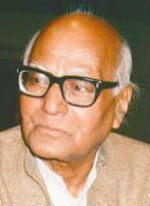
› B.P. Acharya is a retired Special Chief Secretary of Telangana.
Filed under: india | Tagged: hindu astrology, independence day date, jawaharlal nehru, louis mountbatten, tryst with destiny speech | Comments Off on Freedom at Midnight: The astrology of India’s independence – B.P. Acharya