














 “BJP member Ratan Lal Kataria said the river was a symbol of India’s cultural heritage and completes the narrative of the Harappa and Mohenjodaro civilization which grew up by its banks and by the banks of the other historic river Indus.” – TNN
The government has launched a fresh effort to unravel the ancient riddle about the existence of river Saraswati which finds reference in Vedic texts.
Though efforts have been made in the past by geologists and the scientific community, both during British period as well as in independent India, the river remains a mystery so much so that its mention in ancient texts has invariably been termed ‘mythological’.
“There is enough scientific evidence on the presence of the river Saraswati in some parts of the country through which it flowed about five to six thousand years ago … Saraswati is not a myth”, said the Union water resources and river development minister Uma Bharti on Tuesday.
Responding to a calling attention motion in Lok Sabha, Bharti said her government was taking up the issue very seriously “to trace the route of the river”.
She also informed the Lower House that the Central Ground Water Board (CGWB) of her ministry has been directed “to test the water of a well located inside the Allahabad Fort” in order to trace the source and route of the lost river.
The motion was moved in the House by BJP member Ratan Lal Kataria who wanted the government to set up ‘Saraswati Research Institute’ for the “revival” of the river. He reminded the House of a promise made by Prime Minister Narendra Modi who, he claimed, during an election campaign in Kurkshetra vowed to bring to the surface the water of the subterranean river Saraswati.
Stating that a lot of research has been done on the river, particularly in Gujarat, Bharti said there were several rivers named Saraswati which emanated from the Himalayas, including one which mingled with the Triveni in Allahabad, another with Mandakini and the third with Alaknanda river.
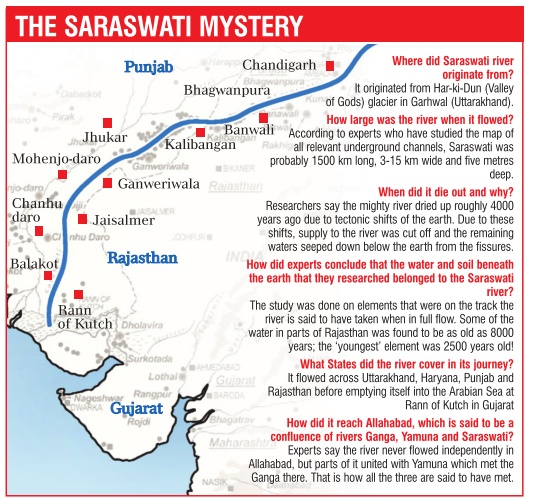
She said there was also a river with the same name that passed through Haryana to Rajasthan and Gujarat.
Raising his demand, Kataria said the river was a symbol of India’s cultural heritage and completes the narrative of the Harappa and Mohenjodaro civilization which grew up by its banks and by the banks of the other historic river Indus.
He said drilling of deep wells in parts of Gujarat had shown the existence of sweet water, which proved the existence of water flow.
Maintaining that research work on the river would also act as a search for lost civilizations and habitations, Kataria demanded the establishment of an authority to carry on the research. – The Times of India, 13 August 2014
Myth to Reality: Sarasvati River is set to flow again – Atul Sethi – The Times of India – Dec 28, 2008
 “The idea that the ancient Sarasvati might be the modern-day seasonal river, Ghaggar, is not new. It was first put forward over 100 years ago by C.F. Oldham, an English engineer who observed that the dry bed of the Ghaggar appeared too broad for a seasonal river. He believed that the Ghaggar was, in fact, flowing on the bed of a bigger river that existed before. Archaeological excavations of the Indus Valley sites have also revealed numerous settlements along the Ghaggar, lending further credence to this theory.” – Atul Sethi
Almost 13 km from Kurukshetra lies the ancient village of Bhoresaidan – named after the Kaurava hero Bhurisrava, who was one of Duryodhana’s 11 distinguished senapatis during the Mahabharata war. A dusty road adjacent to the village leads to a yawning valley, flanked by rocks and covered with a soil that is a curious mix of various sedimentary deposits. Rajesh Purohit, deputy director of the Kurukshetra-based Sri Krishna Museum, bends to scoop up some of the soil. “This soil has a lot of history,” he says gravely. “After all, the river Sarasvati used to once flow here.”
Purohit’s contention is that the ‘valley’ is actually the bed of the Sarasvati, a fact which finds mention in numerous ancient literary texts, but whose existence has often been questioned by historians. “The discovery of the river bed,” he says, “proves beyond doubt that Sarasvati is not a myth.”
That myth may now be laid to rest forever as plans are afoot to revive a part of the course taken by this ancient river. The Haryana government has acquired almost 20 acres of land and work is under way on a 50 km-long channel in Kurukshetra, through which the river will flow again.
“The revival of the Sarasvati will benefit countless people in the region as it will augment ground water resources,” says Darshan Lal Jain of the Sarasvati Nadi Shodh Sansthan, which is working with the government on this project. The plan is not to line with the river’s course with bricks so that water can permeate the ground. With ground water levels dipping to as low as 150 feet, the river’s revival may be a boon for parched Haryana.
A boon that would not have been possible without the discovery of the river bed. “In 2004, an extraordinary phenomenon occurred,” recalls Purohit. “Water started oozing out from a palaeochannel (a dried river bed) at the Kapil Muni temple sarovar at Kalayat. We carried out studies of this water. Simultaneously, a scientific team studied its mineral composition.”
Scientists from ISRO also carried out studies using space imagery and discovered a number of fossil valleys in upper central Haryana. “Mapping images of the palaeo channels showed that they corresponded to the archaeological sites of Haryana,” says Purohit. “This means that these settlements came up near the river, as was the norm in those times and gives further proof that the river Sarasvati indeed existed,” he says.
Incidentally, the debate about the existence of the Sarasvati has been continuing for a long time although lately, most historians have begun to concede that the river perhaps did exist. However, they still continue to debate the name by which the river was known, the route that it took and the reasons for its disappearance. “There is no doubt that the Sarasvati river existed. However, opinion is divided on whether it was known as the Sarasvati or the Ghaggar,” says S. Kalyanraman of the Sarasvati Research and Education Trust (SRET).
The idea that the ancient Sarasvati might be the modern-day seasonal river, Ghaggar, is not new. It was first put forward over 100 years ago by C.F. Oldham, an English engineer who observed that the dry bed of the Ghaggar appeared too broad for a seasonal river. He believed that the Ghaggar was, in fact, flowing on the bed of a bigger river that existed before. Archaeological excavations of the Indus Valley sites have also revealed numerous settlements along the Ghaggar, lending further credence to this theory.
But then, how did this river disappear? “Primarily due to tectonic shifts,” says K.S. Valdiya of the Bangalore-based Jawaharlal Nehru Centre for Advanced Scientific Research.
“Tectonic uplifts caused the deflection of the waters of the Yamuna and Sutlej, which contributed the bulk of the expanse of the river. In a way, it was a case of ‘river piracy’,” says Valdiya, who recently delivered the keynote address at a conference on the Sarasvati that was organised by SRET.
Whatever the reason for its disappearance, this river sutra is far from over. And when this ancient river does start to flow again, everyone will be watching. After all, it is not every day that a river is reborn. – The Times of India, 28 December 2008
Filed under: india | Tagged: geology, ghaggar river, hinduism, history, india, indian government, indian history, indian politics, mythology, politics, rivers, saraswati river, sindhu saraswati civilization, uma bharti, vedas, vedic civilisation | 7 Comments »







 BHARATA BHARATI