













FCRA registration will no longer operate as a general permission to receive foreign money. Regulatory focus has shifted beyond registration to the purposes for which foreign contributions are received, their actual utilisation and governance of recipient organisations. Any breach of rules would invite serious consequences. – Virendra Parekh
The foreign-funded ecosystem is up in arms. To its dismay, the Modi government has shown the temerity to ban use of foreign money for religious conversions and also block its channelization to political campaigns and agitations.
Understandably, the Church is immensely incensed. The Church exists to convert and foreign money is like oxygen to it. Prayers are held at several places for divine intervention to reverse this outrage. But the Church is not alone. Lots of NGOs, acting as front for foreign governments, spying agencies and terrorist organisations under innocuous names, share its anger and frustration. The ecosystem has induced the Kerala assembly to pass a resolution urging the central government to step back.
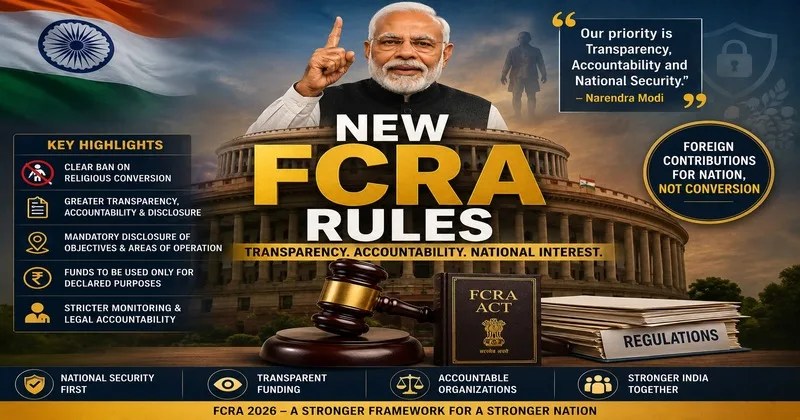
The eye of the storm is the amendments to the Foreign Contribution (Regulation) Act and Rules, notified recently, which have overhauled the framework governing foreign contributions in India. The object is to bring greater transparency and accountability in the purposes for which foreign contributions are received, their actual utilisation and governance of the recipient organisations. The idea is to ensure that such funds do not adversely affect India’s sovereignty, internal security, public interest, or democratic institutions.
Essentially, under the revised rules, NGOs will have to specify the exact nature of their activities from the newly prescribed, more prescriptive schedules for religious, cultural, economic, educational and social purposes, and also specify States or Union Territories where foreign contributions are planned to be utilised. As regards religious activities, use of foreign funds for proselytization is expressly banned. Among the educational activities, awareness programmes on constitutional rights, fundamental duties and civic responsibilities must be strictly non-political; and cultural activities, including promotion of contemporary arts inspired by Indian traditions, must exclude political or ideological content. NGOs receiving foreign money will have to submit detailed activity reports and disclosures relating to official websites, social media accounts, publications and mass communication.
NGOs’ annual reports must disclose name, address and email of ultimate donor(s) where contributions are routed through donor-advised funds or other intermediary remittance vehicles. Hopefully, funds originating from Soros or the Vatican will now be traceable to their real source. Key functionaries responsible for compliance now include directors, trustees, partners and any other individual exercising effective control over the affairs of the organisation, besides traditional office bearers. Organisations which have foreigners (excluding PIOs) as key functionaries will not ordinarily be considered for foreign contributions.
Organisations receiving foreign contributions in instalments under prior permission route must have utilised 75 per cent of previously received foreign funds before subsequent instalments are released, supported by chartered accountant’s certification and on-field regulatory verification. Registration may be cancelled or not renewed without utilisation of at least Rs. 10 lakh of foreign contribution over preceding two financial years.
These tough rules are backed by provisions for stiff penalties. Acceptance or utilisation of foreign contribution without valid registration or prior permission, use of foreign contribution outside approved purposes or geographical areas or for speculative investments would attract cancellation of registration or penalties ranging from a minimum of Rs. 1 lakh to as much as 30 percent of the amount involved whichever is higher, depending on nature of contravention.
More seriously, if the registration of an NGO is cancelled, suspended or not renewed, the government can seize, manage or dispose of assets created by the organisation with foreign aid through a ‘designated authority,’ without the approval of the court or a judicial examination. Once an FCRA registration ceases to exist, the designated authority can take control of assets built using foreign funds—schools, hospitals, places of worship—and use them. This process would be automatic and instantaneous upon the discontinuation of the FCRA status, requiring no judicial determination or adjudicatory process.
The upshot is that FCRA registration would no longer operate as a general permission to receive foreign money. Regulatory focus has shifted beyond registration to the purposes for which foreign contributions are received, their actual utilisation and governance of recipient organisations. Any breach of rules would invite serious consequences.
Naturally, the jholawalla brigade is up in arms. For quite a few behenjis and bhaisahibs, it is a matter of livelihood. Social service is a lucrative business, offering a happy lifestyle, social standing and high moral ground for little effort, if you have right connections or know self-marketing. For others, this is a huge roadblock in implementing their nefarious agenda in the name of environment, tribal rights, empowerment of marginalised groups, et al.
Then again, there is no dearth of missionaries, ‘Mother’ Teresa among them, who portray India before the world in the worst possible manner to attract donations from the bleeding hearts abroad. Thanks to their efforts, many foreigners even now regard Calcutta as a city where children die of hunger on streets and nobody bothers.
The local Church, by leading the protests vociferously, has given itself away. Its agitation is one more confirmation of its real agenda: conversion with the help of foreign money. Its much-touted charity and social service is only a means to the ultimate objective. The restlessness of the Church shows that the government has hit the target.
The amendments are bold, timely and absolutely necessary. Modi government deserves to be complimented for its clarity of purpose and firmness in action. Conversions brought about by foreign-funded organisations have changed the demography of the Northeast and Kerala. The process is afoot in many parts of the country, including Punjab. What conversion changes is not merely the mode of worship, but the convert’s view about himself, his neighbours, his country and his civilizational heritage. That is why they need to be discouraged, if not banned altogether.
Foreign hand was visible in several agitations witnessed in the recent past e.g. agitations against farm laws, CAA, Kalapakkam atomic reactor, the Adani port project in Vizhinjam, Kerala, opposition to the Great Nicobar development project, Cockroach Janata Party protests. Some of these were directed against projects of great economic or strategic importance, some were designed to cause inconvenience to public and make the government unpopular and provoke the government into harsh measures which can be exploited politically at home and abroad while some others aimed at instigating popular anger against the government. The common thread among them all was opposition to national interest. The proposed amendments seek to dry up the flow of foreign money for such agitations.
Critics have termed the amendments a breach of Constitutional provisions and federal principles. But the government is on a sound legal footing. Several judgments from the Supreme Court support its position. The top court agrees with the government that no absolute right inheres in anyone to receive foreign contributions. A three-judge bench in Noel Harper versus Union of India in April 2022 declared that “no one can be heard to claim a vested right to accept foreign donation, much less an absolute right”. As regards conversion, the Supreme Court in Rev. Stainislaus vs State of Madhya Pradesh (1977) clearly ruled that the right to propagate one’s religion does not include a fundamental right to convert another person.
While the legal framework is in place, the implementation will test the government’s capabilties. There are over 15,000 NGOs registered under FCRA. Does the government has machinery to monitor their activities, social media posts and publications on a real time basis? Hopefully, AI could be of help here. Secondly, while the amendments may curb anti-national activities funded with foreign money substantially, a lot of mischief is funded locally also. The termites hollowing the country from within, including the Church, are not exactly paupers. For now, however, the government deserves compliments for a bold initiative.
› Virendra Parekh writes on economics and politics, also on issues related to Indian civilization, history and cultural nationalism.

Filed under: india | Tagged: anti-national activity, christian missionaries, FCRA rules, FCRA violations, NGOs | Comments Off on FCRA Rules: Why missionaries and jholawallas are angry – Virendra Parekh










 BHARATA BHARATI