















 “While Edison considered the light bulb his “crowning triumph,” it joined the long list of contributions that made him a record-holder for sheer number of U.S. patents — 1,093 — until the 21st century. His creations included the movie camera and the microphone, the phonograph and the mimeograph, the stock ticker and even the “stencil-pen,” a precursor to the tattoo gun.” – Jennifer Latson
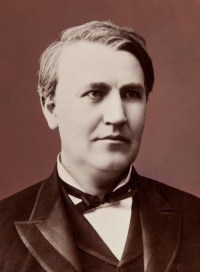 The electric light wasn’t Thomas Edison’s first invention, nor was he the first to create an alternative to gaslight. Electric lights already existed on a street light scale when, on this day in 1879, Edison tested the one he’s famous for. Though he didn’t come up with the whole concept, his light bulb was the first that proved practical, and affordable, for home illumination. The trick had been choosing a filament that would be durable but inexpensive, and the team at Edison’s “invention factory” in Menlo Park, New Jersey, tested more than 6,000 possible materials before finding one that fit the bill: carbonized bamboo.
Edison bragged about the filament’s efficacy and economy to a New York Times reporter who toured the factory just after his successful test run:
“As there is no oxygen to burn,” said Mr. Edison, “you can readily see that this piece of carbon will last an ordinary life-time. It has the property of resisting the heat of the current of electricity, while at the same time it becomes incandescent, and gives out one of the most brilliant lights which the world has ever seen. The cost of preparing one of these little horse-shoes of carbon is about 1 cent, and the entire lamp will cost not more than 25 cents.”
While Edison considered the invention his “crowning triumph,” it joined the long list of contributions that made him a record-holder for sheer number of U.S. patents — 1,093 — until the 21st century. His creations included the movie camera and the microphone, the phonograph and the mimeograph, the stock ticker and even the “stencil-pen,” a precursor to the tattoo gun.
And although his accomplishments spoke for themselves, Edison was equally prolific, and ambitious, in inventing myths to boost his reputation as a larger-than-life innovator, as a 1979 TIME profile notes. As a result, his inventions weren’t just scientific discoveries, but also prevarications. For one thing, he often claimed to be entirely self-taught, having never attended a day of school.
“Untrue,” says TIME. “He had at least three years of formal education as a child — a stint that was not unusually short in the rural Ohio and Michigan of his youth. As a budding inventor, he also attended classes in chemistry at New York City’s Cooper Union after realizing that his self-taught knowledge of that science was inadequate.”
He also boasted of never needing more than three hours of sleep a night. That’s a half-truth, although the full story may be even more impressive: He managed to piece together a full night’s rest by napping artfully throughout the day. Per TIME:
When the Ford Motor Co. archives were opened in 1951, researchers found many pictures of Henry Ford and his pal Edison in laboratories, at meetings and on outings. In some of these photos, Ford seemed attentive and alert, but Edison could be seen asleep — on a bench, in a chair, on the grass. His secret weapon was the catnap, and he elevated it to an art. Recalled one of his associates: ‘His genius for sleep equaled his genius for invention. He could go to sleep any where, any time, on anything.’ – Time, 21 October 2014
» Jennifer Latson is a history writer at Time Magazine and book critic at Boston Globe.

Filed under: USA | Tagged: electric light, inventions, inventors, light bulb, menlo park, thomas a. edison, USA | 1 Comment »











