














 We all need to believe in something. Some find certainty and comfort in religion and gurus, some in ideology, others in science or art. None of the beliefs is inherently good or bad, right or wrong. The problem starts when we start claiming a monopoly on truth and consider a different viewpoint blasphemous. – Manoj Chhabra
In his book The Fall of the Ottomans: The Great War in the Middle East, 1914-1920, Eugene Rogan, a historian at Oxford, outlines how Britain and France sought to dismantle the Ottoman Empire during the First World War. Till then the Empire was the temporal as well as the spiritual seat of Islam. The caliph was king and pope rolled into one. Although a religious state, the constraints of realpolitik kept the policies of the Empire pragmatic and out of the hands of religious extremists.
Colonial powers were aligned against the Empire and successfully used religious, extremist nomadic tribes to break it up. Rogan argues that this policy played an important role in the rise of religious fundamentalism in the region, culminating in The Islamic State of Iraq and Syria (ISIS), which is now a threat to the entire world. One can reasonably argue that it is unfair to blame them as no one could have predicted the exact consequences. It is, however, hard to escape the fact that a large part of the world today is shaped by such unintended consequences.
What was once considered a blessing may sometimes turn out to be a curse, and vice versa. Plastics were once considered fantastic, a marvel of science, but are now a threat to the environment. Pesticides, which facilitated the Green Revolution in India by making us self-reliant in food, contaminate groundwater.
Invention of the printing press is now credited with ushering in the age of enlightenment. Things and events often have long-term consequences, many of which are unintentional. When Chairman Mao was asked about the impact of French Revolution of 1789 on the world, he is said to have replied that it is too early to judge. There seems to be an unwritten law of such unintentional consequences at work here.
Let’s explore this further. Harnessing electricity made possible TV, computers and the internet—all wonderful inventions bringing joy and comfort. But these have also altered human behaviour in ways never imagined by their creators. Watching TV is now linked to obesity, junk food and shrinking attention spans.
The social media revolution is hastening the change. Is TV and social media good or bad? Is it progress or decline? Maybe it is too early to judge. History tells us that the fall of the mighty Roman Empire was marked by orgies and gladiatorial contests. Maybe 100 years from now the future historians may see reality TV (Big Boss?) and social media trolling as symbols of decay and mark the end of Age of Enlightenment. Maybe that’s how a civilization dies, an unintentional consequence of brilliant inventions.
Why does this happen? Well, part of it is simply the hubris of the human species that we know everything. This belief in human infallibility has grown exponentially in the past century, due to a knowledge revolution that spawned rapid technological advances. It’s sometimes easy to believe that there is nothing beyond our grasp; even if some things remain unsolved, it’s just a matter of time. A typical example of such intellectual arrogance was the 1989 essay The End of History by Francis Fukuyama. He postulated that after the fall of communism, political thought and civilisation have matured and free market economy with liberal democracy is the final form of government. Ironically, in less than 30 years, history has taken its revenge as both free market and liberal democracy are under threat even in their bastion, the US.
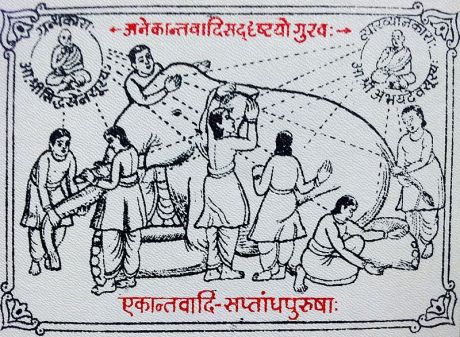
More importantly, there are structural constraints to human knowledge because of the fact that we are but a small part of this infinite universe. This is explained brilliantly in the ancient Jain philosophy of Anekantavada (relativity of views) which describes reality as multifaceted and too complex to be grasped from any one perspective. Leave alone a mountain, even a grain of sand cannot be comprehended in its entirety as each sees it from his or her own perspective.
Stephen Hawking explains the expanding universe by likening it to ants sitting on an inflating balloon that will have everyone else travelling away from themselves. Each ant, from its viewpoint, will be imagining itself as the centre of the universe. However, to an outside observer who is watching both the balloon and the ants the reality is different. Both are right from their own perspective. We can only see and understand things using our limited knowledge and therefore cannot comprehend all the dimensions.
This should be a sobering thought for us human ants who are searching for meaning in our lives in this incomprehensible universe. We all need to believe in something. Some find certainty and comfort in religion and gurus, some in ideology, others in science or art. None of the beliefs is inherently good or bad, right or wrong. The problem starts when we start claiming a monopoly on truth and consider a different viewpoint blasphemous.
Infinitely more harm has been done by those who were convinced of absolute truth of their beliefs than criminals and mercenaries. Whether it is the Crusaders of the Middle Ages, Hitler, Stalin or the teenage suicide bombers today, terrible atrocities have always been justified in the name of a great and noble cause.
Not just a theoretical construct, Jain metaphysics has considerable practical utility. It is an antidote to dogmatic world views held by religious or ideological fundamentalists, who are so full of themselves. It fosters non-violence, tolerance and coexistence. Respecting a multiplicity of beliefs and viewpoints provides a reality check against extremism and raises hopes of living peacefully. Science and technology give us enormous power but a little dose of philosophy might just let us survive our own unintentional follies.
» Manoj Chhabra is an ADGP in Odisha.
Filed under: india | Tagged: anekantavada, dogmatism, hindu philosophy, jain philosophy | Leave a comment »











