













 “At last in 1752, acknowledging that its calendar was now a full 11 days out of sync with the rest of Europe, England finally adopted the Gregorian Calendar, starting the year on January 1 and chopping eleven days from September. Her colonies—including the New World soon to become the United States–followed suit.” – Denver Nicks
 Some things are taken to be so self-evident that they are beyond question: the sun rises in the east; the Cubs will choke in the post-season; and New Year’s Day always falls on January 1. Except it hasn’t always.
For while it may seem obvious that the first day of January marks the beginning of the year it’s only been that way for a few centuries. That’s because we’ve been changing—and obstinately refusing to change—the way we draw up the year ever since Julius Caesar got the calendar wars going.
The story of the calendar used in the U.S. and across the Western world begins in 45 BCE, when Caesar ordered up a 12-month calendar starting on January 1 based on one complete rotation around the sun, with three cycles of 365 days followed by one leap year of 366 days to compensate for small discrepancies in the man-made calendar and the way the earth actually moves around the sun.
The Julian Calendar was in wide use until the fall of the Roman Empire in the fifth century CE, after which the European calendar fell into a bit of disarray. Dates were shifted to coincide with Christian holidays. In some places the year was moved back to start at Christmas, in others moved up to start in March to coincide with the Incarnation of Jesus.
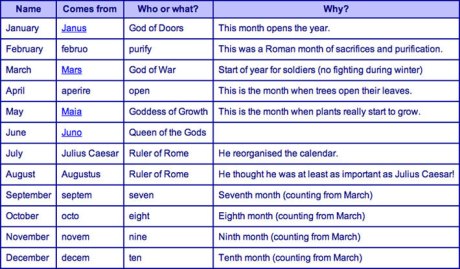
(We still have a vestige of the old March-start calendars hidden with us in plain sight: September, the ninth month of our year, is Latin for seventh month; October for eight month; November for ninth, December for tenth.)
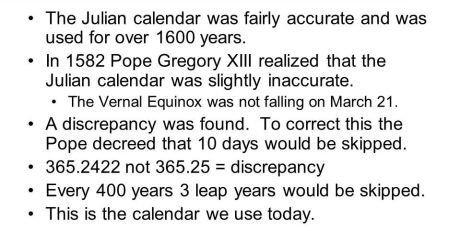
In the Middle Ages smart people sorted out that the Julian leap year was poorly calibrated such that it actually added a day every 128 years, and by the 16th century things were completely out of whack. The  equinoxes were coming too early and some holidays, like Easter, fell in the wrong season. To fix things Vatican created a new calendar, the Gregorian Calendar, which in 1582 officially moved the starting day back to January 1 and reconfigured things in general to impose a sense of order.
However, by the late 16th century England did not recognize the authority of the Pope or of his newfangled calendar. Both it and its nascent colonies kept to the old calendar, despite the confusion—though many people used both, for the sake of being understood. From January to March, for example, some would date documents with both years to attempt to clear things up.
At last in 1752, acknowledging that its calendar was now a full 11 days out of sync with the rest of Europe, England finally adopted the Gregorian Calendar, starting the year on January 1 and chopping eleven days from September. Her colonies—including the New World soon to become the United States–followed suit.
And thus it is that in frigid January rather than milder March we gather to sing old songs, kiss our sweethearts and raise a glass to the new year. – Time, 30 December 2015
» Denver Nicks is a staff writer for Time magazine in New York City.
Filed under: europe | Tagged: calendars, christian festivals, dating system, europe, festivals, gregorian calendar, julian calendar, new year's day | 1 Comment »