















 “The organisers of the Beef Festival in Osmania University lost sight of the fact that accommodation is a virtue. It is not that anyone objects to them enjoying beef kebabs but that they take umbrage at their flaunting it and wilfully trampling on the sensitivities of others. In pressing for the radicals to avoid such public displays, what is being advocated is not food fascism but good civic sense.” – Swapan Dasgupta
The inclination to be wilfully outrageous and even iconoclastic in a bid to challenge orthodoxies is a part of growing up. To that extent, it is possible to avoid getting too worked up at the so-called Beef Festival that was recently organised by some students and politically-inclined staff at Hyderabad’s Osmania University. Although the move was calculated to be provocative, it is fortuitous that the carnivorous festival passed off with only a localised tremor. Puerile expressions of bravado often have the potential of triggering large-scale disturbances. Many of the vicious communal riots in post-Independence India have their origins in seemingly innocuous affronts such as the sprinkling of coloured water during Holi.
 Those familiar with history may be inclined to draw an analogy between what one writer has described as the challenge to “hegemonic cultural formation” in Osmania University and the defiance of taboos by, say, the foot-soldiers of the Young Bengal movement in early 19th century. Inspired by the European Enlightenment, a minority of impetuous students from upper-caste families in Calcutta embraced Christianity and took to beef-eating with gusto. In their enthusiasm to proselytise, they often took to confronting orthodox Hindus with slabs of beef, thereby hoping that the resulting social stigma would force the defiled to embrace Christianity in despair.
The outcome was not exactly as the young converts had hoped for. Social ostracism and the threat of violent retribution actually forced the upper-caste Christians to leave Bengal. Far from being perceived as points of inspiration, the rebelliousness of Young Bengal was mercilessly mocked by mainstream Bengali society. “And what shall I say”, asked the Bengali writer Bankim Chandra Chatterjee, “of that weakest of human beings, the half-educated Anglicised and brutalised Bengali babu who congratulates himself on his capacity to dine off a plate of beef as if this act of gluttony constituted in itself unimpeachable evidence of a perfectly cultivated intellect?”
It took the uprising of 1857, triggered, among other things, by the revulsion of the East India Company’s sepoys to bite cartridges smeared in lard, to firmly convince the authorities that dietary taboos cannot be dismissed as issues of personal choice: they had a bearing on public policy as well.
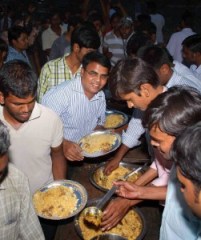 In the aftermath of the kerfuffle in Osmania — seen by the latter-day versions of Young Bengal activists as an act of dalit self-assertion — it has been suggested by a writer in a weekly magazine that “there is no point getting offended if someone enjoys beef in all its juicy glory. Since nobody is being force-fed, tolerance means digesting the idea that just as cows are meant to be milked, cows are also meant to be meat.” Underneath the needlessly hurtful language is the importance accorded to the principle of personal choice.
That an individual has every right to enjoy a dietary regime of his/her own preference is not in any doubt. The problem arises in the public flaunting of these preferences to score a larger political point. That many dalit communities in India have no problems with either beef or pork isn’t in any serious doubt.
Ironically, in their disdain for religion-based dietary taboos, the subaltern classes may actually have a great deal in common with a section of the well-travelled cosmopolitan classes who look down on those who prefer a “Hindu vegetarian” meal on international flights because they are unsure of either the meat or the cooking medium.
Whether out of religiosity or upbringing, most Indians tend to be simultaneously both liberal and conservative in their food habits. Their liberalism lies in not giving a damn about what their friends or colleagues eat at home and being experimental when eating out. We are all familiar with people who maintain a vegetarian kitchen at home but are willing to devour an occasional meat dish at restaurants. I personally know many people who identify themselves as believing Hindus who eat chicken and mutton at home but are willing to devour a beef steak overseas.
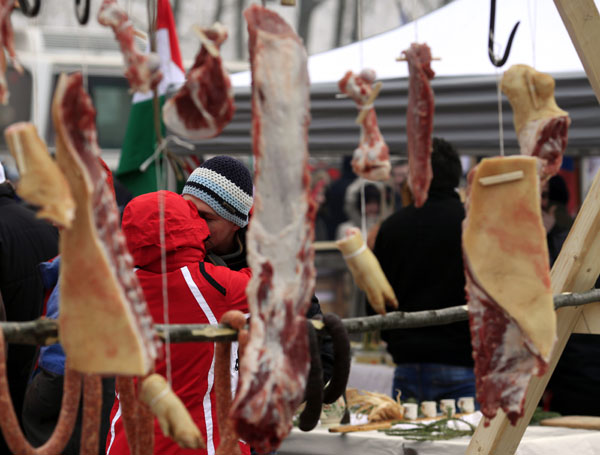 Indians are inclined to be very accommodative when it comes to other people’s preferences. This is because they are aware of the many taboos that govern communities. They may not necessarily agree with these but they are forever willing to respect them. More to the point, at public functions where food is served, there is an unwritten rule that non-vegetarian means mutton or chicken, and never beef or pork. To the ultra-radical, this may seem as a needless genuflection to food fascism and a deliberate attempt to stamp down on the preferences of disadvantaged communities. To the pragmatic, it means respecting what the philosopher Roger Scruton called “ordinary decencies” and taking care to not wilfully offend those who view the cow as sacred and the pig as unclean.
The organisers of the Beef Festival in Osmania lost sight of the fact that accommodation is a virtue. It is not that anyone objects to them enjoying beef kebabs but that they take umbrage at their flaunting it and wilfully trampling on the sensitivities of others. In pressing for the radicals to avoid such public displays, what is being advocated is not food fascism but good civic sense.
India has survived as a plural society because exceptional care has been taken to combine liberty with restraint. When a consensually arrived, unwritten Lakshman rekha is violated, social harmony is threatened. This is why care must be taken to ensure that the Osmania experiment isn’t repeated. – The Asian Age, New Delhi, 4 May 2012
» Swapan Dasgupta is a senior journalist.
Filed under: india | Tagged: andhra pradesh, beef-eating, caste, cow beef, cultural relativism, culture, dalits, dietary taboos, food fascism, hinduism, hindus, human rights, india, indian politics, osmania university, politics, politics of communalism, psychological warfare | 8 Comments »











