












 In the Indic perspective, it is the cosmos that is in the image of the human being. Jain art, for instance, is full of representations of the Cosmic Man or Maha Purusha – Prof Michel Danino
For a second master idea of Indian civilisation (see “Defining Indian Civilisation”), we must turn to the origin of it all: the universe. Perhaps more than any other ancient or classical culture, the Indian has been obsessed with it. I recall a young man sitting in a small shrine on the bank of the Ganges at Bithoor, near Kanpur, explaining (for a very modest fee) how, ages ago, the whole cosmos had originated right there: a short piece of brass pipe marked the precise spot—although several more places in India compete for the honour. Assuming that the universe emerged “somewhere”, why should it matter to anyone? Why should myths of origin and creation have taken root in India as nowhere else, starting from the Rig-Veda’s hauntingly beautiful Nasadiya Sukta, which contemplates a time when neither the existent nor the non-existent existed, and moving on to Brahma’s golden egg or Vishnu’s oceanic sleep on Ananta, the serpent whose very name signifies infinity?
Some scholars have proposed that this is nothing but the popular side of philosophico-spiritual systems that contemplated on the infinite. Perhaps that explains why early advances in mathematics and astronomy were so imbued with infinity—infinity of numbers, of time and space. With some very down-to-earth applications, incidentally, such as the decimal system with the zero, which may not have evolved if composers of Vedic, Jain and Buddhist texts had not delighted in the contemplation of impossibly colossal numbers (almost all of them multiples of ten).
But the universe was perceived as much more than a limitless and largely empty place. It had two crucial properties. The first was of being symbolic—not lumps of matter blindly hurtling about in obedience to various laws, but a living being whose every part carried meaning and a message for the specks of dust that we are. From the orbits of the planets to meteor showers or eclipses, from the flight of birds to sacred numbers, everything is invisibly and intimately connected to us. Is this merely a reflection of humans’ early fear of this measureless cosmos and a consequent desire to remain connected to it in every possible away, or is the cosmos actually a map to be deciphered? That, of course, is a matter of individual experience.
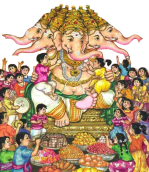
The second property of “our” universe, intimately related to the first, is that size makes no difference: the macrocosm and the microcosm are essentially one and the same. While Genesis speaks of God making man “in his own image”, in the Indic perspective, it is the cosmos that is in the image of the human being. Jain art, for instance, is full of representations of the Cosmic Man or Mahapurusha (also called Vishvapurusha, Lokapurusha, etc.).
Mere fancy? But this conception is precisely the foundation of several disciplines. In classical Indian architecture, for instance, the base of the temple represents the earth, its mid-portion the intermediary worlds, and the shikhar or vimana (the spire over the sanctum sanctorum) the heavenly world. Those three parts are also identified respectively to the feet, body and head of the Mahapurusha, who is now the Vastupurusha—the cosmic being inhabiting the temple, just as he can inhabit an ordinary dwelling if the plan (mandala) is correctly designed to capture him. The temple is now an image of both the human body and the universe: it is an effective bridge between the two, and would have little meaning if its design could not remind us of our true cosmic identity.
Or take Ayurveda. The universe, in the ancient view, is composed of five elements and three distinct functions, apart from other attributes. Since there is no difference between it and our bodies, these principles must apply to them—such is the theoretical foundation of Ayurveda, whose chief objective is to maintain or restore equilibrium in our body among those elements, functions and attributes. Practical treatments and medicines are designed accordingly, whose efficacy has long been proven.
This return to equilibrium, or an individual as well as cosmic harmony, is another ancient obsession. We find it in the Rig-Veda again, under the guise of the quest for ritam, the cosmic order (which will be identified with dharma later). The universe, just as our nations, our society, our families or our own lives, is a place of strife, where forces of order and harmony must confront and control a chaos that constantly threatens to disrupt and engulf everything as though into some black hole. From Nataraja’s dance of creation and destruction under an arch of fire that originates and ends in chaos (symbolized by two makaras) to the Pandavas’ struggle to restore dharma in the Mahabharata, this binary runs deep in Indic mythologies, arts and literatures. When Shiva married Parvati, legend has it that with everyone flocking northward to Kailash to attend the divine wedding, the earth began tilting and cosmic balance was threatened. Shiva then asked the Rishi Agastya to travel to south India: he was of short stature, but his spiritual stature was enough to restore the equilibrium and the return of order.
So there is our second master idea: an obsession with the cosmic, but a rich cosmic tapestry which connects the whole web of life together and imparts meaning as well as a purpose to all its elements. Some of our later master ideas will flow from this one in ways that deeply impacted the lines of development of Indian civilisation, and sometimes the course of Indian history. – The New Indian Express, 11 July 2018
» Prof Michel Danino is a French-born Indian author and visiting professor at IIT Gandhinagar.

Filed under: india | Tagged: cosmic principle, hindu cosmology, infinity, macrocosm/microcosm, zero | Leave a comment »