














 “True to the tenets of Nehruvian secularism, during the period when Manmohan Singh was Prime Minister, the UPA passed legislation such as the Right to Education Act (RTE), which placed the entire onus of providing free education for citizens deemed needy by the state on only those private schools run by Hindus. Those run by those of other faiths were given exemption from such an obligation. This individual knows a Muslim educationist of impeccable secular credentials … who converted a school into a “minority” institution to escape the onerous burdens imposed by the RTE. Perpetuation of Nehruvian secularism has driven many citizens to think in a communal way. Of course, such a fault is deemed to be so only in the case of the “majority community”, while those in the minority are considered “secular” even if undilutedly communal in their outlook and activities.” – Prof Madhva Nalapat
 If “secularism” gets used in occasional discourse as a term of abuse, the reason is that it has never been officially practised in India for centuries. Jews and Zoroastrians came to India during what may be described as “Vedic” times, and there is no record of any discrimination against them, rather they were ensured equality of status with other inhabitants of the subcontinent. And from almost the time of the revelations made in the Holy Quran, Muslims came to parts of India and settled down peaceably, unlike the larger groups that came much later and which succeeded in subduing much of the local opposition to their takeover. Given that “secularism” means the equal treatment of all citizens, irrespective of the faith to which any of them owed fealty, this showed that this very concept was implemented in practice by rulers during ancient times. Incidentally, during that period, caste had yet to degenerate into the “madness” flagged by Vivekananda, a ritualistic system, which based itself on birth rather than merit as the source of position and privilege. This post-Vedic and ossified caste system moved away from the earlier practice of each individual entering a caste only by virtue of the work he or she did, rather than from birth. A corollary doctrine was that the caste system, which thus evolved, was “horizontal” in nature rather than the later “vertical” form. In other words, there was equality within society for those of different castes rather than a hierarchy based on birth that so enervated subcontinental society that it succumbed to invaders from outside. Needless to say, neither during the Mughal nor the British period was secularism practised. During rule by the former, those belonging to the invaders’ faith were given preference, while in the latter period, in cities across India, the land and assets of temples which still remained after the depredations of Mughal rule, were seized by the colonial state. Those Hindu places of worship placed in the custody of the state during the time of the British Raj remain so to this day, despite the six years when A.B. Vajpayee was Prime Minister of India, and constitute an obvious and massive violation of the core secular principle of equality of treatment of citizens of all faiths.
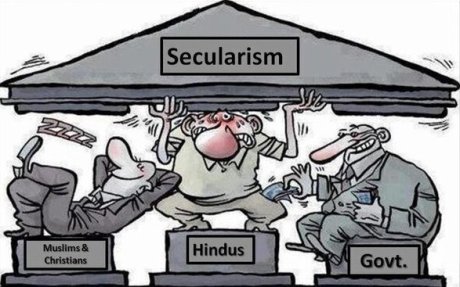
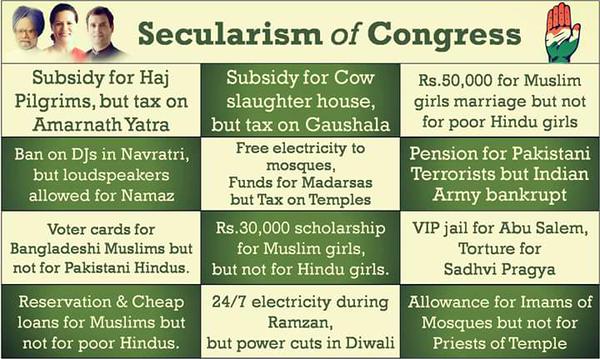
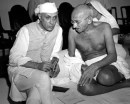 Mahatma Gandhi regarded Jawaharlal Nehru as his successor, and it must be assumed that the Mahatma, with his immense intellect, must have known precisely what the mindset of Nehru was towards the economy and society. Indeed, the younger person made no secret of either, speech-making and writing prolifically over the decades that he worked alongside the Mahatma. Hence, it is likely that Gandhiji approved the unique definition of secularism evolved by the individual he bestowed to the nation as the first prime minister of post-colonial India. This was that there indeed was discrimination based on faith, but this was done only in the case of the “majority” i.e., the Hindu community. Even those historians in thrall to Nehruism would find it difficult to argue that Hindus oppressed Muslims during Mughal rule and belaboured Christians during the two centuries when the British were in charge of most of the country. This is in contrast to the Scheduled Castes and Tribes, who, indeed, suffered gross forms of discrimination during the post-Vedic but pre-Mughal period of this country’s history. However, such lack of Hindu culpability did not prevent Nehru and his successors from maintaining a system whereby Hindus were denied the same right of ownership of their places of worship as was enjoyed by those of other faiths, besides other forms of relative discrimination. The divide between communities caused by Nehruvian policies is what is responsible for the occasionally toxic nature of communal relations across all too many parts of India these days.
 True to the tenets of Nehruvian secularism, during the period when Manmohan Singh was Prime Minister, the UPA passed legislation such as the Right to Education Act (RTE), which placed the entire onus of providing free education for citizens deemed needy by the state on only those private schools run by Hindus. Those run by those of other faiths were given exemption from such an obligation. This individual knows a Muslim educationist of impeccable secular credentials (and it must be said that such moderation is representative of the overwhelming majority of Muslims, as it is among Hindus, Christians and Sikhs), who converted a school into a “minority” institution to escape the onerous burdens imposed by the RTE. Perpetuation of Nehruvian secularism has driven many citizens to think in a communal way. Of course, such a fault is deemed to be so only in the case of the “majority community”, while those in the minority are considered “secular” even if undilutedly communal in their outlook and activities.
The people of India deserve better. They deserve to benefit from actual secularism, which is a system whereby the state is wholly neutral between different faiths and does not discriminate between them in any form. Only such a system would be true to the syncretic—or “Indutva-vadi”—ethos of India, which is a blend of the Vedic, the Mughal and the Western, with each strand present in the cultural DNA of each citizen of this fortunately moderate country. – Sunday Guardian, 29 November 2015
» Prof Madhav Das Nalapat holds the UNESCO Peace Chair and is Director of the Geopolitics and International Relations Department at Manipal University, an international private university headquartered in Karnataka. He is also the Editorial Director of The Sunday Guardian.
Filed under: india | Tagged: communalism, education, india, indian education system, minority institutions, multiculturalism, nehruism, nehruvian secularism, politics, politics of communalism, secularism, syncretism | 4 Comments »











