















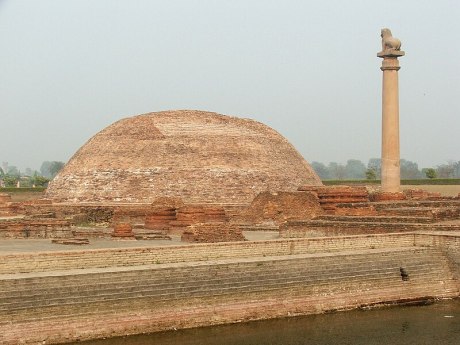
The pillar was a Vedic skambha, identified with Brahman and a support of the universe. The cult of stambha worship glorified the pillar as an object to be venerated, and the capital was invariably crowned by an animal, symbolising the holder’s political or religious allegiance. – Dr. Nanditha Krishna
When we visit a temple, the first structure we usually see is a pillar outside the sanctum. Most Hindus pay obeisance to the pillar before venturing inside the temple. The Atharva Veda says the pillar separates heaven and earth. The Vedic yupa was a sacrificial pillar. Little does the devotee realise that his veneration of the pillar is an ancient form of worship in India.
Some of the earliest pillars of the world are found in Egypt—the obelisks placed before temples with religious significance. The earliest political pillars were built by the Persians.
But the erection of pillars independent of any structure originated in India, according to archaeologist and epigraphist D.R. Bhandarkar. Worship of the pillar was an ancient practice that continued into historical times. There have been various uses attributed to them over time. R.P. Chanda linked the pillar with animal standards or emblems, described in epic literature as dhvaja or skambha that were carried into battle by kings and worshipped before battles. V.S. Agrawala said that two stone pillars found near Vishrant ghat on the Yamuna were probably pillars to commemorate a yajna.
The free-standing kirtistambha was generally associated with rock-cut caves. The pillar was a Vedic skambha, identified with Brahman and a support of the universe. The cult of stambha worship glorified the pillar as an object to be venerated, and the capital was invariably crowned by an animal, symbolising the holder’s political or religious allegiance.
The dominant creative works of the Ashokan period were the stone pillars crowned by capitals of exquisite craftsmanship, topped by animals. According to John Irwin, only four pillars with Ashokan inscriptions were erected by the emperor. For the remaining 36 (or more, for many pillars were lost), there is no conclusive evidence they were built by him. But it’s likely that the series of monolithic columns called dharmastambha were either erected by Ashoka or used by him to inscribe messages of dharma. For Ashoka ordered: “(Wherever) there are stone pillars, it (his edicts) must be caused to be engraved on them.”
Ashoka’s pillars were magnificent creations, heralding a new age of stone sculpture. The columns were carved out of either spotted red-and-white sandstone from Mathura or buff-coloured hard sandstone with small black spots from Chunar near Varanasi. The capitals of the pillars were made up of three sections: a crowning animal, an abacus of animals or plants in the centre, and a lotus petal-shaped bell below fastened to a monolithic shaft by a large metal pin. The shafts were always plain, smooth and circular, tapering upwards and made of a single stone. There was no separate base at the bottom. The abacus was of two types: square and plain, or circular and decorated. The pillar capitals show influences of Achaemenid art.
The animals on the abacus represent the Buddha himself. The bull represented the astrological sign of his birth, Vrishabha, corresponding to Taurus; the horse symbolised his abandonment of his palace in Kapilavastu; the lion was the powerful exposition of dharma by Sakyamuni; the elephant was the guise he chose when he descended from heaven to earth, to be born of Maya.
Seven of the pillars have animal capitals: lions, an elephant and a bull. Xuanzang, visiting Lumbini in the 7th century CE, said that the Lumbini pillar was surmounted by the sculpture of a horse. The abacuses also include the dharmachakra and a goose.
Two of the pillars were relocated to Delhi by Firoz Shah Tughlaq, while several others were relocated by later Mughal kings who removed the animal capitals. The most majestic Ashokan creation was the Sarnath lion capital, with four lions seated back-to-back—which became the symbol of the Indian government after independence.
Bharhut and the cave temples of western India developed unique designs for ornamental pillars which replicated wood carvings. A relief from the Bharhut stupa railing portrays a queenly person on horseback carrying a Garuda dhvaja.
In 180 BCE, Greek governor Antialkidas sent his envoy Heliodorus with a gift of a Garuda dhvaja to Bhagabhadra. The Heliodorus pillar was dedicated in Brahmi to Vasudeva and erected at Besnagar (Vidisha) near Sanchi; other pillars at Sanchi supported huge gateways.
Chandragupta I of the Gupta dynasty built the iron pillar that now stands in Delhi. The pillar, which weighs more than six tonnes and is 7.21 metres high, is known for its unique rust-resistant composition that was unprecedented in its time. It’s a testament to ancient Indian metallurgy. It was probably originally situated at Udayagiri and shifted here by the Tomar king Anangpal. It’s another way that pillars symbolised royal authority in ancient India.
Later, monolithic pillars became ornaments of elaborate temple architecture, holding up ceilings and mandapas. The Pallavas created pillars with seated or rearing lions as the base or even rearing lions on the abacus. Pillar construction reached its zenith during the Kakatiya, Vijayanagara and Nayaka periods, when 100-pillar halls (Varadaraja temple, Kanchipuram), 1,000-pillar halls (Hanamkonda in Telengana, Srirangam in Tamil Nadu) and musical pillars (Vitthala temple, Hampi) swamped southern India.
The development of pillar construction in India is fascinating. But it remains a neglected and poorly-defined area of study. The next time you visit a temple, take a good look at the pillars—they can tell you a story. – The New Indian Express, 27 October 2024
› Dr. Nanditha Krishna is a historian, environmentalist and author based in Chennai.

Filed under: india | Tagged: ashoka pillar, columns in indian architecture., indian history, stambha, temple pillars | Comments Off on The pillars that hold up India’s history – Nanditha Krishna










 BHARATA BHARATI