















 The Cauvery issue blew up because of the increase in demand for its water. The rise in demand was primarily due to three reasons. First, the expansion of cities such as Bengaluru and Mysuru. Second, the drying up of other water sources, including groundwater, in these regions due to excessive exploitation and contamination. Third, the growth of water-intensive but not necessarily water-efficient crops over the years. – Livemint Team
 The prediction that the next world war will be fought over water is perhaps an exercise in hyperbole. But it is hard not to think of such concerns when battlefronts are being formed in the name of water along the banks of the Cauvery. The violence of the past few days is also a gory reminder that sub-national passions are never far below the surface in India.
The Cauvery dispute has its origins in the 19th century. The political frictions that first began between the Madras Presidency of British India and the princely State of Mysore have now been continued by Tamil Nadu, Karnataka, and to a small extent, Kerala and Puducherry.
In 2007, when the state-wise distribution of Cauvery waters was determined by the Cauvery River Tribunal after 16 years of deliberation, it failed to satisfy the states involved. Appeals continued. The Supreme Court order—to release 15,000 cusecs (later modified to 12,000 cusecs) of Cauvery water a day for 10 days to Tamil Nadu—which led to the current mayhem, followed from one of these appeals.
Indian law on the distribution of water between states is a combination of overlapping domains and undefined property rights. Earlier, most states tried to pursue the “theory of absolute territorial sovereignty” or the “theory of territorial integrity” while using river waters. The upper and lower states respectively used the river water even if it was at the expense of the other party. Dams were constructed at the upper course without consultation with lower riparian states, diminishing the flow of the river to the latter. This behaviour diminished the prospects of reaching a welfare equilibrium, or equitable apportionment of water resources, and conflicts arose.
 Water is included in the state list of the Constitution. It can be subject to the Centre’s arbitration if, and only if, it involves a clear case of conflict or dispute. Article 262 of the Constitution allows for the setting up of an inter-state water tribunal in such instances of disagreement. However, tribunals have also been criticized for the delay in their constitution and the delay after their constitution. If the general notion that the Centre is better placed than states to determine the economic value and optimal distribution of a river’s resources is to gain credence, water tribunals have to become more efficient and effective.
As has been outlined in the United Nations Convention on the Law of the Non-Navigational Uses of International Watercourses, equitable and reasonable use of water, application of appropriate measures to prevent harm to other states on the water course, and the principle of prior notification of planned measures should be an integral part of any river water sharing agreement.
But fixing the rights to river water and agreeing on some basic principles will not suffice. It requires a more fundamental solution. The Cauvery issue blew up because of the increase in demand for its water. The rise in demand was primarily due to three reasons. First, the expansion of cities such as Bengaluru and Mysuru. Second, the drying up of other water sources, including groundwater, in these regions due to excessive exploitation and contamination. Third, the growth of water-intensive but not necessarily water-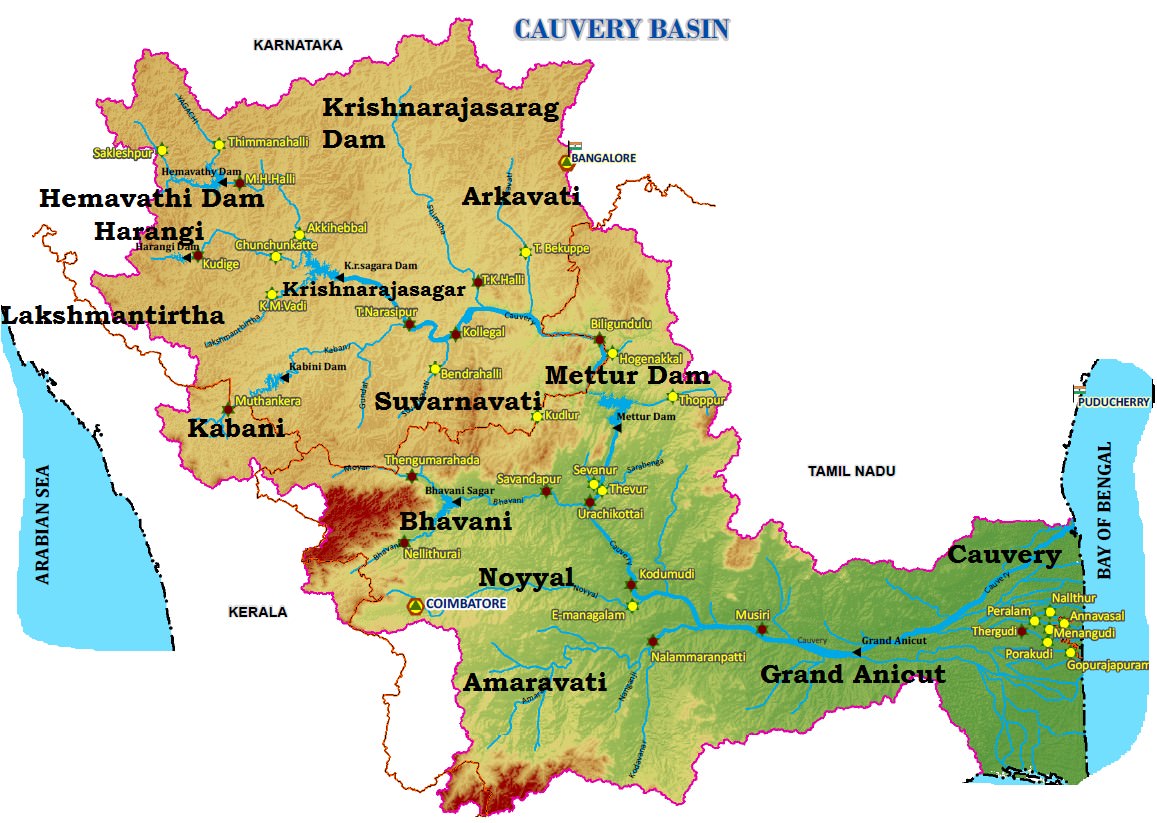 efficient crops over the years. The Cauvery Tribunal has in its report advised against the cultivation of water-intensive crops, especially in rainfall-deficit years.
The decreased flow and diminishing catchment area of the Cauvery made this higher demand for water unsustainable. The best way out is a rational pricing mechanism, as is the case for any demand-supply gap situation. Resource overuse and wastage are the direct result of the same being underpriced or not priced at all. The states of Tamil Nadu and Karnataka are equally placed in economic terms—the difference between their per capita gross domestic product is marginal. Hence, the argument of the lesser state being at a disadvantage does not stand. Pricing water according to its availability in the monsoon and drought years would plug the problems associated with overuse.
The Centre has come up with drafts on two model Bills for water conservation. The first one concerns itself with a national water framework. The second is on groundwater. The attempt is a laudable one. The implementation of these model drafts will, however, be left to the discretion of the states.
Water is a resource that is becoming increasingly scarce. While it is crucial that states insist on their rightful share, it is equally important that they make rational estimates of its economic and ecological value to optimally use this resource. A negotiation based on this recognition is perhaps the only long-lasting solution to issues such as the Cauvery dispute. – Livemint, 14 September 2016

Filed under: india | Tagged: cauvery, cauvery / kaveri, india, karnataka, kaveri, rivers, tamil nadu, water, water resources, water wars | 1 Comment »











