















There are five ways a foreigner can become a citizen of India under the Citizenship Act, 1955, namely, by birth, descent, registration, naturalisation, and incorporation of territory. The CAA, 2019 adds a country-specific exception to the naturalisation section. However, any Muslim can become an Indian citizen under the naturalisation section. – Dr Subramanian Swamy
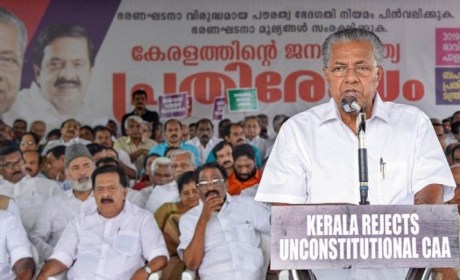
Pinarayi Vijayan, senior leader of the Communist Party of India (Marxist) and the Chief Minister of Kerala has written in The Hindu (Editorial page, “Time to defend India’s secularism”, December 18, 2019) on why he opposes the recently enacted Citizenship (Amendment) Act, 2019 (CAA). He gives three reasons for his opposition to the legislation.
In order to take up and rebut these reasons, the aims and objects of this legislation passed by both Houses of Parliament by a large majority, and the historic context for the legislation need first to be made clear.
The Citizenship (Amendment) Bill was introduced in 2019 after long deliberation by the Joint Select Committee of Members of Parliament. A Report of the Committee was adopted by a majority of Members of Parliament and placed on the table of both Houses in 2016. But Lok Sabha elections intervened and so the Bill had to be re-introduced in December 2019.
Ground realities
The need for this Bill arose partly because the Islamic theocratic nations of Pakistan, Bangladesh, and Afghanistan have brutally persecuted non-Muslim minorities since 1947. This has led to a sharp fall in the proportion of the non-Muslim minorities in the total population of these countries.
Those who survived forcible conversion escaped and illegally entered India. They were Hindus, Sikhs, Jains, Buddhists, Christians, and Parsis and they were categorised as illegal migrants. As of December 31, 2014, they numbered 31,313: Hindus (25,447), Sikhs (5807), Buddhists (2), Christians (55), and Parsis (2). Those belonging to two religions were not in this list: Muslims and Jews. A small number of Jews migrated to Israel. No Muslims or Jews came to India over the last 70 years on grounds of religious persecution.
Political concern
Over the past 70 years, many leaders of different parties expressed concern over the appalling conditions of living of this category of illegal immigrants. Not having citizenship or passports or Aadhaar cards, they could not avail themselves of any proper employment and so lived in conditions of poverty and squalor.
The first authority to express concern over this state of affairs was the Working Committee of the united Congress Party. The Committee adopted a resolution on November 25, 1947 urging citizenship and “full protection to all those non-Muslims from Pakistan who have come over to India or may do so to save their life and honour”. An affirmation of this view came from Dr. Manmohan Singh, the then Leader of the Opposition in Rajya Sabha, on December 18, 2003 (a video clip is available in the Parliament Library). Dr. Singh said then: “After the Partition of our country, minorities in countries like Bangladesh have faced persecution, and it is our moral obligation that if circumstances force people—these unfortunate people—to seek refuge in our country, our approach for granting citizenship to these unfortunate persons should be more liberal.” The same view was expressed in writing in 2014 to Prime Minister Narendra Modi by the then Chief Minister of Assam, Tarun Gogoi.
Chief Minister Vijayan thus seems not to have appreciated the historical context of the CAA and the need to bring to closure the sad consequence of religious theocracy in our neighbouring nations. Instead he advances three reasons to denounce the CAA: First, that it is ultra vires the Constitution of India, especially Articles 5 to 11 and also 14. Second, that it is divisive, and violative of human rights because it discriminates against Muslims. Third, that the Bharatiya Janata Party’s aim is to establish a Hindu nation and that aim underlies the CAA.
The first reason is baseless. Articles 5 to 10 have nothing to do with the CAA. Article 11 in fact empowers Parliament to bring such an amendment as the CAA. As for the CAA violating Article 14, we need to look at the letter of Article 14 but also at judgments galore of the Supreme Court of India on the interpretation of this Article.
A simple example to contradict Mr. Vijayan’s contention is of a Brahmin claiming reservation in education and schools on a par with Scheduled Castes because of Article 14 guaranteeing “equality before law”. The Supreme Court has repeatedly made it clear that equality before law is only for those equally placed. Here on religious persecution, the Muslims of Pakistan, etc., are not similarly placed.
Mr. Vijayan further adds that “Article 14 applies not only to citizens but all persons within the territory of India.” Do we know of a single example of a Muslim citizen of Afghanistan, Pakistan or Bangladesh who entered India due to religious persecution and can be identified as an illegal migrant by the official agencies to qualify for citizenship under the CAA? The Union Home Ministry, in the list prepared of this category of illegal migrants, did not discover a single such Muslim from these three countries.
It should be made clear that there are five ways a foreigner can become a citizen of India under the Citizenship Act, 1955, namely, by birth, descent, registration, naturalisation, and incorporation of territory. The CAA, 2019 adds a country-specific exception to the naturalisation section. However, any Muslim can become an Indian citizen under the naturalisation section.
Hindutva and Constitution
Mr. Vijayan makes a “final point”, that “the agenda of Hindutva and the ultimate goal of establishing a “Hindu Nation” underlie the Citizen (Amendment) Act”. Unfortunately, the present Indian Constitution cannot be amended beyond the Basic Structure of the Constitution as defined by the Supreme Court of India. So there is no need for anyone to unduly worry about it.
For persons like myself, who are committed to teaching Hindutva to our divided Hindu society (on a caste, language, and regional basis), Hindutva is already incorporated in large measure in the present Constitution. For example, the use of Sanskrit vocabulary [Article 351], official promotion of the Devanagari Script and its modified numerals [Article 343], the ban of cow slaughter [Article 48], the uniform civil code [Article 44], and faith as part of the unamendable basic structure. This is enough to usher in a Hindu Nation, because Hinduism is the only religion that formally accepts that all religions lead to God (Sarva Dharma Sama Bhava). Hence Hindutva is not contradictory to secularism. – The Hindu, 21 December 2019
› Dr. Subramanian Swamy is a Member of Parliament and a former Union Minister of Law and Justice.
Filed under: india | Tagged: CAA, constitution of india, hindutva, indian secularism, pinarayi vijayan | 1 Comment »











