








 We shall remember Churchill as a war criminal and an enemy of decency and humanity, a blinkered imperialist untroubled by the oppression of non-white peoples, a man who fought not to defend but to deny our freedom. – Shashi Tharoor
The recent flap over Winston Churchill—with Labour politician John McDonnell calling Britain’s most revered prime minister a “villain” and prompting a rebuke from the latter’s grandson—will astonish many Indians. That’s not because the label itself is a misnomer, but because McDonnell was exercised by the death of one Welsh miner in 1910. In fact, Churchill has the blood of millions on his hands whom the British prefer to forget.
“History,” Churchill himself said, “will judge me kindly, because I intend to write it myself.” He did, penning a multi-volume history of World War II, and won the Nobel Prize for Literature for his self-serving fictions. As the Australian Prime Minister Robert Menzies remarked of the man many Britons credit with winning the war, “His real tyrant is the glittering phrase, so attractive to his mind that awkward facts have to give way.”
Awkward facts, alas, there are aplenty. As McDonnell correctly noted, Churchill as Home Secretary in 1910 sent battalions of police from London and ordered them to attack striking miners in Tonypandy in South Wales; one was killed and nearly 600 strikers and policemen were injured. It’s unlikely this troubled his conscience much. He later assumed operational command of the police during a siege of armed Latvian anarchists in Stepney, where he decided to allow them to be burned to death in a house where they were trapped.
Shortly afterward, during the fight for Irish independence between 1918-23, Churchill was one of the few British officials in favor of bombing Irish protesters from the air, suggesting using “machine gun fire bombs” to scatter them. As Secretary of State for the Colonies, he followed through on that threat in Iraq. He ordered large-scale bombing of Mesopotamia in 1921, with an entire village wiped out in 45 minutes. When some British officials objected to his proposal for “the use of gas against natives,” he found their objections “unreasonable.” In fact he argued that poison gas was more humane than outright extermination: “The moral effect should be so good that the loss of life should be reduced to a minimum.”
This underscores the fundamental contrast in views of Churchill. In Britain and much of the West, he’s seen as the savior of “Democracy, Freedom, and all that is good in Western Civilization,” as one enthusiastic correspondent put it. In fact, his record is far more mixed even there. Throughout the 1920s and early 1930s, Churchill was an open admirer of Mussolini, declaring that the Italian Fascist movement had “rendered a service to the whole world.” Traveling to Rome in 1927 to express his admiration for the Fascist Duce, Churchill announced that he “could not help being charmed, like so many other people have been, by Signor Mussolini’s gentle and simple bearing and by his calm detached poise in spite of so many burdens and dangers.”
What Churchill was above all, though, was a committed imperialist—one determined to preserve the British Empire not just by defeating the Nazis but much else besides. At the start of his career, as a young cavalry officer on the northwest frontier of India, he declared the Pashtuns needed to recognize “the superiority of [the British] race” and that those who resisted would “be killed without quarter.” He wrote happily about how he and his comrades “systematically, village by village, destroyed the houses, filled up the wells, blew down the towers, cut down the great shady trees, burned the crops and broke the reservoirs in punitive devastation. Every tribesman caught was speared or cut down at once.”
In Kenya, Churchill either directed or was complicit in policies involving the forced relocation of local people from the fertile highlands to make way for white colonial settlers and the incarceration of over 150,000 men, women and children in concentration camps. British authorities used rape, castration, lit cigarettes on tender spots and electric shocks to torture Kenyans under Churchill’s rule.
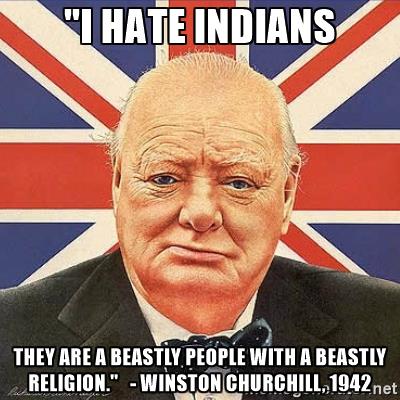
And his principal victims were the Indians—“a beastly people with a beastly religion,” as he charmingly called us, a “foul race.” Churchill was an appalling racialist, one who could not bring himself to see any people of color as entitled to the same rights as himself. (He “did not admit,” for instance, “that a great wrong has been done to the Red Indians of America, or the black people of Australia … by the fact that a stronger race, a higher grade race, has come in and taken its place.”) He fantasized luridly of having Mahatma Gandhi tied to the ground and trampled upon by elephants.
Thanks to Churchill’s personal decisions, more than 3 million Bengalis died of hunger in a 1943 famine. Churchill deliberately ordered the diversion of food from starving Indian civilians to well-supplied British soldiers and even to top up European stockpiles, meant for yet-to-be-liberated Greeks and Yugoslavs. “The starvation of anyway underfed Bengalis is less serious” than that of “sturdy Greeks,” he argued. When reminded of the suffering of Bengalis, his response was typically Churchillian: The famine was the Indians’ own fault, he said, for “breeding like rabbits.” If the suffering was so dire, he wrote on the file, “Why hasn’t Gandhi died yet?”
It’s important to remember that these weren’t enemies in a war—Churchill also wanted to “drench the cities of the Ruhr” in poison gas and said of the Japanese, “we shall wipe them out, every one of them, men, women and children”—but British subjects. Nor can his views be excused as being reflective of their times; his own Secretary of State for War, Leo Amery, confessed that he could see very little difference between Churchill’s attitude and Hitler’s.
Britons and Oscar voters may yet thrill to Churchill’s stirring words about freedom. But to the descendants of the Iraqis whom Churchill gassed and the Greek protesters on the streets of Athens who were mowed down on his orders in 1944 (killing 28 and maiming 120), to sundry Pashtuns and Irish, to Afghans and Kenyans and Welsh miners as well as to Indians like myself, it will always be a mystery why a few bombastic speeches have been enough to wash the bloodstains off Churchill’s hands. We shall remember him as a war criminal and an enemy of decency and humanity, a blinkered imperialist untroubled by the oppression of non-white peoples, a man who fought not to defend but to deny our freedom. – Bloomberg, 16 February 2019
» Shashi Tharoor is an author, politician, and former career diplomat who is serving as Congress Lok Sabha MP from Thiruvananthapuram, since 2009. He also currently serves as Chairman of the Parliamentary Standing Committee on External Affairs and All India Professionals Congress.

Filed under: india, UK | Tagged: bengal famine 1943, british colonialism, crimes against humanity, winston churchill | 2 Comments »