








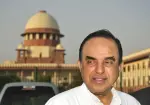

 In 1985, a memorandum had been submitted, signed by one lakh citizens of Patna, to restore the city’s ancient name of Pataliputra and erect a Civilisation Gate in Patna…. The Civilisation Gate is meant to depict civilisation spreading from Bihar to all parts of the world. Pataliputra, in its heyday, was a leading city of the world and the capital of India for nearly 10 centuries. Other measures, like giving a facelift to the city’s riverfront, were also recommended to promote Bihari self-pride. – Lt. Gen. S.K. Sinha
 During the late Mughal era Bihar was part of Bengal suba and remained so for most of British rule. As an appendage of Bengal for a couple of centuries, Bihar remained a backward region. It was only in 1911 that it became a separate province.
When I was a student in Patna in the 1930s and early 1940s, Biharis constituted a minority among the intelligentsia. It was Bengalis who dominated — as professors, school teachers, government officers, lawyers, doctors and even clerks.
The situation was different in Uttar Pradesh. Inheritor of the cultural heritage of the Lucknow nawabs and pure Urdu, it had an air of superiority. I once represented Patna University at an All-India Inter-University Debate in Allahabad in 1941. When my turn came to speak, I was hooted and called a “Bihari buddhu” (fool). I promptly replied, “Bihari Buddha, not Bihari buddhu”. Perhaps that’s what got me the prize!
For centuries under the Mauryas, and later the Guptas, Bihar led the country in every sphere of human endeavour. The whole of India for the first time became one political entity. Bihar was the centre of culture, knowledge and civilisation and impacted all Asia.
During the medieval period, Sher Shah Suri from Bihar was a pioneer of secularism and good governance in the country. Mughal Emperor Akbar followed in his footsteps. Later, Veer Kuer Singh was the most successful military leader of the 1857 war and was the only one to repeatedly defeat British troops in battle. Bihar provided the platform for the Mahatma to launch the Freedom Movement.
 Jayaprakash Narayan, also from Bihar, was the hero of the 1942 Quit India Movement and, in 1977, the saviour of Indian democracy. Dr Rajendra Prasad was the most loyal follower of the Mahatma, who held him in high regard for his legal acumen. He became the first President of India and had an unmatched 11 years in office. In 1956, the US expert Appleby, invited by Nehru, reported that Bihar was the best administered state. It was an irony that feudal Bihar remained backward.
From the mid-60s, Bihar started rapidly going down the slippery slope of rampant corruption and rank casteism. It reached its nadir under Lalu Prasad Yadav. Bihar became a basket case. This dismal situation started improving when Nitish Kumar took over as chief minister.
The growth rate of Gujarat and Bihar are often compared. Bihar started from a lower level and Gujarat from a higher base. Like Narendra Modi, Nitish Kumar was viewed as a possible Prime Minister. Nitish Kumar persistently denied he had any such ambition but his actions spoke differently.
He was happy to be in the National Democratic Alliance and enjoyed the fruits of office as cabinet minister in the Union government while his colleagues in the coalition, Ram Vilas Paswan and Omar Abdullah, resigned in the wake of the 2002 Gujarat riots.
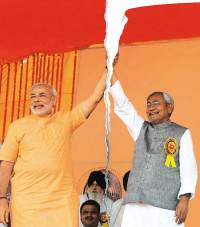
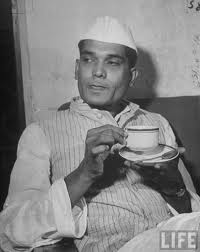 As his reputation as an efficient Chief Minister grew, he started trying to overtake Modi and played the “secular” card. Posters showing him holding hands with Modi, displayed by his alliance partner, the BJP, during an all-India meet of BJP leaders in Patna irked him so much that he called off the dinner he was to host for them.
He managed to get a Pakistani parliamentary delegation to visit Bihar and give him a certificate of good governance. Despite 26/11, he chose to go on a goodwill visit to Pakistan.
His intentions were obvious. He started talking of Bihari pride like Modi boasted of Gujarati pride. He demanded “backward state” status for Bihar and offered political support to the Congress or any party that obliged. This meant that Bihar was up for grabs to the highest bidder! This was hardly in keeping with Bihari pride.
In 1985, a memorandum had been submitted, signed by one lakh citizens of Patna, to restore the city’s ancient name of Pataliputra and erect a Civilisation Gate in Patna, bigger than India Gate in Delhi and the Gateway of India in Mumbai.
The Civilisation Gate is meant to depict civilisation spreading from Bihar to all parts of the world. Pataliputra, in its heyday, was a leading city of the world and the capital of India for nearly 10 centuries. Other measures, like giving a facelift to the city’s riverfront, were also recommended to promote Bihari self-pride.
 The then Congress government in the state wholeheartedly supported the proposal. Rajiv Gandhi was sympathetic but changed his mind when Muslim and Leftist historians objected, saying this would promote Hindu fundamentalism!
When Kumar raised the issue of Bihari self-pride, the Pataliputra proposal was revived. But he was reluctant to rename the city lest he lose the minority votes. Even naming Patna Junction as Pataliputra Junction was not acceptable to him. He chose a new railway station, far away from the geographical limits of ancient Pataliputra, to bear that hallowed name. This is murdering history.
He did, however, agree to the Civilisation Gate and the riverfront project. But when self-promotion replaced Bihari self-pride, this project lost priority and little action has been taken in the last three years.
On the other hand, Narendra Modi and former Uttar Pradesh Chief Minister Mayawati executed the Sabarmati and Gomti riverfront projects in their respective states with great flourish.
The arrogance that comes with power, the rivalry with Modi and the appeasement of minorities have propelled Kumar on a downward course. His humiliating defeat in the Maharajganj byelection and the increasingly poor response to his much-hyped Seva Yatras are not good signs.
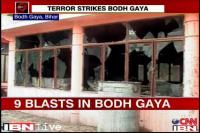 The terrorist attack at Bodh Gaya exposed the criminal negligence of his administration.
Emulating his new-found friends, he is now urging that the issue not be politicised and is covering up his administration’s inexcusable failure.
The tragedy of 23 schoolchildren dying after eating poisoned food in Chapra, and Nitish Kumar’s handling of that tragedy, has been atrocious.
Not only did he not visit the ailing children in a Patna hospital, he did not even issue a statement of sympathy. The minister who made the irresponsible charge of political conspiracy should have been sacked. The officials found negligent should have been fired.
The icon of inclusive development seems to be transformed from a sushasak to a kushasak. – Deccan Chronicle, 31 July 2013
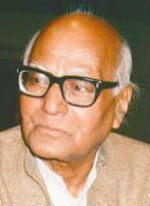
» S.K. Sinha is a retired lieutenant-general of the Indian Army. He was Vice-Chief of Army Staff and has served as governor of Assam and J&K.
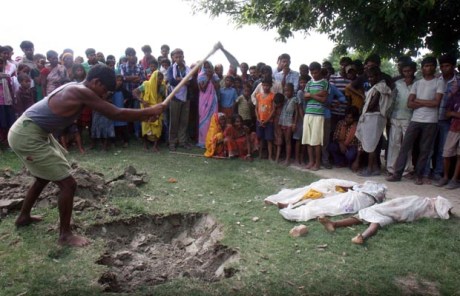
Dharmashati Gandaman villagers bury poisoned school children in the school yard itself as a protest against Bihar’s negligent Nitish Kumar government.
Filed under: india | Tagged: bihar, bihar school poisoning, bodh gaya, bodh gaya blasts, gujarat, history, india, indian politics, legitimizing power, narendra modi, NDA, nitish kumar, politics, prime ministership, psychological warfare, self pride, terrorism, welfare state | 2 Comments »





 BHARATA BHARATI