












 “India’s vegetarian leader Narendra Modi has been vocal about protecting cows and, during the lead-up to his election, his opposition to what he called the “pink revolution” — subsidised meat production and promotion. We can only hope that he makes reducing meat and dairy production and consumption a key point in any plans that India and the United States propose for tackling greenhouse-gas emissions.” – Poorva Joshipura
 Study after study has shown that there’s a strong correlation between climate change and the production of meat and other animal-based foods. And yet meat is regarded merely as a lunchtime entrée at the conference, not a serious topic for discussion.
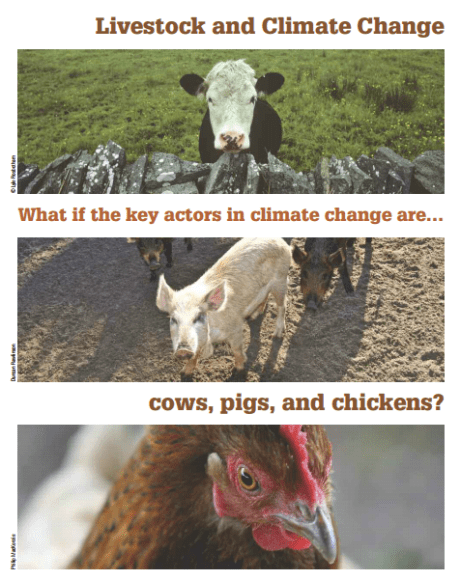
This needs to change. A widely publicised report from the Worldwatch Institute, “Livestock and Climate Change” indicates that more than 51% of worldwide greenhouse-gas emissions are attributable to animal agriculture, specifically to cattle, buffalo, sheep, goats, camels and pigs that are raised and killed for food. Worldwatch Institute’s senior fellow, Robert Engelman has said that the “world’s supersized appetite for meat” is one of the main reasons why greenhouse-gas emissions are still rapidly increasing.
Animal agriculture is one of the largest sources of carbon dioxide and the single largest source of both methane and nitrous oxide, which are, respectively, 25 and 300 times more potent as greenhouse gases than carbon dioxide. Just recently, Chatham House, an international think tank, called for a carbon tax on meat to help combat climate change.
Researchers feel that the livestock sector has been “almost completely overlooked” when it comes to climate change and that the revenue from a meat tax should be used to subsidise healthy plant-based foods, which are less damaging to the environment.
Other climate experts agree that the livestock sector is too often overlooked when it comes to discussions about curbing climate change. Scientists at Chalmers University of Technology in Sweden calculated various ways to combat climate change and found that cutting greenhouse-gas emissions from transportation and energy use alone is not effective. Dr Fredrik Hedenus, the lead scientist of the study, concluded that “reducing meat and dairy consumption is crucial for bringing agricultural climate pollution down to safe levels”.
Ilmi Granoff of the Overseas Development Institute in the United Kingdom has similarly noted that officials should, “Forget coal. Forget cars. The fastest way to address climate change would be to dramatically reduce the amount of meat [eaten by] people”.
An Oxford University study, “Dietary greenhouse gas emissions of meat-eaters, fish-eaters, vegetarians and vegans in the UK”, suggests that people who eat meat are responsible for almost twice as many dietary greenhouse-gas emissions per day as vegetarians and about two and a half times as many emissions as vegans, people who don’t eat meat, eggs or dairy foods.
Why wasn’t this one of the main topics of conversation at the climate summit?
The Oxford study shows that people who eat more than 3.5 ounces of meat per day—only about the size of a deck of playing cards—generate 15.8 pounds of carbon dioxide equivalent (CO2e) each day, while vegetarians and vegans generate 8.4 and 6.4 pounds of CO2e, respectively. Ultimately, this means that the dietary emissions for meat-eaters are 50%-54% higher than they are for vegetarians and 99%-102% higher than for vegans.
 If we’re serious about saving the environment, we must eat plant-based foods rather than animal-based ones. The United Nations Environment Programme’s International Panel of Sustainable Resource Management has called for a global shift towards a vegan diet to protect the world from the worst impacts of climate change. A 2014 study published in New Scientist magazine, “Going vegetarian halves CO2 emissions from your food”, shows that each person can reduce the amount of greenhouse gases that his or her diet contributes to climate change by up to 60% just by going vegan.
And yet every nation has failed to recognise in any meaningful way the contribution of meat and dairy production to climate change.
Australia, for example, is known to have a big appetite for meat. Each year, the average Australian eats approximately 205 pounds of beef and veal, poultry, pork and sheep flesh, the most of any of the 14 member countries of the Organisation for Economic Cooperation and Development (OECD), a group of nations that works to improve the economic and social well-being of people around the world.
The United States is the second largest consumer of meat among OECD nations, and the average American has been reported to eat twice as much meat as the average person worldwide. Argentina, Brazil, Canada, Israel, New Zealand and the European Union nations are also known to be big per capita meat-eaters.
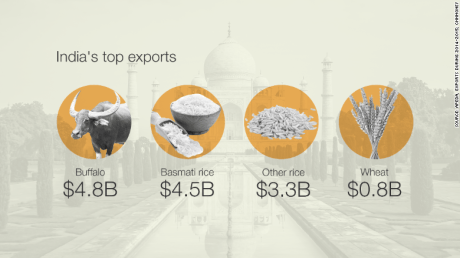
That’s not to say that India doesn’t share in the blame. India is the world’s largest beef exporter. The country is moving towards intensive factory-farming systems like those in the US, in which hundreds or even thousands of animals are packed together in a small space. India accounts for about 6% of the world’s carbon emissions. If India doesn’t take steps to combat climate change, we will all suffer the consequences: a warming climate, changing precipitation patterns, droughts, melting glaciers, rising sea levels and more. And if the meat and dairy industries’ contribution to environmental destruction is not addressed, we may well be heading for disaster. The British risk consultancy firm Verisk Maplecroft indicates that India is an “extreme risk” country, which will experience the economic impacts of climate change most keenly by 2025.
The Sustainable Innovation Forum in Paris didn’t give people a whole lot of reasons to be optimistic. The politics editor at Huffington Post India, a vegetarian who was covering the conference, recently lamented the lack of vegetarian options in Paris. She spoke with a communications expert from Brazil who thought it was alarming that a UN Climate Change Conference was going against the recommendations of the UN’s own Food and Agriculture Organization, which has urged people to eat more vegan meals. “You would think,” she bemoaned, “that at a climate change conference there should be even more vegetarian options than non-vegetarian.”
I suppose it shouldn’t come as any surprise that Christiana Figueres, the UN’s climate chief, was doubtful that our world leaders would reach the 2-degree target.
This is something everyone needs to worry about—now. The World Meteorological Organization recently reported that methane and nitrous oxide appear to be increasing rapidly and that average levels of carbon dioxide have risen 43% above pre-industrial levels. Researchers at Britain’s University of East Anglia warn that the Earth’s average temperature has exceeded historic norms by 1.02 degrees Celsius.
The world’s climate is warming faster than some experts feared, because previous predictions were too optimistic and overestimated the cooling impact of clouds. Scientists at Stanford University in the United States worry that climate change is on pace to occur at a rate that is 10 times faster than any climate shift recorded in the past 65 million years.
 There is some hope, though. While some warming is unavoidable, because humans have already emitted billions of tons of greenhouse gases into the atmosphere, the overall impact isn’t written in stone. Human variables can still slow the pace and magnitude of climate change — or accelerate them.
It’s no secret that PETA encourages people to go vegan for ethical reasons, but we also know that going vegan is the best way to avoid environmental catastrophe.
India’s vegetarian leader Narendra Modi has been vocal about protecting cows and, during the lead-up to his election, his opposition to what he called the “pink revolution”—subsidised meat production and promotion. We can only hope that he makes reducing meat and dairy production and consumption a key point in any plans that India and the United States propose for tackling greenhouse-gas emissions. [Unforunately the Modi Sarkar continues to subsidise meat production and export just like its Congress predecessor! — Ed]
But even though we could not force the delegates in Paris to promote vegan living, we can all take steps to slow climate change, conserve resources and reduce animal suffering, beginning with our next meal, simply by choosing plant-based foods. So the next time you sit down to eat, have a veggie burger instead of a hamburger or enjoy some soy-based chicken, aloo saag, curried vegetables or vegan chilli. You’ll be helping animals, your own health and the health of the planet. – Sunday Guardian, 13 December 2015
» Poorva Joshipura is the Chief Executive Officer of PETA India and Vice President of International Affairs for PETA Foundation UK.

Filed under: india | Tagged: beef, beef export, economic development, environment, environmental pollution, india, indian economy, indian government, meat-eating, NDA government, red meat, vegan diet, vegetarianism, vegetarians | 5 Comments »