







If the Maha Kumbh is succeeding in evoking a sense of oneness, it may not be a bad thing. It gives Hinduism—and its inherent pluralism—a fighting chance to remain in the race. – Rahul Shivshankar
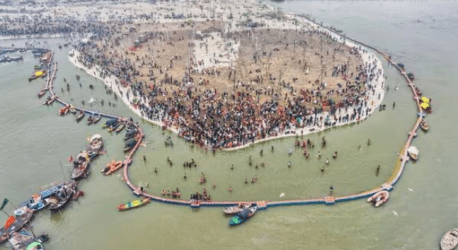
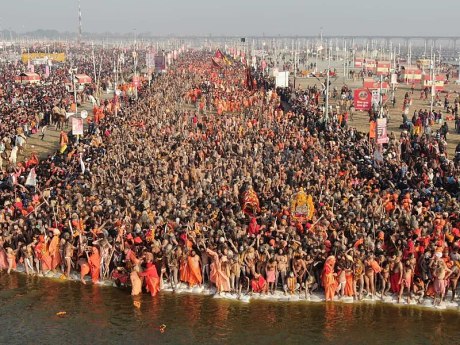
We are told that an astonishing 60 crore people visited the Maha Kumbh Mela to celebrate the benefaction of a once-in-144-year celestial alignment and the redemptive confluence (Sangam) of rivers. Of course, in matters of faith, it is always best to lean towards temperance. But even by the most modest estimates, it is safe to say that the record for spiritual migration anywhere on Earth has been shattered many times over at the Maha Kumbh.
The turnout has remained consistently impressive throughout the duration of the Mela. Even a tragic stampede failed to dampen the ardour of the attendees. If anything, the numbers surged on the next auspicious snan day. Not once did the monster traffic jams or visuals of dangerously overcrowded trains serve as a deterrent. Even when the Opposition, led by Mamata Banerjee, Akhilesh Yadav, Lalu Prasad, and several others, cautioned pilgrims against attending—citing alleged mismanagement by the Uttar Pradesh administration—the devotees kept coming.
Those who consider themselves experts in these matters are surprised. They argue that the Kumbh Mela has never been the ultimate destination—only those moved by a deeply felt spiritualism would undertake the journey. More often than not, the yatri would be elderly, proceeding with a “sense of detachment,” aware that their “aged bodies were nearing the end of life.”
There may be some truth to this. If one were to examine Kumbh Mela attendance records from the past, the numbers would be significantly smaller—perhaps indicating that seeking out the Kumbh Mela, even the Maha Kumbh Mela, was not always considered an obligatory rite of passage on a pilgrim’s spiritual journey.
So, what explains this unprecedented rise in self-actualised spiritual perambulation?
Secular fundamentalists will argue that the record-breaking attendance is a portentous sign that a pluralistic faith is acquiring a “codified, performative, and mandatory” character—akin to Abrahamic faiths, which are often defined by a tendency towards “mass mobilisation” around heraldic or emblematic religious celebrations.
But those who have advanced this Sangam sutra to explain the record attendance at the Maha Kumbh are being unfair, to put it mildly.
The Maha Kumbh is no Hajj. The latter is open exclusively to Muslims. Unlike the guardians of the Kaaba in Mecca, no authority stands at the gateways to the Sangam ghats demanding proof of a visitor’s Hinduness. Again, unlike the Hajj, it is not obligatory for Hindus to attend the Kumbh.
Moreover, Prayagraj is not Mecca, where, as per religious injunction, no non-Muslim can enter. Neither does the Mela claim to be “the season” in the way religious observances are structured in the Christian West.
In fact, the presence of so many Hindu sects, alongside Christians, Sikhs, and even, by some accounts, curious Muslims, is a testament to the fact that Hinduism is the pre-eminent all-welcoming, big-tent faith, founded on the credo “Vasudhaiva Kutumbakam”.
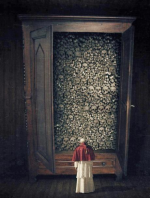
Hinduism has never had, and still does not have, a Vatican. Nor does it centre around a single pivotal deity. This inherent pluralism means that the same people who enthusiastically embraced the Kumbh will also head off in different directions, seeking blessings, purification, enlightenment, atonement, nirvana, or moksha elsewhere. Indeed, even as the Maha Kumbh witnessed record-breaking footfalls, thousands of Hindus were simultaneously offering oblations to a kula devta in Mehandipur, Tirupati, and Ayodhya. Check the numbers.
Frankly, at a time when competitive identity politics is all the rage, Hinduism could well benefit from its adherents exhibiting a greater sense of ownership.
Hinduism is competing in a marketplace dominated by well-organised, proselytising religions eager to claim a lion’s share of the follower base. With no central organising credo and no rigid core tenets, Hinduism’s inherent tolerance makes it ill-equipped to counter legions of missionaries, flush with funds and backed by the promised safety net inherent to Abrahamic faiths.
There is also the spectre of vote-bank politicians appeasing minorities while turning a blind eye to conversion mafias. Some of these politicians—many from the Hindu fold—justify conversions by citing Hinduism’s long-standing social evil: caste prejudice.
Meanwhile, those who highlight that caste discrimination is not exclusive to Hinduism and persists even among converts in their newly adopted faiths are immediately branded anti-secular.
Thus, if the Maha Kumbh is succeeding in evoking a sense of oneness, it may not be a bad thing. It gives Hinduism—and its inherent pluralism—a fighting chance to remain in the race. – News18, 22 February 2025
› Rahul Shivshankar is the consulting editor for Network18.

Filed under: india | Tagged: bathing festival, hindu dharma, hindu spirituality, maha kumbh mela 2025, religious pluralism | Comments Off on Maha Kumbh Mela: A sense of oneness – Rahul Shivshankar