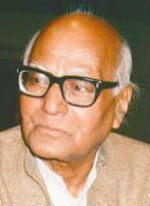









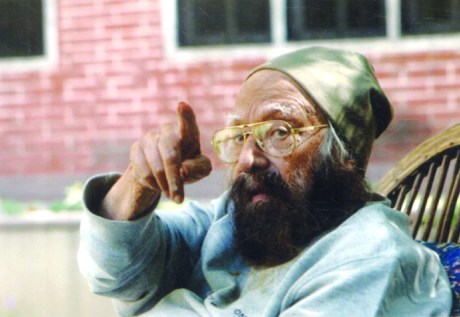
 At long last, shortly before he would turn 100, Khushwant Singh has gone. India loses a pleasant writer and frequently humorous political and social commentator. He was a forthright spokesman of the Nehruvian English-speaking elite, at one time even the direct press chief of Jawaharlal Nehru himself. He also served as an assistant to Sikh leader Master Tara Singh, as novelist and historian of Sikhism, as editor for an array of papers, and as columnist, best known for the title of his long-running column “With malice towards one and all”.
By coincidence, I met Khushwant Singh on the airplane Delhi-Frankfurt some 22 years ago. Frankly, I got a rather good personal opinion of him. It was timely that we met, because I needed to prove my existence. He had just written a newspaper column stating that my book on Ayodhya had been written by Sita Ram Goel using a European name as pseudonym to confer an air of outside objectivity on his pro-temple thesis. Well, that matter was settled then.
We struck up a conversation, of which I distinctly remember that, upon my enquiring, he confirmed that he believed in a separate Sikh identity, as demonstrated by sporting beards and turbans, but that he did not believe in the need for any religion. (In my book Negationism in India, I devote some pages to Khushwant Singh’s argument for the separate identity of Sikhism, and wonder aloud about this contradiction.) For emphasis, he repeated his main point: “No religion.” In a way, this is a classical Hindu position: one’s belonging to a community does not depend on a particular belief, so one can be an unbeliever all while remaining a card-carrying member.
He had always made fun of religion as such (and this without anyone charging him under Art. 295A), lampooning pieties such as “work is worship” with additions like “yes, but worship is not work”. And he did so till the end: as late as 2011 and 2013, he published books against religion and the belief In God, afterlife or rebirth. While Western scholars are now wavering about their long-held thesis of “secularization”, seeing a revival of religion in Russia and China and a demographic explosion among believers, here was one Indian who did see secularization as the wave of the future. He inferred that the development of the “scientific temper”, as enjoined by the Indian Constitution, would necessarily lead to the people’s outgrowing Scriptural beliefs.
Yet he had deplored it when his son came home from the West divested of his turban. The son saw no point anymore in wearing the uniform of a particular religious sect when religion itself made no sense anymore. The simplicity of common sense reasons that religious identity presupposes religion. But the convoluted logic imposed by Indian identity politics and Nehruvian secularism will have none of it. If you manage to sell the identity of your religious community as somehow non-Hindu, ex-Hindu or anti-Hindu, secularists feel honour-bound to defend it. So, even without religion, a Sikh identity must be upheld because it irritates Hindus.
Or that at least is what secularists, in their utter ignorance of Hindu history, think. They do not know that Guru Govind Singh was cent per cent a Hindu and founded the Sikh militant order to serve and defend Hindu Dharma. They have defined Sikhism as a separate religion, and they don’t look any farther than the present legal arrangement, somewhat like foreign tourists who rely on a guidebook to quickly teach them about India. Indeed, the best appreciation of Nehruvian secularism is that it is the uncomprehending tourist view of India’s religions.
Like an obedient secularist, he was very good at getting the Hindus’ goat, e.g. by condemning Shivaji for disposing of his enemy Afzal Khan; but he was not so good at lampooning Islam or Christianity. Yet, unlike other secularists, he did occasionally criticize even Islam and Christianity. But not too much, so he did support the ban on Salman Rushdie’s The Satanic Verses: avoiding the inevitable bloodshed was more important than upholding freedom of speech. In this manner, the religious obscurantists always have their way on condition of credibly threatening violence, for then the secularists will present it as virtuous and wise to drop freedom of speech and give in to the demand for book-banning.
He also did the secularist thing in supporting the Emergency dictatorship. Nehruvian secularism, being a despotism by nature, always disliked unmanipulated democracy. Indeed, it was under the Emergency that the Constitution was enriched with the declaration of India as a “secular, socialist” republic, the only part of the Constitution without genuine democratic legitimation.
Once he fell from his usual anti-Hindu stance. Condemning Congress for the 1984 anti-Sikh riots, he preferred to vote for their most credible opponents, the BJP, in subsequent elections, before the Ayodhya demolition of 1992 made him revert to his more familiar opposition to Hindu nationalism.
But he had the virtue of being able to take a laugh at himself, much in contrast to the pompousness and self-importance of most secularists. As a dabbler in erotic writing, he gracefully accepted the sobriquet “dirty old man” of Indian public life. At least I will vouch for “old man”, and hope to emulate him in remaining active as a writer till age 98. That is when his last book came out: The Good, the Bad and the Ridiculous (October 2013), another argumentation against religion, which he saw as his farewell to writing. And now, on 20 March 2014, he has taken his leave from life, peacefully in his own home in Delhi.
Since he is not going to heaven or hell, and since he is not coming back either, we had better get used to living without Khushwant Singh. For a committed atheist, it would mean nothing to wish him “Fare well” or “God be with you”, so I will only say: “It was nice knowing you.” – Koenraad Elst Blog, 21 March 2014
» Dr. Koenraad Elst is a Belgian writer and orientalist (without institutional affiliation). He was an editor of the New Right Flemish nationalist journal Teksten: Kommentaren en Studies from 1992 to 1995, focusing on criticism of Islam. He has authored fifteen English language books on topics related to Indian politics and communalism, and is one of the few western writers to actively defend the Hindutva ideology.
See also
Filed under: india | Tagged: atheism and agnosticism, authors, india, indian secularism, indira gandhi, khushwant singh, koenraad elst, nehruism, nehruvian secularism, nehruvian socialism, obituary, secularism, sikhism | 5 Comments »